A sudden clunk on the Coronado Bridge or a sputtering engine in North Park. A dead battery in a La Jolla parking garage. Whatever the reason, you’re now standing next to your bike, and your ride is over for the day. That feeling of frustration is something we understand, and the first few decisions you make are critical for both your safety and your bike’s condition.
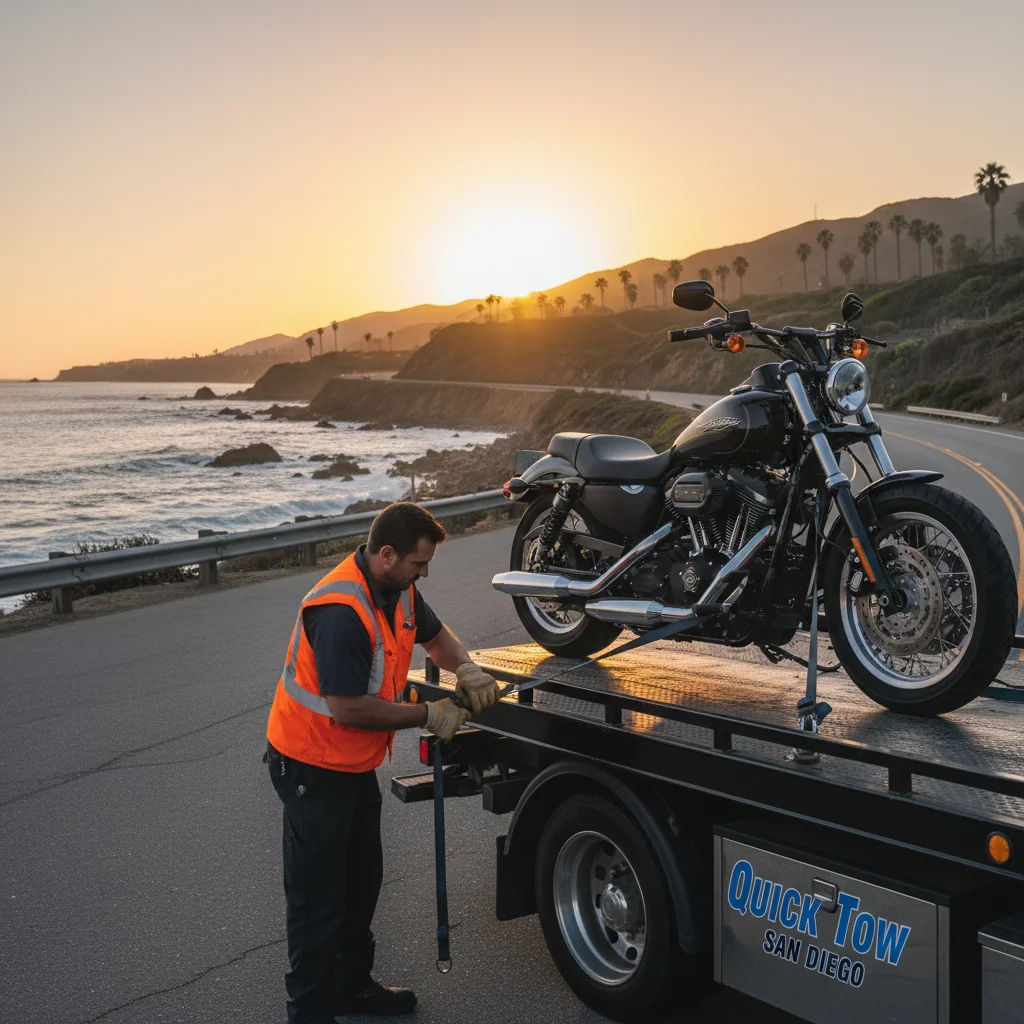
First: get yourself and your bike to a safe location
Before you even think about calling for a tow, your top priority is personal safety. Traffic in San Diego, especially on freeways like the I-5, 805, or Highway 94, moves fast and drivers aren’t always looking for a stationary motorcycle.
Your first step is to get out of the flow of traffic. If you can, coast or carefully push your bike to the far right shoulder, an off-ramp, or into a nearby parking lot. The further you are from active lanes, the better. Once you’ve moved the bike, turn on your emergency flashers to increase your visibility to other drivers.
Then, get away from the motorcycle. The safest place for you is off the road entirely, preferably behind a guardrail or up an embankment. According to safety experts at the NHTSA, staying in your vehicle (or on your bike) on a busy shoulder is incredibly dangerous. Create as much distance as possible between yourself and moving traffic while you wait for help to arrive. Only after you are in a safe spot should you pull out your phone to search for emergency motorcycle towing in San Diego.
Why a standard tow truck is the wrong choice
When you call for a tow, you might be tempted to just call the first company that pops up. But most towing companies primarily handle cars and trucks, and their standard equipment can cause serious damage to a motorcycle. A typical wheel-lift or hook-and-chain truck is designed to lift a vehicle by its frame or wheels, which is a disaster for a bike.
Using this kind of equipment on a motorcycle can lead to a long list of problems:
- Scratched paint and chrome: Metal hooks and chains will inevitably scrape and gouge your bike’s finish.
- Bent forks or frame: The immense pressure from a wheel-lift can twist and damage crucial structural components.
- Broken fairings: The plastic or fiberglass bodywork on sportbikes is especially fragile and can easily crack under pressure.
- Damaged handlebars and controls: Improper strapping can snap levers, break mirrors, and damage your grips or throttle.
Your bike isn’t just a small car. It requires a completely different approach to be transported safely. An operator without the right training or equipment is a gamble you don’t want to take with your prized possession. They might get the bike onto their truck, but it’s unlikely to arrive at its destination in the same condition it was in when they found you.
What to look for in a dedicated motorcycle tow service
To avoid the risks of a standard tow, you need to find a company that specializes in moving two-wheeled vehicles. A professional motorcycle towing service will have specific equipment and training that sets them apart. When you’re making the call, this is what you should expect as a bare minimum.
First, they must use a flatbed tow truck. A flatbed provides a stable, level platform to secure your bike for transport. There’s no dragging or awkward lifting involved. The bike is simply rolled up a ramp and onto the bed.
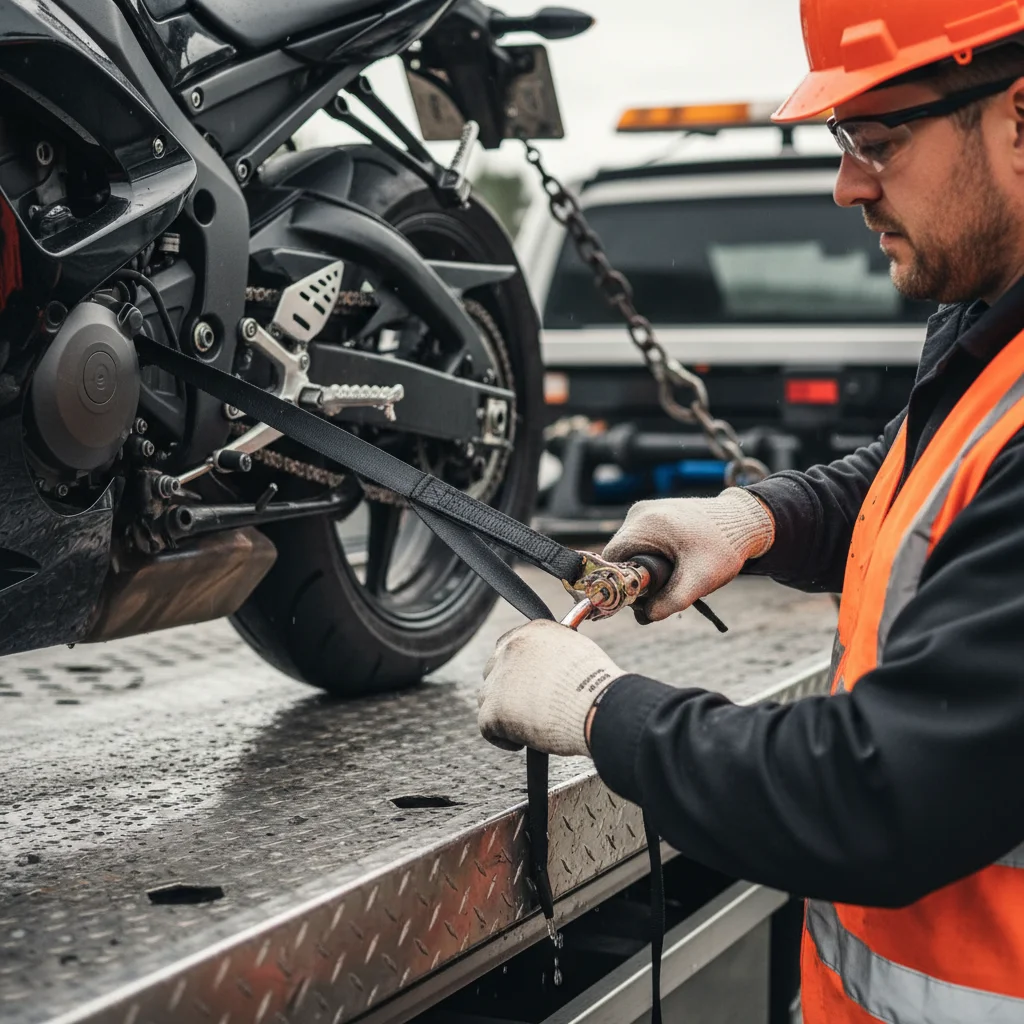
Second, they need the right gear. This includes a motorcycle wheel chock to hold the front wheel steady and prevent any side-to-side movement. Crucially, they must use soft straps or soft-loop tie-downs. These are fabric loops that wrap around solid parts of your bike’s frame or forks, allowing the operator to attach the main tow straps without any metal hooks touching your machine. At Quick Tow, our dedicated motorcycle towing service is built around this damage-free philosophy.
Finally, look for a company that offers 24 hour motorcycle towing in San Diego. Breakdowns don’t stick to a 9-to-5 schedule, and neither should your roadside assistance provider.
Questions to ask before they dispatch a truck
When you’re stressed on the side of the road, it’s easy to forget the important details. To make sure you’re hiring the right team for the job, have a short list of questions ready when you call. A professional company will be happy to answer them and a hesitant answer is a major red flag.
Here’s what you should ask before you agree to a dispatch:
- “Do you use a flatbed truck for motorcycles?” If the answer is anything but a confident “yes,” hang up and call someone else.
- “Do you have soft straps and a wheel chock specifically for securing a motorcycle?” This question shows you know what you’re talking about and filters out companies that might try to “make do” with the wrong equipment.
- “Is your driver experienced in towing motorcycles like mine?” Towing a 900-pound Harley-Davidson requires a slightly different technique than towing a lightweight sportbike. Experience matters.
- “What is your estimated time of arrival (ETA)?” A professional dispatcher should be able to give you a reasonably accurate window based on your location and current traffic.
- “Can you provide a quote for the service?” Ask for a clear price, including any potential mileage or after-hours fees, to avoid surprises later.
Taking a few extra minutes to vet the company will give you peace of mind that your bike is in good hands.
How we strap down your bike without damaging it
We know how much your bike means to you. It’s not just a machine; it’s an investment and a passion. That’s why the securing method matters: a low-deck flatbed, a wheel chock, and soft straps, never chains. We believe in doing the job correctly every time, which is why we’ve detailed our entire process for motorcycle towing done right.
Our process is meticulous:
- Secure Loading: First, we lower the flatbed and extend the ramp. We then carefully walk your bike up the ramp, we never ride it, and position it on the bed.
- Wheel Chock: The front wheel is immediately secured into a heavy-duty, padded wheel chock. This is the primary anchor point, preventing the bike from rolling forward, backward, or tipping.
- Soft Straps: We use a minimum of four, and often six, soft-loop tie-downs. These fabric loops are placed around solid structural components, like the lower triple tree or the frame. We never attach hooks directly to your handlebars, forks, or any painted surfaces.
- Balanced Tension: The tie-down straps are then attached to anchor points on the flatbed. We apply steady, even pressure to each corner, slightly compressing the bike’s suspension. This makes the motorcycle one with the truck, eliminating any chance of it bouncing or shifting during transport, even on bumpy San Diego roads.
This systematic approach ensures your bike is completely immobilized and protected from start to finish.
Average response times for motorcycle towing in San Diego County
When you’re stranded, every minute feels like an hour. We get it. That’s why we prioritize providing an accurate ETA and getting to you as quickly as possible. Response times across San Diego County can vary based on a few key factors.
Traffic is the biggest variable. A call from downtown during rush hour or when a Padres game is letting out will naturally take longer than a midday call from a quiet neighborhood in Clairemont. Likewise, your location plays a big role. For central areas like Mission Valley, Kearny Mesa, or Pacific Beach, our average response time is typically between 30 and 45 minutes.
If you’re further out in North County (like Oceanside or Escondido) or East County (like El Cajon or Alpine), the travel time for the truck we send will be longer because of the distance. When you call, the operator taking the job uses your precise location to give you an honest arrival estimate. If you break down on a freeway, the California Highway Patrol’s Freeway Service Patrol may be the first to arrive, but you can still request a specific tow provider for the actual transport.
When to call us
If your bike has left you stranded, don’t risk damage with a standard tow truck. For professional, damage-free motorcycle towing, you need a team with the right equipment and experience. We treat every motorcycle like it’s our own.
Call us at (858) 923-5787 for a same-day estimate.