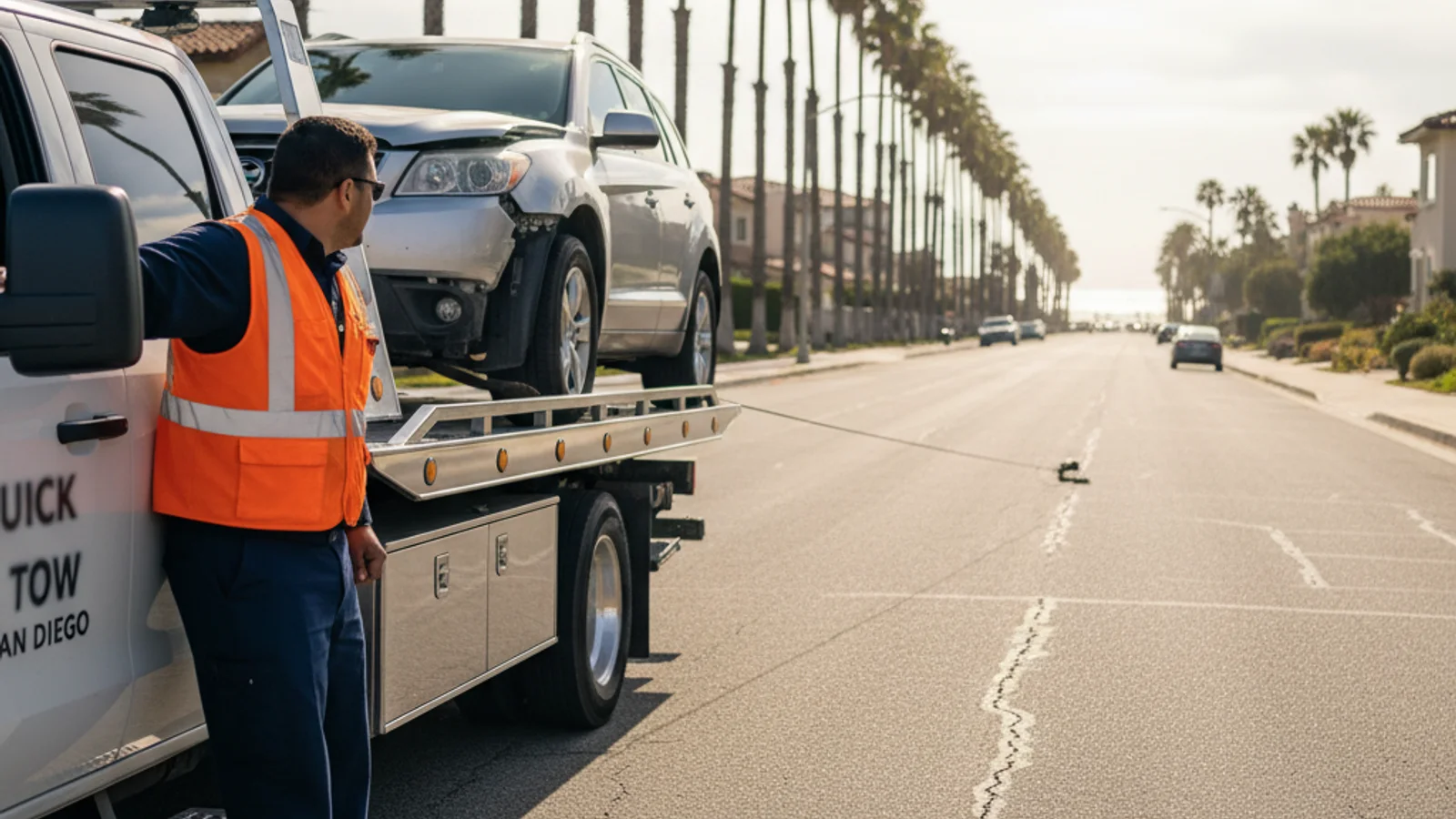
In May 2026, an off-road recovery video crossed 1.2 million views in under a month. The premise was simple: a Cybertruck tried to pull a stuck side-by-side out of the desert. It went badly. The Cybertruck got stuck. Then a real recovery truck, a flatbed-equipped wrecker, had to come pull both of them out.
Quick Tow SD has been answering calls about EV towing in San Diego County for years, and dispatches flatbed operators trained on EV procedures. We’re writing this post because the video, while entertaining, exposes a question we get every week from EV owners: if my Tesla, Rivian, Lucid, or Ford Lightning ever needs a tow, what’s the right call?
Quick answer: flatbed only, never wheel-lift, never another vehicle pulling it. Call (858) 923-5787 if you’re stranded in an EV anywhere in San Diego County. We dispatch live, 24/7, and the flatbed we send fleet handles every EV on the road.
Source: Matt’s Off Road Recovery, Cybertruck Tried to Rescue a SxS Huge Mistake! (May 2026)
TL;DR
- A Cybertruck attempted to pull a stranded side-by-side and ended up stuck itself, requiring a dedicated wrecker.
- EVs are NOT designed to tow each other or rescue other vehicles in soft terrain. Weight distribution, drivetrain electronics, and lack of low-range gearing all work against them.
- When an EV needs a tow in San Diego County, the only correct method is flatbed. Wheel-lift is dangerous. Towing with another vehicle is dangerous.
- Quick Tow SD’s flatbed fleet handles Tesla, Rivian, Lucid, Ford Lightning, and every other EV on the road.
What happened in the video?
The Cybertruck owner attempted what looked, on the surface, like a routine rescue. A side-by-side off-road vehicle was bogged down in sand. The Cybertruck approached with a strap, hooked up, and tried to pull.
Within seconds, the EV started spinning its own wheels. Then it sank. Both vehicles ended up needing a third party, a proper recovery truck with a winch, the right tires, and the experience to know which direction to pull from, to extract them.
The lesson sounds obvious in hindsight: a stuck vehicle takes more force to free than a normal driving scenario, and that force has to be transmitted through tires, suspension, and a drivetrain that’s all designed for normal driving. EV drivetrains in particular are tuned for instant high torque, which works great on pavement and works very badly when you need to slowly meter power onto loose terrain.
Why is towing an EV different from towing a gas car?
Three reasons, and they all matter when you’re the one stranded.
One: the drivetrain stays connected to the wheels. On a conventional car, you can put it in neutral, disconnect the driveshaft if needed, and roll. On most EVs, the motor is integrated directly with the wheels and there’s no clean way to disconnect. Drag the wheels along the ground and you’re forcing current through electronics designed to generate it, not absorb it. That can damage the motor, the inverter, or both.
Two: weight. A Tesla Model Y weighs about 4,400 lb. A Cybertruck pushes 6,600. A Rivian R1T tops 7,100. Wheel-lift towing, where two wheels are on the ground and two are lifted, puts the full weight of the vehicle through one axle. On a heavy EV, that axle is already carrying a lot. Lifting one end multiplies the stress on the wheel bearings, the suspension, and the brake components on the wheels still touching pavement. Many EV manufacturers explicitly void warranty coverage when wheel-lift is used.
Three: brake and steering systems. When the vehicle is off, the power assist for brakes and steering is also off. If something goes wrong during the tow and the vehicle needs to be guided, the driver inside has to muscle the wheel and stand on the pedal. Some EV systems lock entirely when the vehicle senses unusual forces.
The Cybertruck-pulling-the-SxS video showed all three of these problems compounding at once. The Cybertruck’s drivetrain wasn’t designed for sustained low-speed high-torque pulling on sand. Its weight made it sink. And once it was stuck, neither the driver of the Cybertruck nor the driver of the SxS could safely move either vehicle.
What should I do if my EV breaks down in San Diego?
Call a flatbed-equipped tow operator immediately. Don’t try to push it. Don’t try to have a friend pull it with their truck. Don’t try to roll it onto a trailer if the trailer isn’t rated for the EV’s weight.
Specifically, here’s what to do:
- Get the vehicle to a safe spot if it’s still moving. Shoulder, parking lot, anywhere off the active lane.
- Turn the vehicle off and put it in park. Most EVs have a tow mode in their settings, engage it if available. This disables the parking brake to allow the flatbed loading.
- Call (858) 923-5787. Tell dispatch it’s an EV, the make and model, and where you are. We’ll dispatch a flatbed.
- Stay with the vehicle until the driver arrives. Don’t let anyone else (well-meaning passerby, friend with a pickup, AAA gas-truck-only contractor) try to move it.
Arrival time across San Diego County depends on where you are and what is on the road. Flatbed fleet is the default for any EV call we take.
Will my warranty be voided if it’s towed wrong?
Yes, in most cases. Tesla, Rivian, Ford, Lucid, and GM all explicitly require flatbed transport in their owner manuals. If a non-flatbed tow operator drags your EV up onto a wheel-lift, you may be on the hook for any drivetrain damage that follows. And the damage can be expensive, drive motor replacements on EVs run $3,000 to $9,000 in parts alone.
This is why we don’t roll a wheel-lift truck on EV calls. Flatbed only. Period.
What if I’m in a remote part of San Diego County?
Quick Tow SD covers all 67 cities in SD County, including the more remote areas: Borrego Springs out in Anza-Borrego, the I-8 grade through Pine Valley and Boulevard, the canyon roads around Julian and Descanso, the desert washes near Jacumba Hot Springs. Response takes considerably longer in those areas, but someone will come.
If you broke down in a place where a typical sedan tow couldn’t reach you, mention that on the call. We have access to specialty flatbed equipment with extended winches and skid plates designed for soft terrain. Don’t assume “no one can help” without calling.
Frequently asked questions
Can a regular pickup truck tow my Tesla?
No. Even a Ford F-250 or Ram 2500 with a hitch isn’t the right tool for an EV. The issue isn’t capacity, it’s the wheel-on-ground problem. Your EV’s wheels need to be off the ground. That means flatbed transport, not a tow strap.
What about Tesla’s own Roadside Assistance?
Tesla Roadside dispatches third-party flatbed operators in your area. Quick Tow SD is in those rotation networks across San Diego County. When Tesla Roadside calls us, we respond on the same dispatch system as direct calls. If you’re a Tesla owner and you want faster service, you can also call us directly at (858) 923-5787, no app, no membership, no wait.
Can I be towed by a recovery winch out of mud or sand?
Yes, if the recovery operator uses a proper soft-shackle winch line attached to a frame recovery point on your vehicle. Don’t use the tow hooks on a bumper or a tie-down on an EV, those aren’t rated for recovery loads. If your EV is genuinely stuck in soft terrain, ask the operator how they’re going to attach. If they say “I’ll just hook a strap to your bumper,” tell them no and call us.
How much does it cost to tow an EV in San Diego County?
The base hook-up plus per-mile rate is the same as any other passenger vehicle. Long-distance EV tows out of San Diego (LA, Phoenix, Vegas) get flat-rate quotes up front. Call (858) 923-5787 for an honest quote.
What if the EV is dead and won’t unlock or shift to neutral?
Most EVs have a manual release mechanism inside the vehicle to enable flatbed loading even when the 12V battery is fully dead. Tesla calls it Transport Mode; Rivian and Lucid have similar procedures. The flatbed operator we send will know how to activate this on your specific model. Stay with the vehicle and let them work.
Last updated: May 14, 2026.
Need an EV-rated flatbed tow in San Diego County? Call Quick Tow SD at (858) 923-5787. The line takes calls 24/7 across all 67 SD County cities. Flatbed default for every EV call.