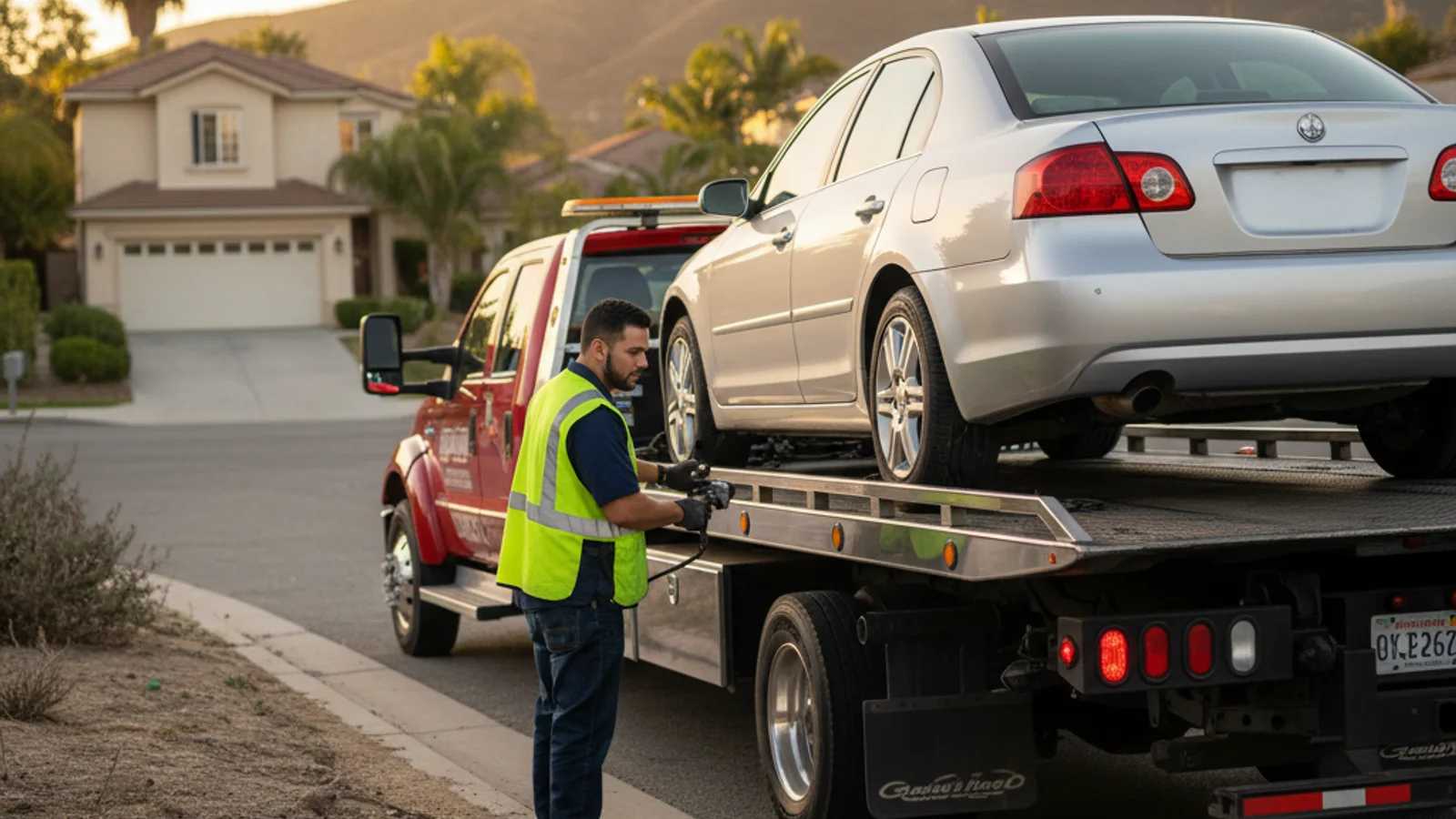
A widely-watched off-road video this month showed a Jeep with a snapped tie rod, the steering linkage component that connects the steering rack to the wheels. The result: one front wheel pointed inward at maybe 30 degrees, completely independent of the steering wheel. The vehicle could not be driven. It also could not be wheel-lift towed. Here’s what to do if it happens to you in San Diego County.
Quick Tow SD’s default for any mechanical failure that affects steering, suspension, or wheel alignment is flatbed transport. We don’t try to wheel-lift a vehicle with broken steering, that’s how you get a vehicle dragged sideways down the road. Dispatch is live, 24/7. Arrival estimate given on the call, for your exact location.
Steering or suspension failed? Call (858) 923-5787. Tell us what’s broken (or what you think is broken) and we’ll dispatch a flatbed.
Source: Matt’s Off Road Recovery, This Is NOT Good… Jeep’s Tie Rod Snaps on Triple 7’s! (May 2026)
TL;DR
- A snapped tie rod, broken ball joint, or failed steering linkage means the vehicle cannot steer one or both front wheels.
- Wheel-lift towing in this state is dangerous. The unsteerable wheel drags or wobbles. Damage to the wheel, axle, brake, or oncoming traffic is the outcome.
- Flatbed is the only correct transport method. All four wheels off the ground.
- Quick Tow SD’s standard procedure for any “the wheel is turned but the steering wheel isn’t” call is flatbed dispatch.
What broke and why does it matter?
A tie rod is a metal arm that connects the steering rack, the gear that the steering wheel turns, to the wheel itself. When the steering wheel turns left, the tie rod pushes the wheel left. There’s one tie rod per front wheel.
When a tie rod snaps:
- The steering wheel still turns
- The wheel attached to the broken tie rod doesn’t follow
- The wheel can point inward (toed-in) or outward (toed-out) at any angle
- The wheel can change direction unpredictably as the vehicle moves
- Trying to drive it ranges from “almost impossible” to “actively dangerous”
Related failures with similar consequences:
- Ball joint failure, wheel can disconnect entirely
- Steering rack failure, neither front wheel follows the steering wheel
- Lower control arm bushing failure, wheel position drifts unpredictably
- Wheel bearing collapse, wheel can come off the hub
- Snapped CV axle, front-wheel-drive car loses drive to that wheel
All of them require flatbed transport. None can be safely wheel-lift towed.
Why can’t you just put it on a wheel-lift truck?
A wheel-lift tow hoists two wheels off the ground and lets the other two roll. That works when the rolling wheels can roll straight. When they can’t, because one is pointed inward at 30 degrees, like in the video, the lifted vehicle drags sideways. Three things happen:
- Tire damage. Sidewall scrubbing on pavement at 40 mph chews up a tire fast.
- Wheel and axle damage. Forces the wheel wasn’t designed to take.
- Vehicle drift. A car being towed crooked tries to swing sideways. At highway speed this is dangerous for the tow truck driver, the car, and everyone else on the road.
The video makes this clear watching the recovery team work. The Jeep wasn’t going anywhere except onto a flatbed.
What should I do if I think my steering broke?
Five steps, in order:
- Get to a safe spot if the vehicle is still moving. Shoulder, parking lot, anywhere off the active lane. Drive slowly and don’t make turns you don’t have to.
- Turn the engine off. Don’t keep cranking the wheel, you can damage the steering rack if it’s still partially connected.
- Get out and look. If one front wheel is visibly pointed differently than the other, that’s likely a tie rod. If both are pointed straight but the steering wheel does nothing, it’s the rack.
- Call (858) 923-5787 and describe what you see. “My right front wheel is pointed inward and won’t move” is exactly what dispatch needs to hear. We’ll send a flatbed.
- Don’t try to drive it to a repair shop. If a tie rod just snapped, the steering rack and other linkage components may be partially damaged too. The next thing to fail could be more serious.
Where in San Diego County does this happen most?
Steering and suspension failures happen everywhere, but a few patterns we see repeatedly:
- I-8 and I-15 commuter corridors. High-mileage daily drivers eventually have a component fail. Most common: outer tie rod ends on older sedans.
- Backcountry roads. Pothole strikes and rough pavement loosen joints. SR-78 east of Escondido and the canyon roads around Alpine see this often.
- Off-road areas. Anza-Borrego, Ocotillo Wells, and the back roads around Julian and Descanso. Big tires, soft suspension, and a hidden rock or hole can snap something.
- Truck and SUV with modifications. Lifted trucks running oversized tires (the “Triple 7” tires in the video name refers to 37-inch tires) put far more strain on stock steering components than the factory rated them for.
What about if it happened off-road?
Quick Tow SD dispatches into off-road areas across SD County, including Anza-Borrego, Ocotillo Wells, and the rural areas east of Pine Valley. Mention on the call that the vehicle is off-pavement and exactly where you are. Off-road recoveries take longer to dispatch but we will come.
For an off-road steering failure, the recovery typically involves:
- A winch-out to get the vehicle to a place where a flatbed can reach
- A flatbed load with all four wheels secured
- Transport to your chosen repair shop or storage location
Frequently asked questions
How much does a flatbed tow with broken steering cost?
Same base rate as any other flatbed tow: the operator quotes the hook-up plus mileage and confirms the total before the truck rolls. Long-distance tows are quoted flat-rate up front. Call (858) 923-5787 for an honest quote.
Can I drive a car with one bad tie rod slowly to a shop?
No. The wheel position is unpredictable, the other tie rod is likely worn too (they fail in pairs), and a sudden additional failure at speed can cause loss of control. Even at parking lot speeds, the wheel can swing and lock against the fender. Flatbed only.
What if my steering went out on the freeway and I can’t pull over?
If you can’t pull over, that’s an immediate 911 situation. CHP can shut down the lane and respond. While waiting, turn on hazards, try to ease the vehicle to the right shoulder, and call (858) 923-5787 once you’re stopped.
How do I know if it’s the tie rod or something else?
Tell-tales: clunking or popping from the front when you turn, uneven tire wear, the steering wheel feeling loose or off-center, vibration in the steering. A snapped one is dramatic and obvious, the wheel points differently than it should. If you’re not sure, describe what you observe to dispatch. We don’t need a perfect diagnosis to dispatch correctly.
Is this typically covered by insurance?
Roadside assistance riders on your auto policy usually cover tow service for mechanical failures, not just accidents. Check your policy. If you have a rider, we can bill them directly, give us the policy number when you call.
Last updated: May 15, 2026.
Steering or suspension failed in San Diego County? Call Quick Tow SD at (858) 923-5787. The line takes calls 24/7 and flatbed is the default for any steering or alignment failure.