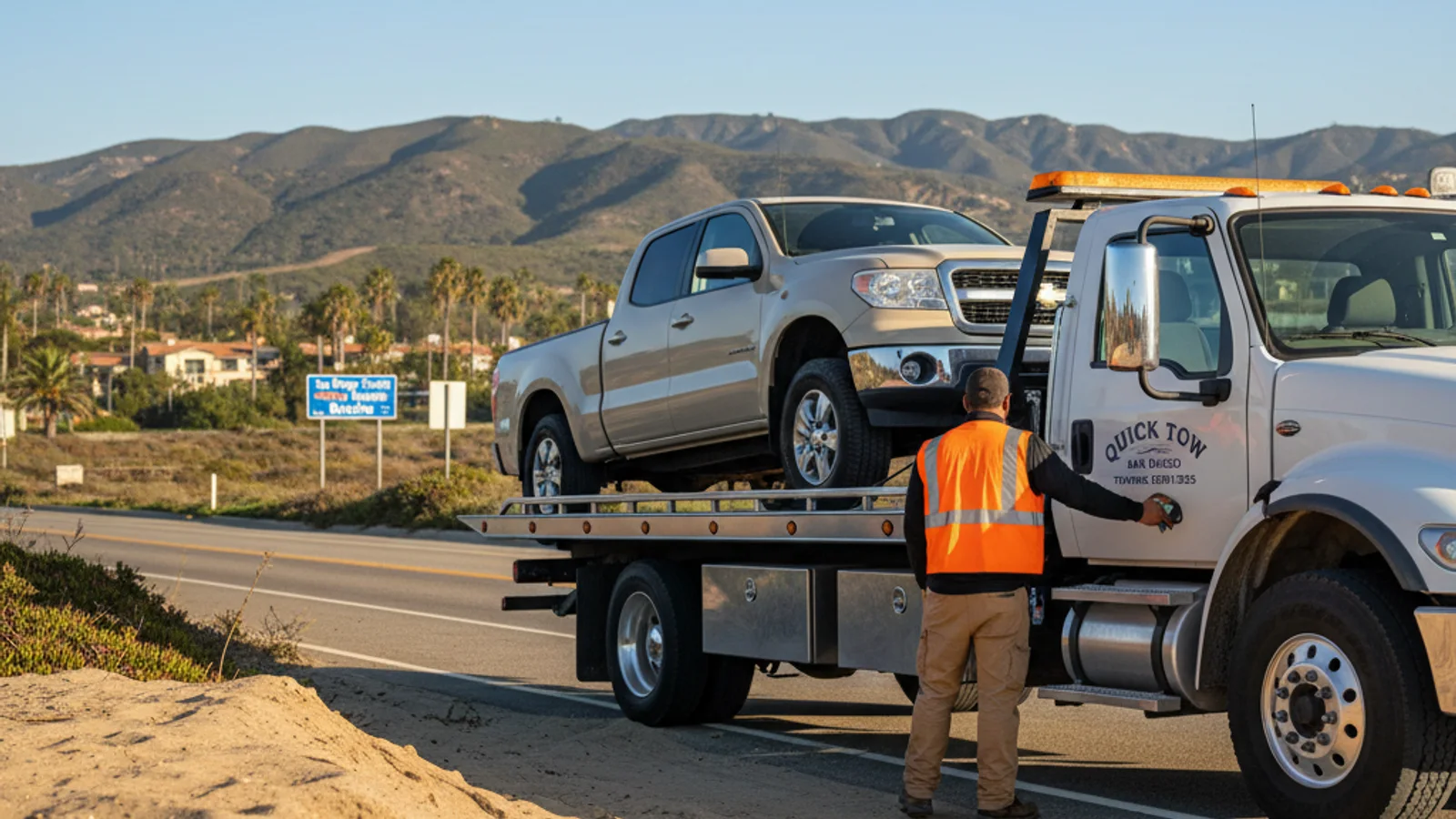
Anyone who’s spent time in Anza-Borrego, off the dirt roads near Borrego Springs, or even just on the Silver Strand sand parking near Imperial Beach knows the feeling. Soft ground, tires spinning, and the slow realization that the car isn’t going anywhere on its own. A widely-watched off-road recovery video this month, a Mercedes overlander stuck at Babylon Mill, showed exactly how the recovery has to be done. Spoiler: it’s not a wheel-lift tow.
Quick Tow SD handles sand and off-road recovery across all 47 cities in San Diego County, including the desert areas around Anza-Borrego and Borrego Springs, the beach lots from Coronado to Imperial Beach, and the back roads through Pine Valley and Jacumba. Dispatch is live, 24/7, average 30 to 45 minute arrival countywide.
Stuck right now? Call (858) 923-5787. If you’re in the backcountry, mention your nearest landmark and any GPS coordinates you can read off your phone.
Source: Matt’s Off Road Recovery, Mercedes Overlander Gets Sand Trapped At Babylon Mill! (May 2026)
TL;DR
- Sand recovery is fundamentally different from a roadside tow. You need a winch, an anchor, the right shackles, and an operator who knows the direction of pull.
- Wheel-lift tows don’t work in sand, the lifted axle just digs deeper.
- “Just put a strap on it and yank” is how vehicles get more damaged, not less. Frame recovery points matter.
- San Diego County has multiple zones where sand recoveries happen routinely: Anza-Borrego, the Imperial Beach / Silver Strand sand, Fiesta Island, and any beach-parking after high tide.
What happened in the video?
An overlander built on a Mercedes chassis attempted to cross a wash near Babylon Mill in the Utah desert. The sand was loose, the truck was heavy, and within a hundred feet the tires were buried to the axles. The recovery itself took multiple stages: a winch from a safe anchor point, careful direction of pull, and gradual extraction rather than a single yank.
What the video makes clear, watching the recovery team work, is that sand extraction is an engineering problem more than a strength problem. The wrong angle of pull or the wrong attachment point can damage the vehicle far worse than just leaving it where it is.
Why does sand make a normal tow impossible?
Three reasons.
One: the tires are already off the firm ground. A wheel-lift tow assumes the lifted end’s wheels are no longer doing the work and the towed end’s wheels can roll. In sand, the towed end’s wheels just plow forward. The vehicle doesn’t roll, it gets dragged, and the dragging force will tear up the suspension or rip the wheel mounts.
Two: the recovery vehicle can get stuck too. Drive a flatbed tow truck onto soft sand to load a stuck vehicle and you now have two stuck vehicles. The Cybertruck-pulling-the-SxS situation we covered in another post is the same dynamic. Recovery requires staying on firm ground and pulling the stuck vehicle out.
Three: the angle and force of pull matters. Pulling a stuck vehicle straight backward usually doesn’t work. You often need to pull it forward and at an angle, or use a snatch block to change the direction. Done wrong, you bend the frame or rip out a recovery point. Done right, the vehicle moves with surprisingly little force.
What’s the right equipment for sand recovery in San Diego County?
Real off-road recovery operations carry:
- A heavy winch rated for at least 12,000 lb pull, more if the stuck vehicle is a truck or overlander
- Synthetic winch line (safer than steel cable when it fails, doesn’t whip back the same way)
- A tree or anchor point to pull against, or a recovery jack as a portable anchor
- A snatch block for redirecting the pull or doubling the line’s mechanical advantage
- Bow shackles rated for the load, not bumper hooks
- Recovery boards (waffle-pattern traction mats) to give tires something to grip while the winch is pulling
- A spare tire and shovel in case the recovery dislodges a tire from the rim
Plus the operator’s experience to know which one to use in what order.
A Quick Tow SD off-road recovery truck carries all of the above. If you call us for a sand recovery, that’s what arrives. We don’t try to do this with a wheel-lift truck, that’s setting up to make the situation worse.
Where in San Diego County does sand recovery happen most?
Five places see most of our sand calls:
- Anza-Borrego State Park and Borrego Springs. Soft wash crossings, off-pavement camping spots, dirt roads after rain.
- Ocotillo Wells SVRA. Open OHV area east of Borrego, heavy off-road traffic and frequent stucks.
- The Silver Strand sand parking lots. Most parking on the Strand is paved but there are several soft-sand pull-offs where cars get buried.
- Fiesta Island in Mission Bay. Beach parking and the off-road dog area. Soft after high tide.
- The back roads east of Alpine and Descanso. Forest service roads and ranch access that look firm and turn to mud or sand after weather.
If you broke down in any of these, the dispatch question is where exactly and what’s the nearest road we can drive a recovery truck on. Don’t tell us “in the desert”, tell us “two miles south of S-22 past the Galleta Meadows sculpture area.”
What should I do while waiting for recovery?
Don’t dig yourself deeper. Specifically:
- Stop trying to drive out. Each attempt usually sinks the vehicle more.
- Get out and walk around the vehicle. Look at how deep each tire is buried.
- Lower tire pressure if you can. Going from 32 PSI down to 18 PSI roughly doubles the tire’s footprint and sometimes that alone is enough to get unstuck. You’ll need to reinflate later, but that’s fixable.
- Clear sand from in front of the tires if the vehicle is going to be driven out. A small shovel or even your hands works.
- Don’t engage four-wheel-drive lockers and floor the accelerator. That’s how you snap a CV joint or burn a transmission.
- Stay with the vehicle. Don’t walk for help in remote areas. We will come to you.
Frequently asked questions
Can I be towed out of sand by a friend with a pickup?
Maybe. If your friend has a properly rated recovery strap (NOT a tow strap, those are different), proper recovery points on both vehicles (not bumpers, not tie-downs), and knows what direction to pull, sometimes it works. More often the friend’s pickup gets stuck too. If you’re not sure your friend knows the difference between a tow strap and a recovery strap, call us instead.
How much does sand recovery cost in San Diego?
Sand and off-road recovery is typically billed at an hourly rate plus mileage from our dispatch base. Call (858) 923-5787 for a quote, we’ll give you a real number based on your location and what’s stuck. We don’t bait-and-switch on price.
Can you reach me in Anza-Borrego?
Yes. We dispatch into Anza-Borrego State Park, Ocotillo Wells, the BLM areas around Borrego Springs, and the back roads east of Julian. Response time is longer than in the urban grid, typically 60 to 120 minutes depending on where exactly you are. Mention your GPS coordinates or your nearest road junction when you call.
Will my insurance cover off-road recovery?
Some comprehensive auto policies include roadside assistance that covers off-road recovery up to a maximum dollar amount or distance. Check your policy. AAA Premier covers up to 200 miles of towing including off-road. AAA Classic typically does not.
What if my vehicle is upside down or rolled?
That’s accident recovery, not just sand recovery. Different equipment, a heavy wrecker with overhead winch and proper rigging. Quick Tow SD handles both. Call us either way and describe what happened. We dispatch the right truck for what’s actually on the ground.
Last updated: May 14, 2026.
Stuck in sand or off-pavement in San Diego County? Call Quick Tow SD at (858) 923-5787, 24/7 live dispatch, off-road recovery equipment standard, average 30 to 45 minute arrival in urban areas, 60 to 120 in backcountry.