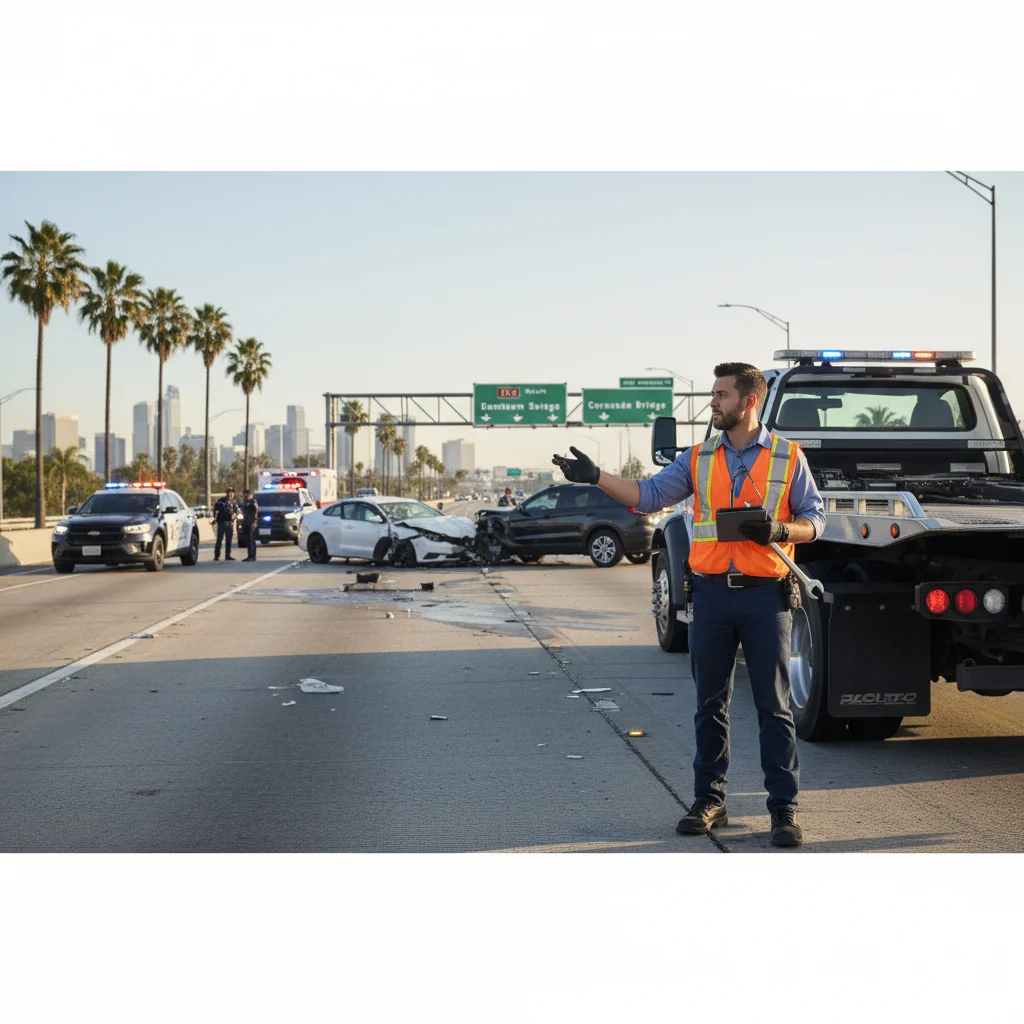
A car accident can happen in an instant. One moment you’re driving along I-5 through La Jolla, or navigating the I-15 commuter traffic in Escondido, and the next you’re dealing with the shock of a collision. Knowing what to do immediately after a car accident in California can make a difference. It protects your safety, helps with legal and insurance claims, and ensures your vehicle gets proper care.
This guide provides San Diego drivers with clear, actionable steps for handling a car accident in 2026. We cover everything from immediate safety measures to contacting authorities, documenting the scene, and arranging reliable towing.
Prioritizing safety and assessing the situation
Your safety, and the safety of others, comes first after any accident. Even a minor fender bender can be disorienting. Stay calm and follow these initial steps.
Check for injuries
Immediately after impact, check yourself and any passengers for injuries. Ask if everyone is okay. If anyone seems hurt, or if there’s any doubt about their condition, call 911 right away. Do this before anything else. Your health is more important than vehicle damage.
Move to a safe location if possible
If the accident is minor and your vehicle is drivable, move it to the safest possible location. This usually means pulling over to the shoulder of the road or freeway. On busy San Diego freeways like the I-5, I-8, or I-805, staying in traffic lanes is dangerous. If you’re on a surface street, try to get to a side street or parking lot.
- If your car is not drivable or moving it is unsafe: Stay inside your vehicle with your seatbelt on. Turn on your hazard lights. If you have flares or reflective triangles, deploy them carefully to warn oncoming traffic. For accidents on major arteries like SR-163 or SR-52, visibility is key.
Turn on hazard lights
Regardless of whether you move your vehicle, turn on your hazard lights. This makes your vehicle more visible to other drivers, especially at night or in bad weather.
Contacting authorities and documenting the scene
Once safety is addressed, the next critical steps involve reporting the accident and gathering information.
When to call 911 or local law enforcement
You should always call 911 if:
- Anyone is injured.
- There’s significant property damage (typically over $1,000, but call if in doubt).
- The accident blocks traffic.
- You suspect a driver is under the influence of drugs or alcohol.
- A driver leaves the scene (hit and run).
For minor accidents with no injuries and minimal damage, you might not need to call 911 for emergency services. However, it’s often wise to call the non-emergency line of the San Diego Police Department or the California Highway Patrol (CHP) for an official report, especially if you’re on a freeway. An official report can be valuable for insurance claims.
On California freeways, the CHP handles accident response. Quick Tow SD works closely with CHP and other local law enforcement agencies across San Diego County. If your vehicle is on a freeway shoulder, a CHP officer will likely be dispatched. Often, they will call a tow company from their CHP-rotation list for accident scenes. We are on that list for many areas.
Exchange information with other drivers
Gather specific information from all drivers involved. Do not skip this step.
- Full name and contact information (phone, email).
- Driver’s license number.
- Insurance company and policy number.
- Vehicle make, model, year, and license plate number.
- Location of the accident (street names, cross streets, freeway mile marker).
Do not admit fault
Even if you think you might be at fault, do not admit it at the scene. Stick to the facts. Let law enforcement and insurance companies determine fault. Anything you say can be used against you later.
Gather witness information
If there are witnesses, ask for their names and contact information. Their account can be helpful if there’s a dispute about what happened.
Document the scene thoroughly
Use your phone to take photos and videos of everything.
- Vehicle damage: Get multiple angles of all damaged areas on both vehicles.
- Scene overview: Take pictures showing the position of vehicles, road conditions, traffic signs, and any skid marks.
- Surroundings: Include street names, landmarks, and relevant lighting conditions.
- Injuries: If there are visible injuries, document them (with permission).
These visual records are powerful evidence for your insurance claim and any legal proceedings.
Dealing with vehicle damage and arranging towing
After the immediate scene is handled, your damaged vehicle needs attention. This is where a reliable towing service like Quick Tow SD comes in.
Assessing your vehicle’s condition
Before you drive away, check your vehicle for:
- Fluid leaks: Puddles under your car could indicate serious damage to the engine, transmission, or cooling system.
- Steering and braking issues: If the steering feels off or the brakes don’t work correctly, do not drive.
- Tire damage: Punctures or bent rims can make driving dangerous.
- Broken lights or mirrors: These are safety hazards and may be illegal to drive with.
If there’s any doubt about your vehicle’s safety or drivability, do not attempt to drive it. It’s safer and often cheaper in the long run to get a tow. Driving a damaged car can cause further, more expensive problems or even another accident.
Calling for a tow truck
When you need a tow, you want a company that’s fast, reliable, and uses the right equipment. Quick Tow SD is available 24/7 across all of San Diego County. You can reach us at (858) 923-5787.
We offer various towing services suitable for accident recovery:
- Emergency Towing: For immediate needs after a collision. Learn more about our emergency towing services.
- Accident Recovery: Our specialized service for getting your vehicle safely off the road and to a repair shop or your home. This includes clearing debris and ensuring the scene is safe. Visit our accident recovery page for details.
Understanding tow truck types and why it matters in San Diego
Not all tow trucks are created equal, and using the wrong type can cause additional damage. This is especially true for many vehicles commonly driven in San Diego.
| Tow Truck Type | Best Use Cases | Key Considerations for San Diego | Flatbed (Rollback) Towing | Vehicles that need to be towed with all four wheels off the ground