When your car breaks down on the side of the I-5 or in a Mission Valley parking garage, your first thought is just “I need a tow.” But as cars get more complex, the type of tow truck matters more than ever. For many modern vehicles, requesting a specific flatbed towing service in San Diego is the only way to prevent expensive, secondary damage.
What a flatbed tow truck actually is (and isn’t)
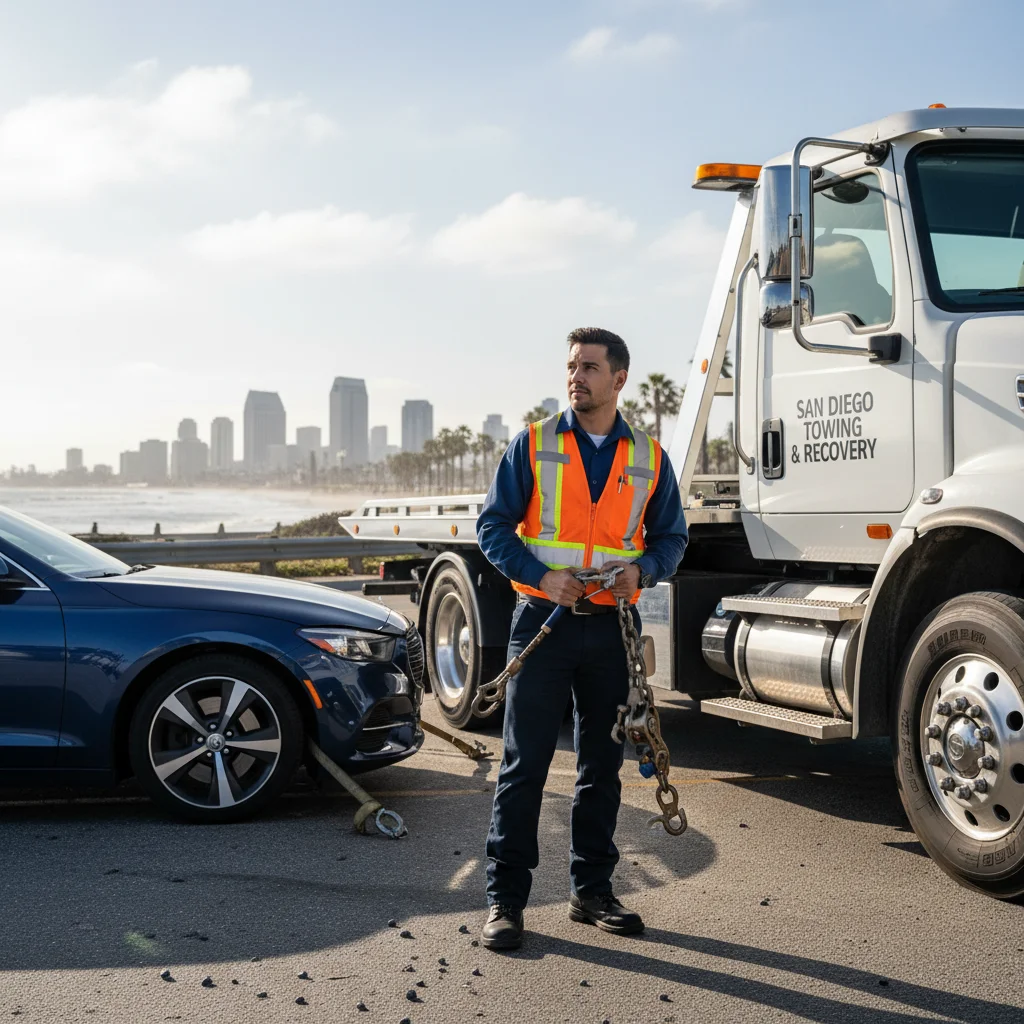
You’ve definitely seen them on San Diego freeways. A flatbed tow truck is exactly what it sounds like: a truck with a long, flat platform on the back. This bed is hydraulic, allowing it to tilt down at an angle and slide back to create a ramp. Your vehicle can either be driven up this ramp or, more commonly, pulled on using a powerful winch.
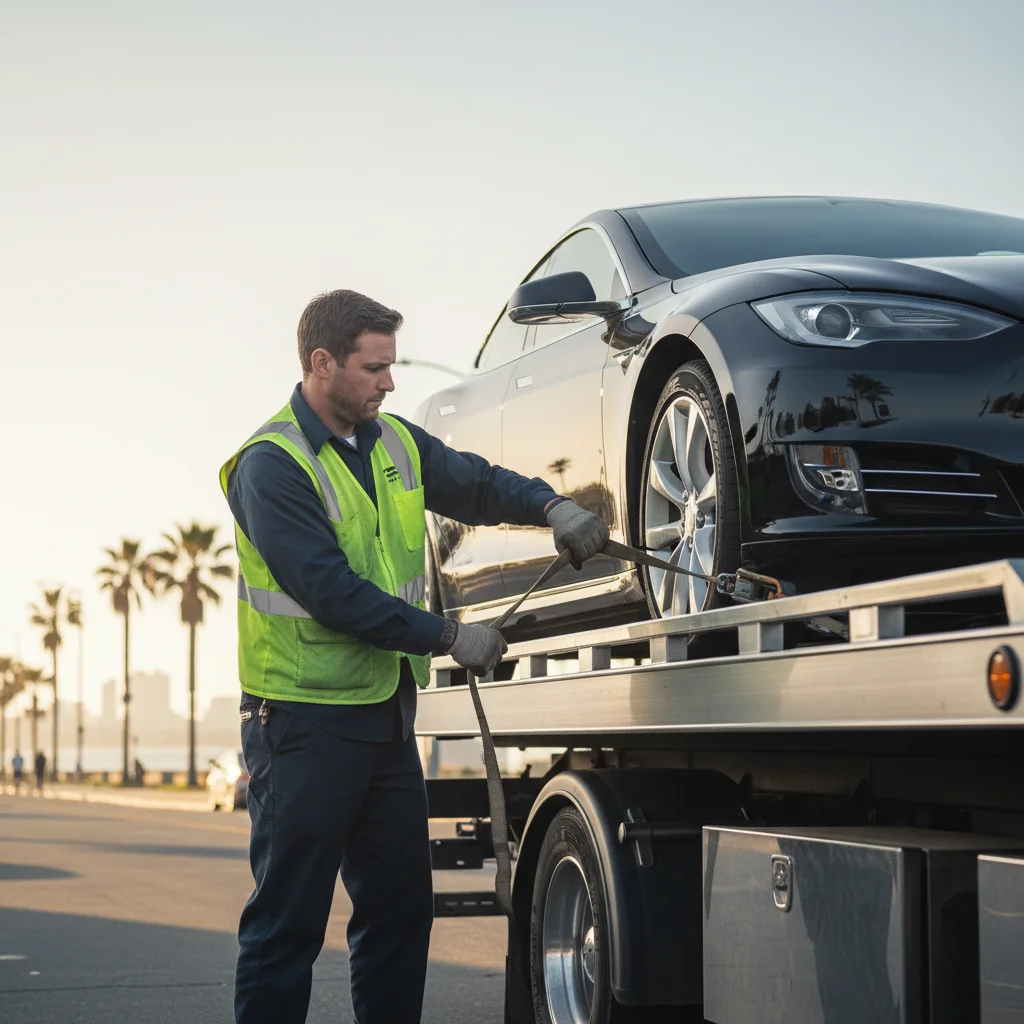
Once your car is on the bed, it’s secured at all four wheels with heavy-duty straps. The operator then levels the bed and locks it into place for transport. The key difference from other tow trucks is that your entire vehicle rides on top of the truck, with none of its wheels touching the road. This is the safest way to transport a vehicle, period.
This is different from a traditional “wheel-lift” or “hook-and-chain” tow truck, which lifts either the front or rear two wheels of your car off the ground and pulls it behind them. While effective for certain situations, that method can be problematic for many modern cars. Our professional flatbed towing is designed to eliminate those risks completely.
Vehicles that must go on a flatbed: AWD, EVs, lowered cars, exotics
Not every car needs a flatbed, but for some, it’s non-negotiable. Using the wrong type of tow truck on these vehicles can cause thousands of dollars in damage to the drivetrain, suspension, or body. If you drive one of the following, you should always request a flatbed.
All-wheel drive (AWD) and 4x4 vehicles
This is the most common reason for a required flatbed tow. On an AWD or 4x4 vehicle, the drivetrain is designed to send power to all four wheels. If you tow it with two wheels on the ground, the wheels that are spinning are fighting against the ones that are stationary. This can quickly overheat and destroy the vehicle’s center differential, transmission, and other expensive drivetrain components. Most owner’s manuals for cars like Subarus, Audis with Quattro, and many SUVs specifically forbid any towing that isn’t on a flatbed.
Electric vehicles (EVs)
EVs present their own set of challenges. They are incredibly heavy due to their large battery packs, and their electric motors can be damaged if the wheels are allowed to spin freely while being towed. Manufacturers like Tesla have very specific procedures for transport, almost all of which require a flatbed. Attempting a wheel-lift tow on an EV can lead to costly repairs to the electric drive units. For a deeper dive into the specifics, our guide to EV and Tesla towing covers everything you need to know.
Lowered cars and sports cars
If your car has been lowered or has a low-profile body kit, a traditional tow is a recipe for disaster. The steep angle of a wheel-lift ramp can easily scrape and damage front bumpers, side skirts, and the undercarriage. A flatbed truck’s bed can be lowered to a much more gradual angle, allowing the vehicle to be loaded without any risk of cosmetic or structural damage.
Exotic, classic, and luxury vehicles
When you’re transporting a high-value asset, you want zero risks. A flatbed is the gold standard for moving exotic, classic, or luxury cars. It’s a “no-touch” method, meaning there are no hooks or chains attached to your vehicle’s frame or suspension. The car is secured by its tires, ensuring the body, paint, and alignment are perfectly preserved during transit. It’s not just a tow; it’s professional vehicle transport.
Flatbed vs wheel-lift: how to know which to ask for
When you call for a tow, the dispatcher will ask you a few questions to determine the right equipment for the job. But knowing the difference yourself can speed up the process and ensure you get the right service for your specific car and situation.
The basic rule is simple: if your vehicle falls into any of the categories listed above, AWD, 4x4, EV, lowered, exotic, or classic, you must ask for a flatbed. The same is true if your car has significant damage from an accident, such as broken axles or wheels that won’t turn. In these cases, a flatbed is the only safe option.
For a standard front-wheel-drive or rear-wheel-drive car (that isn’t lowered) with a simple mechanical issue like a dead battery or alternator failure, a wheel-lift tow is often perfectly fine. It can sometimes be faster and slightly more affordable. However, many drivers simply prefer the peace of mind that comes with a flatbed.
Ultimately, the choice comes down to safety and risk prevention. For a complete comparison of the two methods, we’ve put together a guide on flatbed vs. wheel-lift towing that explores the pros and cons of each in detail.
What flatbed towing costs in San Diego in 2026
Pricing for any towing service can vary, but we believe in transparency. When you call for a quote, you should understand the components of the bill. In San Diego, the cost of a flatbed tow is generally broken down into a few key parts.
The base hook-up fee
This is the standard charge for dispatching the truck and the operator to your location and loading your vehicle. For a flatbed in San Diego County, you can expect this fee to be somewhere between $100 and $175. This is typically a bit higher than a standard wheel-lift tow because the equipment is more specialized.
Per-mile rate
After the hook-up fee, you’ll be charged a per-mile rate for the distance your vehicle is transported. This rate usually kicks in after a set number of miles (e.g., the first 5-10 miles might be included in the hook-up fee). In 2026, typical per-mile rates for flatbed towing in San Diego range from $4 to $8 per mile.
Other factors that can affect the price
Several variables can influence your final cost:
- Time of day: Calls late at night, on weekends, or during major holidays often have a surcharge.
- Location difficulty: If your car is in a hard-to-reach spot, like a narrow alley, a parking garage with low clearance, or off-road, extra labor and time may be required.
- Vehicle condition: If the car doesn’t roll or steer, it takes significantly more time and skill to winch it onto the flatbed, which may add to the labor cost.
- Wait time: If the tow operator has to wait for you to arrive on scene, you may be billed for their time.
A reputable company will always provide you with a clear and detailed quote over the phone before they dispatch a truck.
How fast we can get a flatbed to you across the county
When you’re stranded, speed is everything. We understand that. That’s why Quick Tow SD works with flatbed operators positioned throughout San Diego County to ensure the fastest possible response times. We’re not just a single-location operation; we’re a network ready to respond.
Our dispatch system is designed for efficiency. Central, high-traffic areas like Downtown San Diego, Mission Valley, Kearny Mesa, and La Jolla are the quickest to reach, and the operator taking the job gives you the estimate.
We provide comprehensive coverage across the entire county. Whether you’re in the South Bay in Chula Vista, National City, or up the I-15 corridor through Poway and Escondido, we have a truck nearby. We also serve North County coastal cities like Oceanside and Carlsbad, and we’re ready to head east to El Cajon, Santee, and beyond. For these more distant locations or during peak rush hour on the 805, the drive takes longer, and the operator taking the job gives you an honest arrival estimate for your exact spot.
Our 24/7 service means you’re never truly alone, no matter the time or place. When you search for “flatbed towing near me,” our local presence ensures we’re actually near you.
What to check before the truck leaves with your car
Once the tow truck arrives, things can happen quickly. The operator is a professional focused on getting your car loaded safely. Before they drive away, take a moment to run through a quick mental checklist to protect yourself and your property.
- Take Pictures: Use your smartphone to take a quick walk-around video or several photos of your car’s condition before it’s loaded. This creates a clear record of any pre-existing dings or scratches.
- Confirm the Destination: Verbally confirm the full name and address of the repair shop or your home with the driver. Miscommunications happen, and this simple step prevents your car from ending up at the wrong “Joe’s Auto.”
- Remove Your Valuables: Do a final sweep of your car for personal items. Grab your phone, wallet, keys, sunglasses, FasTrak transponder, and especially your garage door opener if the car is going to a shop.
- Get Paperwork: Don’t let the driver leave without giving you a receipt or an invoice. It should clearly state the name of the towing company, the services performed, the total cost, and the driver’s name or truck number. This is crucial for insurance purposes and your own records.
A professional driver will expect you to do these things and will be happy to wait the extra minute it takes. It’s a sign of a responsible vehicle owner.
When to call us
When you’re dealing with a high-value vehicle, an AWD system, or an EV, don’t leave the tow to chance. A professional flatbed service ensures your car arrives at its destination safely and without any risk of secondary damage. If you need reliable, fast, and fairly priced flatbed towing anywhere in San Diego County, we’re here to help 24/7.
Call us at (858) 923-5787 for a same-day estimate.