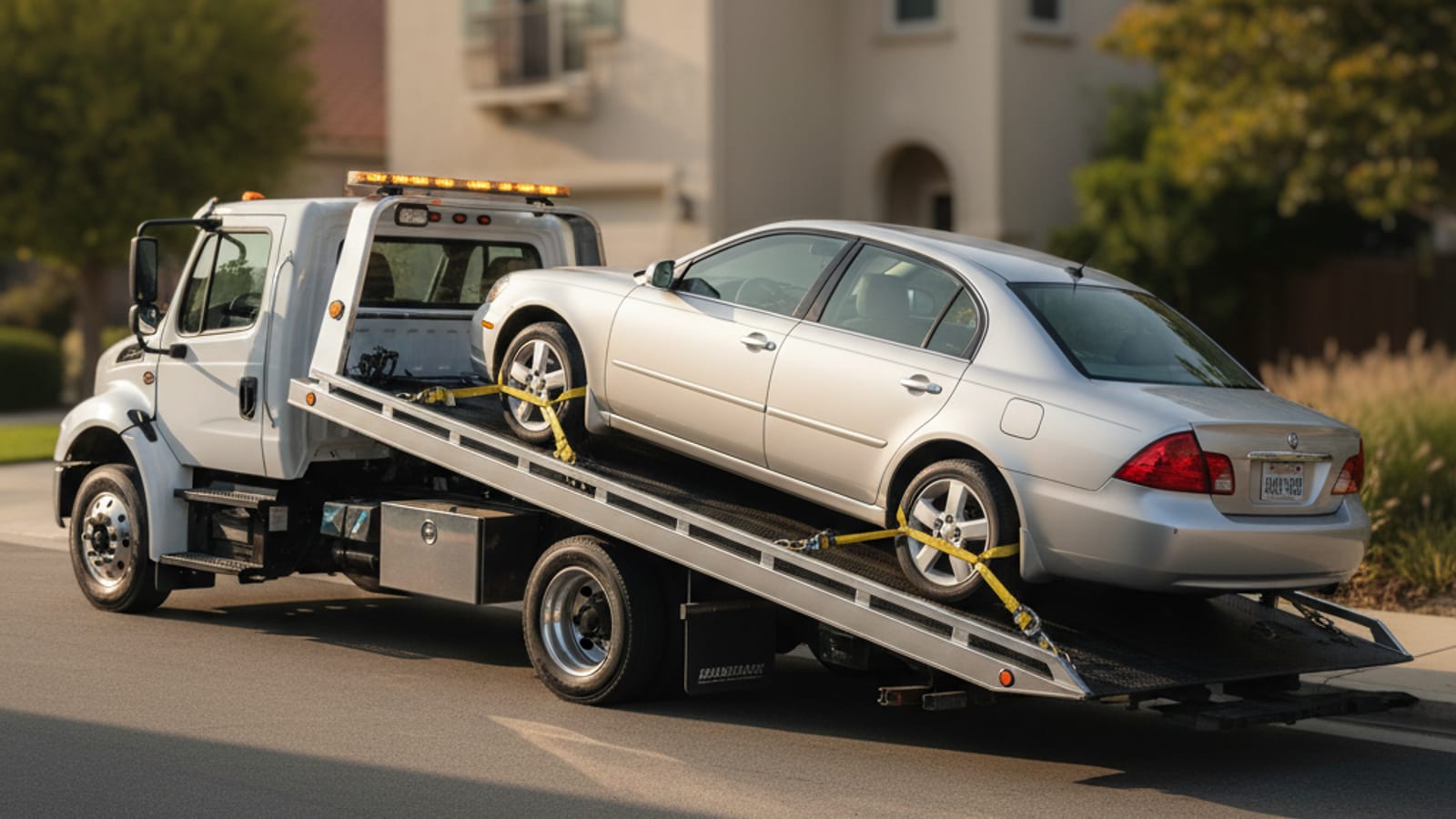
A wheel-lift can transport some AWD and electric vehicles when rated dollies support the other wheels. A wheel-lift alone leaves two wheels rolling on the road. The correct setup depends on the manufacturer’s instructions for the exact vehicle.
Before dispatch, identify the vehicle and describe its condition, location, and destination. Ask how the proposed equipment follows the correct transport procedure.
The three transport setups
Flatbed vs wheel lift towing isn’t always a choice between two truck types.
- Flatbed: The vehicle rides on a deck with every tire off the road.
- Wheel-lift alone: One end is raised while the other tires roll.
- Wheel-lift with dollies: One end is raised, while rated dollies support the other tires.
A wheel-lift arriving for an AWD vehicle or EV isn’t automatically wrong. The important distinction is whether tires will roll on the road.
Truck type also isn’t enough to confirm proper transport. Vehicle condition, loading method, securement, clearance, and access all affect the plan.
Why the exact vehicle matters
Similar-looking vehicles can have different transport instructions. Model year, drivetrain, equipment, and damage can change the required method.
Don’t rely only on an AWD, 4WD, or EV badge. Check the owner’s manual for the exact vehicle. If you don’t know the drivetrain, tell the operator instead of guessing.
Location matters too. A disabled vehicle inside a downtown San Diego parking structure presents different access limits than one in an open South Bay lot. A steep driveway, narrow entrance, soft shoulder, or locked wheel can change which equipment can be positioned.
Wheel-lift alone versus dollies
A wheel-lift alone raises one axle. The tires at the other end remain on the road and rotate during transport.
Dollies change that arrangement. They support the remaining tires so every tire stays off the road. The dollies and operating plan still need to meet the vehicle manufacturer’s procedure and any stated limits.
That distinction matters for many AWD and EV calls. Hearing “wheel-lift” doesn’t tell you whether the vehicle’s ground wheels will roll.
Tesla Model 3 guidance
Tesla’s US Model 3 Instructions for Transporters require every tire to remain off the ground and unable to spin during transport.
Tesla recommends a flatbed or comparable transport vehicle. The instructions also permit wheel lifts with dollies under stated conditions. For the Model 3 covered by those instructions, dolly transport is limited to 35 miles, or 55 kilometers. The dolly manufacturer’s speed rating also applies.
Those limits don’t establish a rule for every Tesla or EV. The professional should consult the instructions for the exact vehicle being transported.
Tesla describes Tow Mode as a limited loading and repositioning function. It isn’t permission for road transport with tires turning. When Tow Mode is unavailable, professional loading may require the dollies or tire skates specified by Tesla.
A collision-damaged Model 3 requires high-voltage precautions. Emergency-response professionals must evaluate safety. A tow operator alone can’t certify that the battery is safe.
Ford Mustang Mach-E guidance
Ford’s online Mustang Mach-E transport guidance recommends a flatbed or a wheel-lift with dollies. Both methods keep every wheel off the ground.
Ford also says its online guidance can differ from the manual supplied with a particular vehicle. The manual for that vehicle should guide the transport decision.
This example doesn’t set one procedure for every Mach-E model year, Ford EV, or other electric vehicle. It shows why the exact manufacturer instructions matter.
When a flatbed may fit the job
An operator may propose a flatbed tow when the manufacturer recommends one or the vehicle’s condition supports that method.
A flatbed keeps the tires off the road, but that fact alone doesn’t prove the loading plan is suitable. The professional still needs to account for damaged wheels, locked steering, limited clearance, disabled systems, and approved securement points.
The pickup site matters as well. A flatbed needs enough room to enter, position, and load the vehicle using the correct procedure.
When a wheel-lift may fit the job
A wheel-lift may be suitable when the manufacturer permits the proposed setup and the professional can follow every condition.
Some vehicles may permit two tires to roll on the road. Others, including the manufacturer examples above, require dollies so every tire remains raised.
Don’t assume every FWD or RWD vehicle can roll safely behind a wheel-lift. Don’t reject a wheel-lift solely because a vehicle is AWD or electric. Confirm what will support each wheel and which manufacturer instruction permits that setup.
Practical dispatch checklist
Give the dispatcher enough detail to plan the complete job:
- Vehicle: State the full year, make, model, and drivetrain. Say when the drivetrain isn’t confirmed.
- Condition: Report collision damage, flat tires, damaged suspension, locked wheels, steering problems, missing keys, or lost electrical power.
- Movement: Explain whether the vehicle starts, rolls, steers, or releases its parking brake. Don’t force any control yourself.
- Access: Describe garages, gates, low ceilings, steep driveways, narrow aisles, soft shoulders, or traffic exposure.
- Destination: Provide the complete destination and expected route distance.
- Equipment: Ask whether the plan uses a flatbed, wheel-lift alone, or wheel-lift with rated dollies.
- Procedure: Ask which instructions apply to the exact vehicle and whether its condition changes them.
- Price: Request the complete job-specific quote. Ask whether it covers loading, dollies, distance, access or recovery work, after-hours service, taxes, and other line items.
- Timing: Ask the assigned operator for an arrival estimate based on the pickup location.
Quick Tow SD connects callers with independent licensed operators throughout San Diego County. The line takes calls 24/7. The operator performs the work, sets the price and arrival estimate, and receives payment directly from the customer.
Prices are job-specific
There isn’t one standard San Diego price difference between flatbed and wheel-lift service. The operator’s quote depends on the actual job.
Review the quoted components before authorizing service. Compare them with the final invoice, then ask about any difference before paying.
Leave recovery to the professional
This article isn’t a loading guide. Vehicle transport can require model-specific controls, tools, and safety procedures.
Don’t improvise dollies, force the vehicle into neutral, release locked systems, or activate a transport mode without the correct instructions. Don’t attempt loading, jump-start work, or contact with damaged high-voltage components.
Describe what the vehicle is doing. Then let the appropriate professional follow the manufacturer’s procedure.
The practical answer
A wheel-lift alone and a wheel-lift with dollies are different transport setups. For some AWD and EV models, rated dollies can make wheel-lift transport appropriate by keeping every tire off the road.
The correct choice comes from the manufacturer guidance for the exact vehicle, its condition, and the planned trip. Confirm that procedure, the equipment, access, destination, price, and arrival estimate before dispatch.
To request a job-specific quote, contact Quick Tow SD with the vehicle and pickup details.