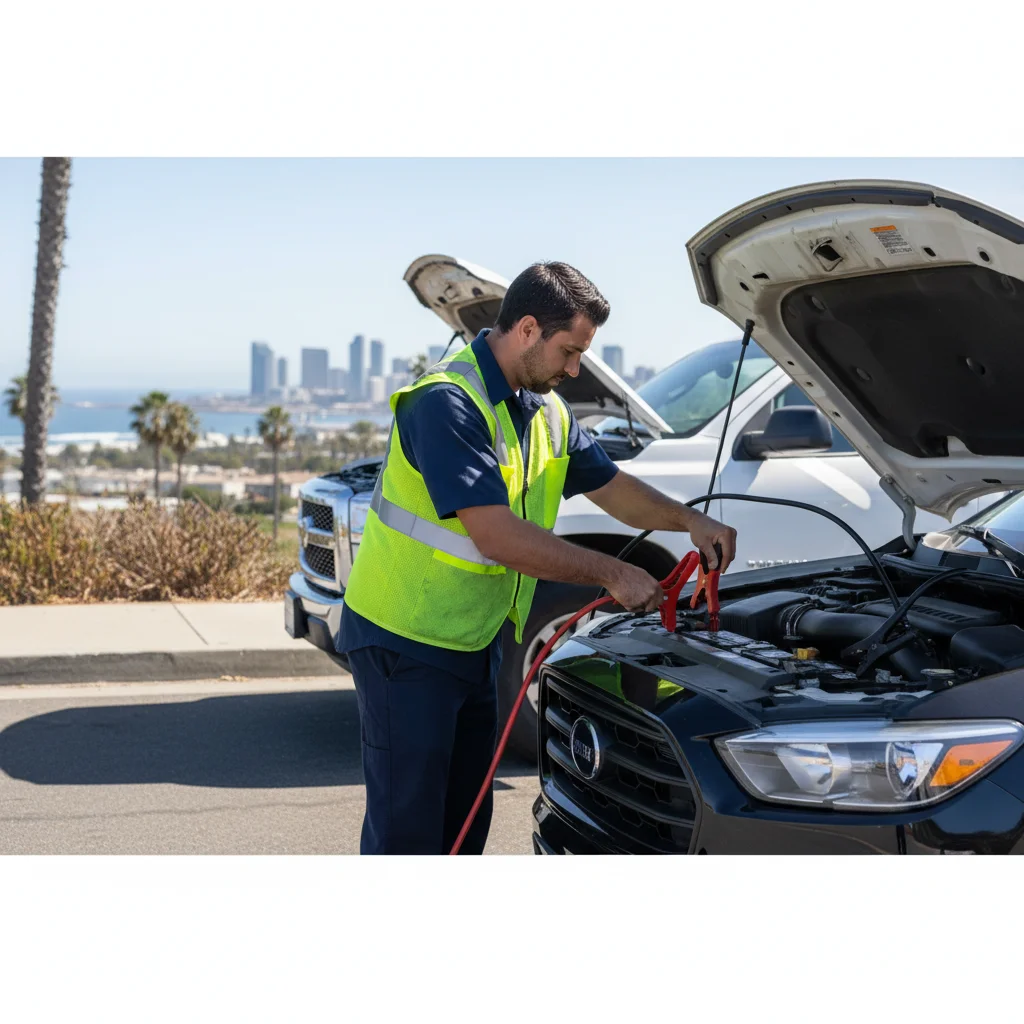
To jump start a car safely, connect red to the dead battery’s positive terminal, red to the donor’s positive, black to the donor’s negative, then black to bare metal on the dead car’s engine block. Start the donor, wait a few minutes, then start the dead car. No second car? A portable jump starter does the same job. Full steps and the no-donor method are below.
Picture this: you’re leaving a Padres game downtown, or maybe finishing a hike near Lake Cuyamaca. You turn the key, and nothing happens. Just a click, or silence. A dead car battery is a common problem. It can leave you stranded anywhere, from a busy parking lot in Mission Valley to a quiet street in La Jolla. Knowing how to jump start a car safely can get you moving again.
This guide provides a clear, step-by-step process for jump starting your vehicle. We also cover common mistakes, safety precautions, and when it’s smarter to call for professional roadside assistance. Especially here in San Diego, where traffic on the I-5 or I-15 moves fast, safety is always the priority.
Why car batteries die: common San Diego scenarios
Car batteries typically last three to five years. Several factors can shorten their lifespan or cause a sudden failure.
- Leaving lights on: Interior dome lights or headlights left on overnight drain the battery.
- Extreme temperatures: San Diego’s warm summers, especially inland in places like El Cajon or Escondido, can accelerate battery fluid evaporation and internal corrosion. Cold snaps in the mountains near Julian or Pine Valley also reduce battery cranking power.
- Short trips: If you only drive short distances, your alternator might not have enough time to fully recharge the battery.
- Parasitic drain: Sometimes, an electrical component in your car draws power even when the vehicle is off. This can slowly drain the battery over time.
- Old age: Batteries simply wear out. As they age, their ability to hold a charge diminishes.
Before you begin: safety first
Jump starting a car involves working with electricity and corrosive chemicals. Taking proper precautions is essential.
Assess your situation
Before you even open your hood, look around.
- Location safety: Are you in a safe spot? A busy freeway shoulder, like on the I-5 near Camp Pendleton or the I-8 through East County, is dangerous. If you’re on a major road, turn on your hazard lights immediately. Consider moving to a safer location if possible, or call for help. The National Highway Traffic Safety Administration (NHTSA) offers clear guidelines for roadside safety.
- Visibility: Is it dark? Do you have a flashlight?
- Weather: Is it raining? Avoid jump starting in heavy rain. Water conducts electricity and can increase the risk of shock.
- Ventilation: Ensure you’re in an open area. Batteries can release hydrogen gas, which is flammable.
Gather your gear
You’ll need a few items to jump start a car safely.
- Jumper cables: These are essential. Ensure they are heavy-gauge (thick wires) and at least 10-12 feet long.
- Safety gloves: Protect your hands from battery acid or heat.
- Eye protection: Safety glasses or goggles are highly recommended to shield your eyes from sparks or battery acid.
- Owner’s manual: Your vehicle’s manual provides specific instructions for your model, including battery location and jump starting procedures. For some newer vehicles, especially hybrids or luxury cars, there might be specific jump points.
Know your vehicle and the donor vehicle
Not all vehicles jump start the same way.
- Battery location: Most cars have the battery under the hood. Some, however, place it in the trunk, under the back seat, or even in the wheel well. Consult your owner’s manual.
- Positive (+) and negative (-) terminals: Identify these clearly. The positive terminal is usually marked with a plus sign (+) and covered by a red cap. The negative terminal has a minus sign (-) and often has a black cap or no cover.
- Voltage: Most passenger cars use a 12-volt battery system. Ensure both vehicles are 12-volt systems. Never attempt to jump a 12-volt car with a 24-volt truck.
- Hybrid and electric vehicles (EVs): Many hybrids have a small 12-volt battery that can be jump started, but often have specific jump points. Electric vehicles (EVs) cannot be jump started in the traditional sense. Their large drive batteries are not designed for it. If your EV is dead, it needs professional towing, likely a flatbed tow. Attempting to jump an EV can damage its delicate electronics. Similarly, many AWD vehicles (Subaru, Audi, Tesla, Rivian) should also be transported via flatbed if they cannot start or roll, as wheel-lift towing can damage their drivetrains. This is a common issue we see across San Diego County.
The step-by-step guide to jump starting
Follow these steps precisely to jump start a car safely.
1. Position the vehicles
Park the donor vehicle (the one with the good battery) facing the disabled vehicle. The two cars should be close enough for the jumper cables to reach both batteries, but do not let the vehicles touch each. Ensure both vehicles are in park (automatic) or neutral (manual) and turn off their engines. Engage the parking brake on both cars.
2. Turn off all accessories
Make sure the headlights, radio, air conditioning, and any other accessories in both vehicles are off. This prevents electrical surges and protects the vehicle’s systems.
3. Connect the jumper cables - the critical sequence
This sequence is vital to avoid sparks and potential injury.
- Red clamp to dead positive: Connect one red (positive) jumper cable clamp to the positive (+) terminal of the dead battery.
- Red clamp to donor positive: Connect the other red (positive) jumper cable clamp to the positive (+) terminal of the donor battery.
- Black clamp to donor negative: Connect one black (negative) jumper cable clamp to the negative (-) terminal of the donor battery.
- Black clamp to dead car ground: Connect the other black (negative) jumper cable clamp to an unpainted metal surface on the engine block or chassis of the dead vehicle. This provides a ground connection away from the battery itself, minimizing the risk of sparks near potentially flammable hydrogen gas. Do not connect it to the negative terminal of the dead battery.
Double-check all connections. Ensure the clamps are firmly attached and not touching any moving engine parts.
4. Start the donor vehicle
Start the engine of the donor vehicle. Let it run for five to ten minutes. This allows the donor battery to transfer some charge to the dead battery. You can rev the engine slightly to increase the charging rate.
5. Start the dead vehicle
After the donor vehicle has run for a few minutes, try to start the disabled vehicle.
- If it starts, let both cars run for another five minutes with the cables still connected.
- If it doesn’t start, turn off the ignition in the dead car, wait a few more minutes, and try again. If it still doesn’t start after a couple of attempts, there might be a more serious issue than just a dead battery.
6. Disconnect the cables - the reverse sequence
Once the dead vehicle has started, disconnect the jumper cables in the exact reverse order of connection. This minimizes the risk of sparks.
- Black clamp from dead car ground: Disconnect the black (negative) clamp from the unpainted metal surface on the formerly dead vehicle.
- Black clamp from donor negative: Disconnect the black (negative) clamp from the negative (-) terminal of the donor battery.
- Red clamp from donor positive: Disconnect the red (positive) clamp from the positive (+) terminal of the donor battery.
- Red clamp from dead positive: Disconnect the red (positive) clamp from the positive (+) terminal of the formerly dead battery.
7. After the jump start
Once your car is running, do not turn it off immediately. Drive the vehicle for at least 15-20 minutes. This allows your alternator to fully recharge the battery. Short drives after a jump start, common for quick errands in places like Chula Vista or San Marcos, might not be enough to get a full charge.
If your car dies again shortly after, or if you needed a jump start, it’s a strong sign that your battery is failing or your charging system has a problem. You should have your battery and alternator checked by a mechanic soon. Many auto parts stores offer free battery testing.
No second car? how to jump start with a portable jump starter
You don’t need a donor vehicle to get going. A portable jump starter, sometimes called a jump box or battery pack, does the same job from a unit small enough to keep in your trunk. This is the method that saves you when you’re alone in a beach lot in Ocean Beach or a trailhead near Mission Trails with no one around to help.
1. Confirm the jump box is charged
These units lose charge sitting in a hot San Diego trunk. Check the charge indicator before you rely on it. A unit that’s been ignored for months may not have enough power to crank an engine. Charge it fully at home so it’s ready when you need it.
2. Turn off your car and its accessories
Make sure the ignition is off and headlights, radio, and air conditioning are off. Keep the jump box switched off while you connect the clamps.
3. Connect the clamps in the right order
The sequence mirrors the cable method, just without a donor battery.
- Red clamp to your positive terminal: Connect the red (positive) clamp to the positive (+) terminal of your dead battery.
- Black clamp to bare metal: Connect the black (negative) clamp to an unpainted metal surface on the engine block or chassis, not the negative terminal of the battery. This keeps any spark away from the battery’s hydrogen gas.
Keep the unit clear of moving parts, don’t let the clamps touch each other, and keep your face away from the battery as you connect.
4. Power on and start the engine
Switch on the jump box, then start your car. If it cranks and turns over, let it run above idle for a few minutes. If it doesn’t start after a couple of tries, stop. Repeated cranking won’t fix a battery that can’t hold a charge.
5. Disconnect in reverse
Turn the unit off, remove the black clamp from the metal ground first, then the red clamp from the positive terminal. Drive at least 15 to 20 minutes so the alternator recharges the battery.
If the jump box can’t start the car, or the car dies again right after, the battery is likely done and you need a new one or a tow. We can deliver and install a battery on the spot, or move the vehicle if the problem runs deeper. See our guide on when to tow versus repair in San Diego for what to weigh.
Common jump start mistakes and how to avoid them
Ignoring these can lead to damage or injury.
- Incorrect cable connection: Reversing polarity (connecting positive to negative) can cause severe damage to both vehicles’ electrical systems, including the alternator and computer. It can also cause sparks, fire, or battery explosion. Always follow the correct sequence.
- Allowing clamps to touch: If the positive and negative clamps of the jumper cables touch each other when connected to a battery, it creates a short circuit. This can produce sparks and damage the battery.
- Not using eye protection: Sparks and battery acid are real hazards.
- Trying to jump a damaged battery: If a battery is cracked, leaking, or swollen, do not attempt to jump start it. It could explode.
- Ignoring vehicle specific instructions: As mentioned, some vehicles, especially hybrids and EVs, have specific procedures or are not suitable for traditional jump starting. Always check the owner’s manual.
- Leaving accessories on: This can create a power surge when connecting or disconnecting cables.
When not to jump start - call for professional help
Sometimes, jump starting isn’t the solution, or it’s simply too risky. This is when a professional roadside assistance service like Quick Tow SD becomes invaluable.
- Unsafe location: If your car dies on a busy freeway like the I-805 near National City, the I-15 during rush hour, or a narrow, winding road in East County’s Crestwood area, it’s not safe to attempt a jump start. Traffic moves too fast. The California Highway Patrol (CHP) recommends calling for assistance in such situations.
- Damaged battery: If you see any signs of battery damage (cracks, leaks, swelling), do not try to jump it.
- Repeated failures: If your car needs frequent jump starts, the battery is likely at the end of its life, or there’s an underlying electrical issue.
- No donor vehicle available: You can’t jump start without another car.
- Specific vehicle types: For EVs and many AWD vehicles, a simple jump start isn’t appropriate. These vehicles often require specialized care, including flatbed towing. Trying to wheel-lift an AWD vehicle can damage its drivetrain, leading to costly repairs ($2,500-$5,000). EVs need flatbeds because their drive motors can remain engaged, causing damage if dragged ($8,000-$18,000 repair). We see this frequently with Teslas and Rivians across San Diego.
- You’re unsure or uncomfortable: If you’re not confident in the process, it’s always best to call a professional. Safety should be your top concern.
San Diego roadside realities: why Quick Tow SD is your local lifeline
San Diego County presents unique challenges for drivers. From coastal cruising to mountain passes, Quick Tow SD understands these local conditions.
San Diego’s unique roadside challenges
- Freeway breakdowns: We regularly respond to breakdowns on all major San Diego freeways:
- I-5: From the Mexican border up through Sorrento Valley, Del Mar, Encinitas, and the Camp Pendleton corridor. A dead battery on the I-5 shoulder near La Jolla can be particularly hazardous.
- I-15: The main north-south artery connecting downtown to North County Inland cities like Escondido, San Marcos, and Poway. Commuter breakdowns are common.
- I-8: The east-west grade heading into East County (El Cajon, La Mesa, Santee) and towards the desert can strain older batteries and engines.
- SR-163, SR-52, SR-56, I-805, SR-94, SR-78: These busy routes also see frequent roadside incidents.
- Climate effects: Inland areas like Ramona and Lakeside can hit triple-digit temperatures, taxing batteries. Even the occasional cold snap in Julian or Mt. Laguna can reveal a weak battery.
- Coastal areas: Beach parking lots in Ocean Beach, Pacific Beach, and Coronado are common spots for drivers to accidentally drain their batteries. Shoulders on the Pacific Coast Highway can be tight and dangerous.
- Vehicle types: San Diego has a high concentration of newer vehicles, including many EVs and AWD models. Our team is trained on the specific requirements for these vehicles, ensuring safe handling.
- Response times: No average arrival figure is published, because no source for one exists. You get an estimate for your exact location on the call. Remote areas like Julian, Pine Valley, or Borrego Springs take considerably longer because of travel distance. We cover all 67 cities and communities in San Diego County.
- State route response: Quick Tow SD responds to breakdown and accident-recovery calls on the county’s major state routes, coordinating with authorities when the situation calls for it.
Quick Tow SD’s services
When a jump start isn’t enough, or you need professional help, Quick Tow SD is ready.
- 24/7 availability: The line takes calls around the clock, every day of the year.
- Ask for a flat rate: Get the number quoted before the truck is dispatched.
- Comprehensive roadside assistance:
- Jump starts: We can safely jump start your vehicle.
- Battery delivery and installation: If your battery is dead, we can often deliver and install a new one on the spot.
- Tire changes: Flat tire service.
- Fuel delivery: If you run out of gas.
- Lockout service: Get back into your vehicle.
- Expert towing services:
- Flatbed towing: Essential for AWD vehicles, EVs, classic cars, or significantly damaged vehicles. This ensures no stress on the drivetrain.
- Wheel-lift towing: For standard front-wheel or rear-wheel drive vehicles.
- Heavy-duty towing: For commercial trucks, RVs, and buses, often needed in areas like Otay Mesa or on the I-8 grade.
- Motorcycle towing: Specialized equipment for safe transport.
- Accident recovery: Professional recovery services after a collision.
- Emergency towing: For any urgent towing need.
Pricing for roadside assistance and towing in San Diego
Understanding typical costs can help you plan. Our pricing is always flat-rate and transparent.
| Service Type | Description | Typical San Diego Cost (2026) |
|---|---|---|
| Jump Start | On-site battery boost | $75 - $125 |
| Battery Delivery & Install | New battery delivered and installed (cost of battery extra) | $120 - $180 |
| Flat Tire Change | Spare tire installation | $75 - $125 |
| Fuel Delivery | Up to 2 gallons of gas (cost of fuel extra) | $75 - $110 |
| Vehicle Lockout | Unlocking vehicle doors | $75 - $125 |
| Light-Duty Hook Fee | For standard cars/trucks, includes first 5-7 miles (wheel-lift or flatbed) | $95 - $175 |
| Heavy-Duty Hook Fee | For commercial trucks, RVs, buses | $285+ |
| Long-Distance Towing | Per mile rate, requires written flat quote | Varies |
Prices are estimates and can vary based on vehicle type, specific location, and time of day. Ask dispatch for the actual flat rate before you agree to the job.
For more details on towing costs, refer to our blog post on tow costs in San Diego.
Frequently asked questions
Can I jump start a hybrid vehicle?
Many hybrid vehicles have a small 12-volt battery that can be jump started. However, they often have specific jump points, which may not be the main battery itself. Always consult your owner’s manual for the correct procedure and location of these points. Never try to jump the main high-voltage battery.
Can I jump start a car by myself without another vehicle?
Yes. A portable jump starter, also called a jump box, lets you jump your own car with no donor vehicle. Confirm the unit is charged, turn off your car and accessories, connect the red clamp to your positive terminal and the black clamp to bare metal on the engine, then switch the unit on and start the engine. If it won’t start after a couple of tries, the battery likely needs replacing or the car needs a tow.
How do I know if my battery is truly dead or if it’s something else?
A truly dead battery usually results in no crank, no lights, or very dim lights and a clicking sound. If your car cranks but won’t start, or if all electrical components work but the engine doesn’t turn over, the issue might be with your starter, alternator, or fuel system. A professional diagnostic can identify the exact problem.
How long should I drive after a jump start?
After a successful jump start, drive your vehicle for at least 15-20 minutes. This allows your car’s alternator enough time to recharge the battery sufficiently. If you make only short trips, the battery may not fully recover, leading to another dead battery soon after.
What if my car won’t start after a jump?
If your car doesn’t start after several attempts to jump it, or if it starts but immediately dies, it indicates a more serious problem. The battery might be too old or damaged to hold a charge, or there could be an issue with your alternator, starter, or other critical engine components. In this situation, it’s best to call for professional assistance.
Is it safe to jump start a car in the rain?
It is generally not recommended to jump start a car in heavy rain. Water can conduct electricity, increasing the risk of electrical shock or short circuits. If you must attempt it in light rain, take extra precautions: ensure all connections are dry and wear rubber gloves and eye protection. If you are unsure, wait for the rain to stop or call for professional roadside assistance.
A dead battery is an inconvenience, but knowing how to jump start your car safely gives you a clear plan. For those times when you can’t, or when safety dictates professional help, Quick Tow SD is ready. Our experienced team provides reliable 24/7 roadside assistance and towing services across all of San Diego County.
If you find yourself stranded with a dead battery, or any other roadside issue, don’t hesitate to call Quick Tow SD at (858) 923-5787. We’ll get you back on the road, safely. Learn more about our full range of services on our /services/roadside-assistance/ page.