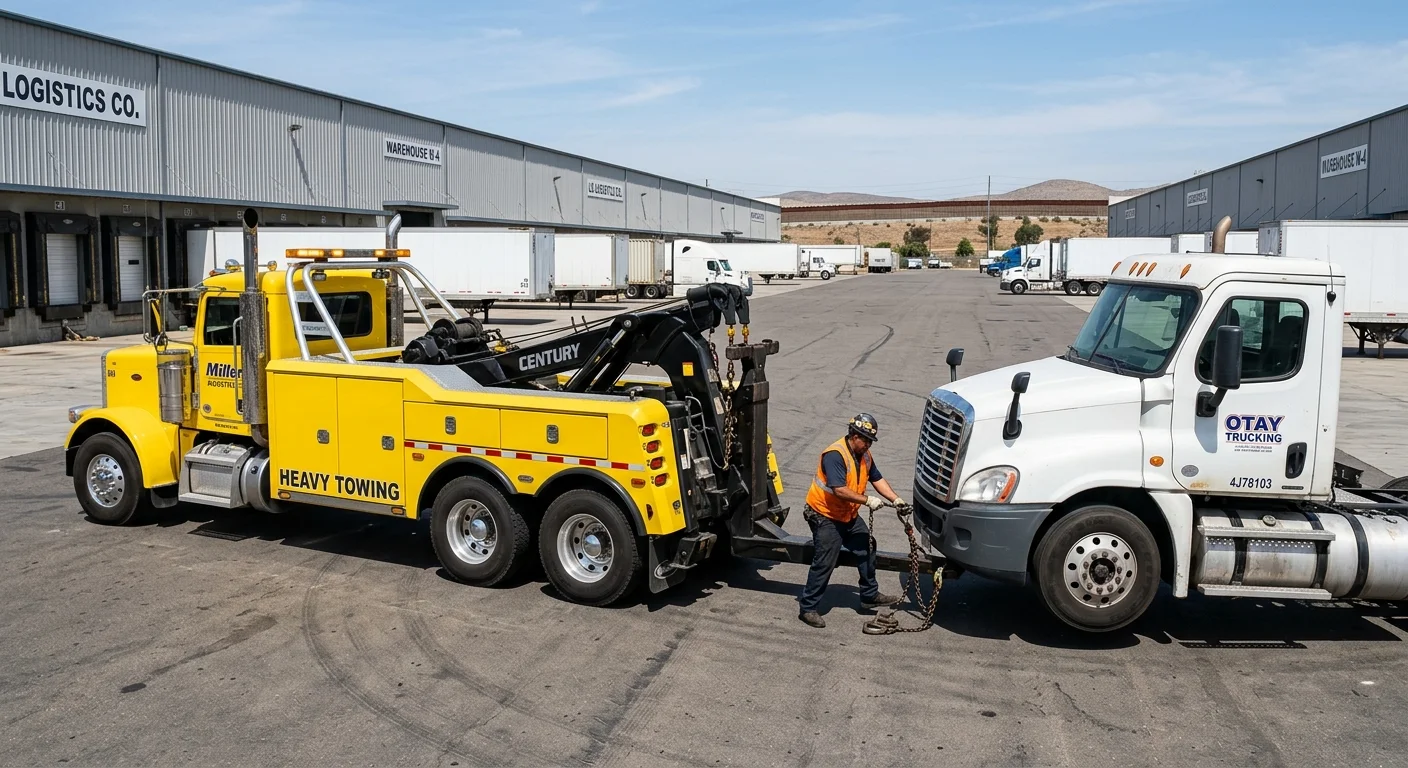
Quick Tow SD dispatches semi truck roadside assistance in San Diego 24 hours a day: commercial jump starts for dual-battery systems, diesel fuel delivery, winch-outs from soft shoulders, cab lockouts, and tire change support. The main freight corridors are the quickest to reach; remote stretches of I-8 east of El Cajon take longer, and the operator taking the job tells you what to expect. Every job gets a flat rate quoted before anyone rolls - no surprises on the invoice.
What roadside can fix on the shoulder vs. what needs a tow
This distinction matters because the wrong call costs you time and money.
Roadside can handle:
- Dead commercial batteries. Semi tractors run dual 12-volt batteries in series, and a standard jump box won’t touch them. A commercial jump start unit delivers enough cold-cranking amps to get a Class 8 diesel started. If the alternator is charging normally after the start, the rig leaves under its own power.
- Diesel fuel delivery. Running out of fuel happens on long hauls. We deliver enough diesel to get you moving and to the nearest truck stop. Note: diesel fuel delivery does not include priming an air-locked fuel system - that’s a mechanical repair that needs a mobile diesel mechanic.
- Winch-out from a soft shoulder. Pulling off on loose soil or gravel, especially on I-8 grades or the sandy shoulders near Otay Mesa, can sink drive axles fast. A winch-out gets the rig back on solid pavement without a full recovery rig in most cases. If the truck is significantly buried or off an embankment, a heavy wrecker is the right tool - dispatch will tell you which applies.
- Cab lockouts. Keys locked inside the cab happen. We get the door open without damage.
- Tire change support. We can swap a blown steer tire if you have a spare on the truck. We don’t carry commercial truck tires or perform mobile tire mounting - for a blown drive or trailer tire without a spare, a commercial truck tire service is the call.
Roadside cannot handle:
- Mechanical failure, engine problems, transmission issues, or anything that requires diagnosis and repair on the shoulder. That’s a mobile diesel mechanic, not a tow service.
- DOT inspections or out-of-service orders.
- Reefer unit repairs.
- Priming fuel systems after a full runout.
Dispatch will tell you this plainly on the phone. We don’t roll a unit to a job we can’t complete.
Where semi breakdowns happen most in San Diego
San Diego’s freight routes concentrate commercial truck volume into a handful of corridors, and those corridors account for most breakdown calls.
I-5 through National City and Chula Vista carries the heaviest border-freight load in the county, running from the Otay Mesa Port of Entry north through downtown. The stop-and-go density means electrical drain and overheating show up here more than anywhere else.
I-8 east of El Cajon is the grade route to El Centro and the Imperial Valley. Westbound trucks bleed brakes on the descent. Eastbound trucks push hard on the climb. Both directions see brake fade, overheating, and fuel consumption spikes. CHP runs a weigh station near the summit and mechanical problems often surface right after.
SR-67 and SR-94 east of the metro carry regional freight on tighter two-lane sections. Breakdowns here mean less shoulder room and slower arrival times. Give dispatch your exact milepost - the nearest cross street isn’t always useful on these routes.
Otay Mesa freight zone (SR-905 corridor) is time-sensitive territory. A breakdown near the port of entry creates immediate logistics problems for border crossing schedules. Quick turnaround on jump starts and winch-outs is what matters most here. Our post on heavy-duty towing in Otay Mesa covers what happens when a full tow is needed in that corridor.
How a commercial jump start actually works
A semi tractor typically runs two Group 31 batteries wired in series, producing 24 volts for the engine control modules and some accessories, with 12-volt taps for lights and cab systems. The setup varies by make and model.
A consumer jump pack doesn’t have the capacity. The commercial unit we use delivers 1,500 to 2,000 cold-cranking amps across the correct terminals. The technician connects positive to positive, negative to chassis ground (not to the dead battery terminal), and lets the pack charge for a few minutes before cranking. Most dead-battery starts succeed on the first or second attempt.
After the engine runs, the technician checks that the alternator voltage is in the normal range, around 13.8 to 14.4 volts across the batteries under load. If it’s not charging, the rig has a charging system problem and another breakdown is coming soon. Dispatch will tell you what was found. Whether you drive to a shop or call for a heavy-duty tow is your decision.
Winch-out: what determines whether it works or whether you need a heavy wrecker
A standard winch-out applies a controlled cable pull to a rated recovery point on the vehicle, dragging it back onto solid pavement. It works well when the drive axles are sitting on soft material but the frame and suspension are intact.
It doesn’t work - and we’ll say this upfront - when the vehicle is:
- Significantly off the roadway on a slope or embankment
- Buried past the frame rails
- Resting on damaged suspension or axles
- In a position where a straight cable pull would cause more damage
In those cases, a heavy wrecker is the right call. We can dispatch both from the same call if the situation on arrival turns out to be more serious than it appeared. See our accident recovery service for the heavy recovery side.
What to have ready when you call
Specific information gets the right unit dispatched faster.
Tell dispatch: your location by highway and milepost or nearest landmark (GPS coordinates work too), what the truck is doing or not doing, whether it’s a tractor only or a loaded combination, and the approximate GVWR or axle count if you know it. For a winch-out, describe how far the truck is off the pavement and whether the ground is soft soil, gravel, or sand.
For fuel delivery, tell dispatch whether you have ultra-low sulfur diesel or if the truck has a DEF system - both are standard, but knowing helps.
Fleet operators: have your account or company name ready. We document the job for insurance and fleet billing purposes.
Call Quick Tow SD at (858) 923-5787 - the line takes calls 24/7 and the operator quotes a flat rate before anything rolls.
When roadside isn’t the answer and towing is
Some situations look like roadside calls but aren’t.
If the engine cranks and starts after a jump but dies again within a few miles, the charging system is failed and another dead battery is coming. A tow to a truck shop beats a second roadside call on the same run.
If the truck went off the shoulder and is sitting at an angle or partially on the slope, a winch-out attempt without the right equipment risks rolling the vehicle. Describe exactly what you’re seeing and let dispatch make the call on which unit to send.
If the truck is mechanical, diagnosis and repair on the shoulder isn’t something we do. The honest call is a tow to the nearest shop that handles your make, and we can dispatch that directly. For a full breakdown of how semi truck towing works - equipment classes, rotators, pricing - that post covers it.
For general towing service across San Diego County, the process is similar but uses lighter equipment for passenger vehicles and smaller commercial units.
Frequently asked questions
What does semi truck roadside assistance in San Diego include?
Quick Tow SD dispatches commercial jump starts, diesel fuel delivery, winch-outs from soft shoulders, cab lockouts, and tire change support for semis and commercial trucks. We do not do mechanical repair, reefer service, or mobile diesel work - when those are the answer, dispatch will tell you on the call. Every service is quoted at a flat rate before the unit rolls.
How long does commercial roadside assistance take in San Diego?
The main freight corridors - I-5, I-8 west of El Cajon, and the Otay Mesa area - are the quickest to reach. Remote stretches on I-8 east of El Cajon, SR-67, or SR-94 take longer. The operator taking the job gives you an honest arrival estimate when you call, not a number pulled from the air.
Can you jump start a semi truck with dual batteries?
Yes. Semi tractors run dual Group 31 batteries that need commercial-grade jump equipment, typically 1,500 to 2,000 cold-cranking amps. A consumer jump pack won’t move them. After the start, the technician checks that the alternator is charging correctly before leaving the scene. Call (858) 923-5787 for a flat-rate commercial jump start anywhere in San Diego County.
What’s the difference between a winch-out and a tow for a semi?
A winch-out pulls the truck back onto solid pavement using a cable attached to a rated recovery point - it keeps the rig moving under its own power. A tow is for when the truck can’t drive at all, or when the recovery situation requires heavy equipment. If you’re not sure which applies, describe what you’re seeing to dispatch and they’ll tell you which unit to send.
Do you cover all of San Diego County for commercial roadside?
Yes. Quick Tow SD covers all of San Diego County, including Chula Vista, National City, El Cajon, Santee, Poway, Escondido, Oceanside, and the Otay Mesa freight corridor. Call (858) 923-5787 any time, day or night. Give dispatch your location and vehicle details and they’ll get the right unit moving.