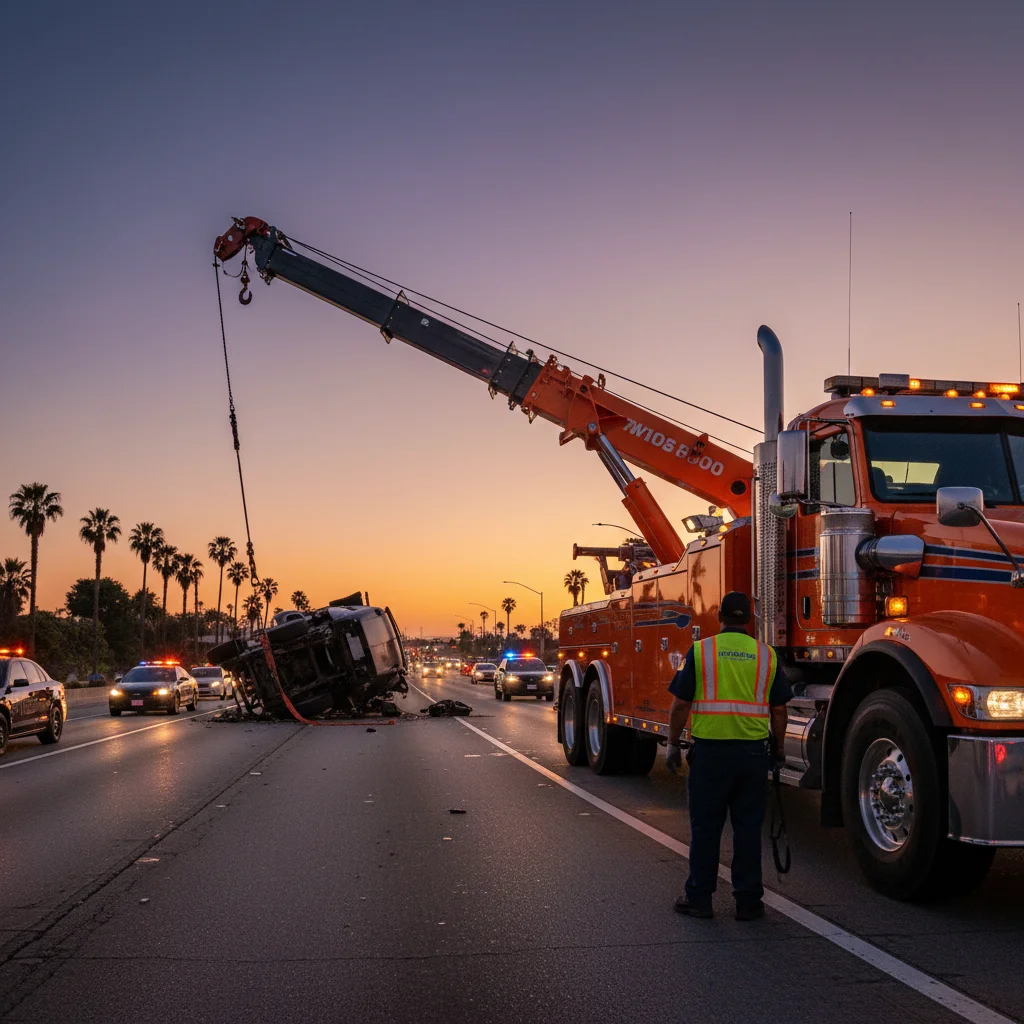
Semi truck towing in San Diego means dispatching specialized heavy-duty equipment: wheel-lifts rated for Class 8 loads, rotators for jackknife and recovery situations, and lowboys for equipment transport. Quick Tow SD connects you to that rotation network 24/7, with a flat rate quoted in writing before anything rolls. Whether your rig is upright on a freeway shoulder or needs a full recovery, you get the number in writing from the operator taking the job.
What counts as a semi or big rig for towing purposes
The weight threshold that defines commercial heavy-duty towing in California is 26,001 lbs gross vehicle weight rating. Anything above that line needs equipment specifically rated for the load.
That covers most combinations you’ll see on San Diego roads: Class 8 semi-tractors solo or with a trailer, tractor-trailer combinations (18-wheelers, flatbeds, reefers, tankers), dump trucks and concrete mixers above the threshold, and heavy construction equipment on a lowboy. Box trucks, sprinter vans, and large pickups often fall into medium-duty territory and use a cheaper equipment class.
If you’re not sure where your truck lands, the door-jamb placard lists the GVWR. Give that number to dispatch and we confirm the right equipment before it leaves the yard.
The equipment types and what each one handles
Heavy wheel-lift and integrated wrecker. The standard tool for an upright, disabled Class 8 tractor. The under-lift cradles the drive axles and the truck tows in a conventional position. Covers mechanical failures, fuel issues, and blowouts where the vehicle is stable and on pavement.
Rotator. A rotating-boom wrecker, typically rated at 50 to 75 tons, handles jackknifed trailers, overturned semis, and any recovery where a standard under-lift can’t reach the vehicle. The 360-degree boom lets the operator work angles a conventional wrecker can’t. Rotator work runs at higher rates because recovery takes longer.
Lowboy trailer. Heavy equipment that can’t roll on its own, bulldozers, cranes, compactors, gets moved on a lowboy. Lowboy moves often need route planning for height and weight restrictions on San Diego surface streets.
Tell dispatch what you have and where you are, and they’ll confirm which rig is coming.
Where breakdowns cluster in San Diego
San Diego’s freight geography concentrates commercial truck traffic on a few corridors, and those corridors are where breakdowns happen.
I-5 through Chula Vista and National City carries border-freight volume from the Otay Mesa Port of Entry north through downtown. Traffic density means a breakdown blocks lanes fast.
I-8 east of El Cajon is the route to El Centro. The grade climbs through the mountains and trucks slow significantly. Brake fade and overheating are common on the westbound descent. CHP runs a weigh station at the grade, and mechanical failures often show up shortly after weigh-in stops.
I-15 through Miramar and Escondido connects San Diego’s industrial parks to the Inland Empire. The curves near Miramar and the grade through Escondido both see regular semi incidents.
SR-905 and Otay Mesa is border-freight territory. Any breakdown near the port of entry creates an immediate logistics problem. For more detail on that specific corridor, see our post on heavy-duty towing in Otay Mesa.
Jackknife and recovery situations: what happens on scene
A jackknife happens when the trailer swings out of alignment with the tractor, usually on a grade, in a curve, or under hard braking. The combination locks up across multiple lanes and a rotator is almost always required.
The operator walks the vehicle first, checking the kingpin angle, trailer brake condition, and rigging points before touching anything. Then heavy chains and straps attach to rated recovery points. The boom pushes or pulls the trailer back into alignment until the combination can be towed conventionally. If the trailer is loaded, a freight coordinator may need to be on scene before the combination is legal to move. Tell dispatch upfront if there’s a loaded trailer involved.
For situations where a rig has left the roadway, the process is similar but longer. Our accident recovery service covers off-road and embankment extraction for commercial vehicles.
What to have ready when you call
Heavy-duty dispatch goes faster with specific information. Vague information means the wrong equipment rolls.
Tell dispatch: vehicle make, model, GVWR or axle count (a standard 18-wheeler is a 5-axle combination), load status and commodity (hazmat changes everything), your position by highway and nearest milepost, and whether the vehicle is upright or off the roadway. If CHP is already on scene, say so. Fleet operators should have the account number ready.
Pricing reality for commercial towing
Heavy-duty towing is quoted per job. The variables are equipment tier, tow distance, whether recovery is required before the tow, and wait time if CHP manages the scene. Our tow cost guide explains how the base math works for San Diego.
What we commit to: the quote is in writing before the truck rolls. No “the driver will tell you on scene” pricing. If the situation on scene requires a different equipment tier, we call with a revised quote before proceeding.
Fleet operators: motor carrier insurance and cargo policies often cover commercial towing. Confirm your coverage before authorizing work and ask us if you need documentation for a claim.
Long distance semi truck towing out of San Diego
Long distance semi towing is its own job class. A disabled rig that needs to reach a shop in Los Angeles, the Inland Empire, Yuma, or Phoenix rides behind a Class 8 wrecker the whole way, and the per-mile rate for heavy equipment runs several times the light-duty rate. Two things keep that bill sane: a written flat quote for the full route before the truck moves, and honest routing advice - sometimes the cheaper answer is a local tow to a San Diego heavy-truck shop instead of a 350-mile haul to your usual vendor.
The I-8 corridor east toward Imperial County and the I-15 north toward Barstow are the routes we see most. Both involve long grades that are exactly where rigs fail, and both have stretches where the nearest heavy-duty yard is an hour out. If your truck is down on one of those runs, tell dispatch the mile marker and the destination, and you’ll get the full-route number in writing. For how long-haul pricing works in general, see our guide to long-distance towing out of San Diego. If the rig can be fixed on the shoulder instead - a dead battery, fuel, or a winch-out - start with semi truck roadside assistance and skip the haul entirely.
Frequently asked questions
What is semi truck towing in San Diego? Semi truck towing in San Diego is the dispatch of heavy-duty equipment, wheel-lifts, rotators, or lowboys, to recover and transport Class 8 commercial trucks and tractor-trailer combinations. It requires different gear and different operator certification than passenger car towing. Quick Tow SD dispatches this equipment 24/7 with flat rates quoted before the truck rolls.
How much does big rig towing cost in San Diego? Big rig towing is quoted per job based on equipment tier, tow distance, and whether recovery is needed first. An upright-truck tow costs very differently from a rotator recovery of a jackknifed combination. We don’t post a number without knowing your situation. Call (858) 923-5787, give dispatch your vehicle details, and get a written flat rate before anything rolls.
Can a regular tow truck handle a semi or commercial truck? No. A standard flatbed or wheel-lift rated for passenger cars doesn’t have the boom capacity or axle ratings to legally move a vehicle over 26,000 lbs GVWR. Using undersized equipment risks cargo damage, frame damage, and liability. Class 7 and Class 8 vehicles need a rated heavy-duty wrecker or rotator.
Who do I call for 18 wheeler towing near me in San Diego? Call Quick Tow SD at (858) 923-5787. We connect you to a heavy-duty rotation network covering all of San Diego County, including the Otay Mesa freight corridor, I-5 through Chula Vista, I-8 through El Cajon, and I-15 through Miramar and Escondido. The line takes calls 24/7.
What happens if my semi jackknifed on a San Diego freeway? CHP will stage traffic control and may contact a rotation tow service. If you want to dispatch your own provider, call (858) 923-5787 immediately with your milepost and vehicle details. A rotator is typically required for jackknife recoveries. See our heavy-duty towing service page for what the process looks like from dispatch to destination.
Need a heavy-duty tow anywhere in San Diego County right now? Call (858) 923-5787. The line takes calls 24/7, and the operator taking the job quotes the rate in writing before the truck rolls.