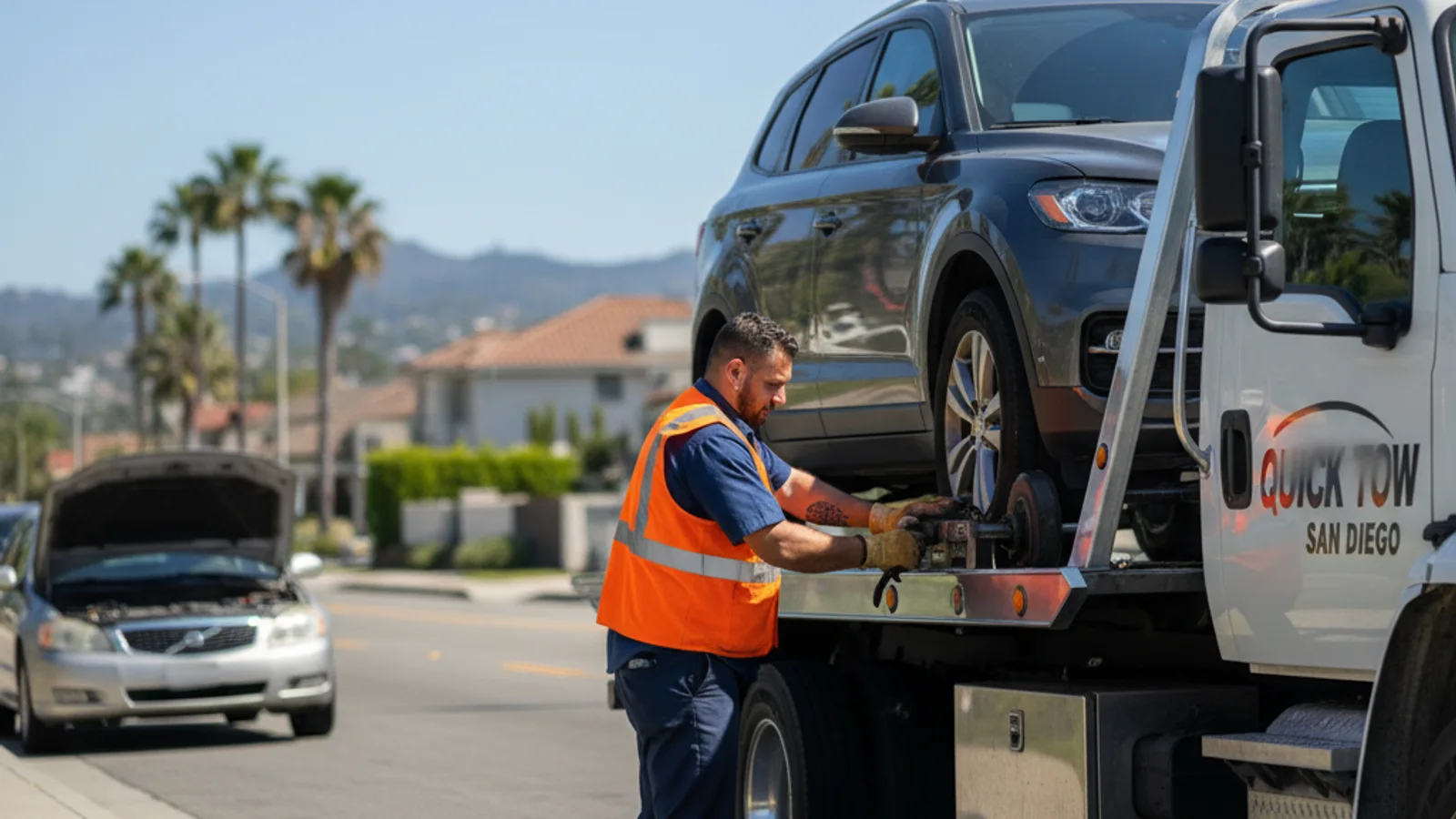
A recovery video that crossed 600,000 views in May 2026 opened on a stranded family in Arizona who’d called multiple tow companies. Every single one had said no. Some quoted impossible prices, some said they didn’t go that far out, some just didn’t answer the phone. By the time a real recovery crew showed up, it was a different conversation about why this happens.
We’re writing this because we get the same question every month from San Diego County drivers: “Three companies told me they couldn’t come. Are you actually going to come?” Yes. Here’s why some companies say no, and how to find one that won’t.
Quick Tow SD covers all 67 cities in San Diego County, including the remote desert areas around Anza-Borrego, the mountain corridors out toward Boulevard and Jacumba Hot Springs, and the canyon roads east of Alpine and Julian. The line takes calls 24/7, and the operator taking the job gives you an arrival estimate for your exact spot; backcountry addresses take considerably longer to reach than the urban core.
Stranded and getting no answers? Call (858) 923-5787. We’ll tell you on the phone whether we can come, when, and what it’ll cost, no surprises.
Source: Matt’s Off Road Recovery, No One In Arizona Would Rescue Them… Now I Know Why! (May 2026)
TL;DR
- Tow companies turn down calls for predictable reasons: wrong equipment, wrong location, wrong time of day, or wrong economics.
- The “we’ll come but it’s $1,500 cash up front” treatment is itself a kind of refusal, most stranded drivers won’t pay it and the company moves on.
- A legitimate operator should tell you upfront whether they can come, when, and what it’ll cost. The dispatcher who hedges or won’t quote is usually a company that’s going to refuse on arrival.
- For remote or unusual recoveries in San Diego County, ask three specific questions on the dispatch call: do you have the equipment, what’s your real ETA, and what’s the all-in price.
What was happening in the video?
A family was stranded with a vehicle that needed extraction from a remote area. The terrain wasn’t extreme by recovery standards, but it was far from any major town. The family called what they assumed would be the nearest tow companies. Some never answered. Some answered but quoted a price they couldn’t pay. Some said they’d come and then never showed.
When the actual recovery crew arrived, Matt’s team, which makes a YouTube channel out of doing the recoveries other operators won’t take, the family had been stranded for hours.
The recurring pattern: the smaller a town’s tow company is, the fewer specialty assets they have. They don’t have the off-road truck, the heavy-duty wrecker, the rotator, the long-distance flatbed. So when a call comes in that requires one of those, they decline. The customer interprets that as “no one will help me.” The reality is “no one within 50 miles has the right equipment.”
Why would a tow company refuse a call?
Five legitimate reasons. Plus one less-legitimate one.
One: wrong equipment. A small-town tow operator with one light-duty wrecker can’t handle a stuck 26-foot moving truck. They’re not refusing because they don’t want the work, they literally can’t do it. The right answer for them is to tell you that and refer you to someone who can. The wrong answer is to hang up.
Two: wrong location. Some operators have a hard radius around their dispatch base. Drive 50 miles past it and they don’t come. This is more common with smaller operators who can’t afford to have their one truck tied up for four hours. Larger fleets with multiple trucks have more flexibility.
Three: wrong time. After-hours pricing premiums exist for a reason, overtime labor, fewer trucks available, longer response. Some operators just don’t run an overnight shift at all. If you call at 2am and the operator’s drivers all went home, no one is coming.
Four: wrong vehicle. EVs need flatbed. Lifted trucks need flatbed and specific clearance. Heavy-duty needs heavy-duty equipment. RVs need wide-deck flatbeds. An operator without that specialty equipment can’t take the call.
Five: weather. When the wind is high and a tow truck operator estimates they’ll lose control of a load, they decline. Same for ice on the I-8 grade (rare but it happens) or flash flooding in Anza-Borrego.
The less-legitimate reason: economics. Some operators take the cherry calls, short distance, easy load, daytime, and decline the rest. The customer with the harder situation gets harder pushback. This is the version Matt’s video was documenting: companies that “answered” but priced the call at $1,500 cash, knowing the customer would balk and they wouldn’t have to actually go.
What should I ask when I call?
If you suspect you’ve called a “no thanks” operator, get them on the record. Three questions:
- “Do you have a [flatbed / heavy-duty wrecker / off-road truck] available right now?” Be specific about what you need. If they can’t give a yes/no, they’re probably going to say no on arrival.
- “What’s the realistic ETA?” Not “as soon as possible.” A real number. If they hedge (“could be one hour, could be three”), they’re not committing.
- “What’s the all-in price?” Base + per-mile + any after-hours surcharge + any specialty fee. If they can only quote the base and “we’ll figure out the rest when we get there,” they’re leaving themselves an out.
A legitimate operator answers all three. Quick Tow SD’s dispatch will tell you the equipment available, and the operator taking the job gives you an arrival estimate for your exact spot and a real price quote.
What if I’m somewhere remote in San Diego County?
We dispatch into:
- Anza-Borrego State Park and the surrounding desert
- Borrego Springs and the back roads
- Pine Valley, Boulevard, and Jacumba Hot Springs along the I-8 corridor
- Julian, Cuyamaca, and the Lagunas mountain areas
- Camp Pendleton and the Fallbrook / Bonsall rural areas
- Tecate and the border corridor
Response takes considerably longer than in urban San Diego, but someone will come. When you call, give us your exact location (GPS coordinates from your phone are ideal) and what’s wrong with the vehicle. We’ll quote a realistic ETA and price.
If we can’t help, which is rare but happens, usually when the situation requires equipment we don’t carry, we’ll tell you on the phone and refer you to an operator who can. We won’t hedge, won’t quote a “no thanks” price, and won’t take the call and ghost.
Frequently asked questions
What if I’ve called five companies and no one has agreed to come?
Call us at (858) 923-5787 and explicitly say “I’ve called five companies and they all said no.” That tells the dispatcher you’re in a non-standard situation and they should escalate to the on-duty supervisor. We’ll figure out whether we can help, and if not we’ll point you to who can.
What’s a normal price for a non-standard recovery?
Hourly billing is standard for unusual recoveries. Ask dispatch for the rate before you agree, it depends on the equipment required, plus mileage from our dispatch base. Heavy-duty work runs higher. An “all-in” quote on the phone should match the actual final bill within reason. If an operator quotes $300 and the bill is $1,200, that’s bait-and-switch and you can dispute it (see our Know Your Rights guide).
What if the operator demands cash up front?
Legitimate operators take payment after the service is complete, by credit card, debit card, or insurance billing. A “cash up front before we leave the yard” demand is a major red flag. Don’t pay it. Call another operator.
Can a tow company legally refuse to take my car?
In California, yes, except for emergency or police-rotation calls where they’re under contract. A private operator can decline any non-rotation call for any business reason. They’re required to tell you up front if they’re going to decline.
Can you handle a stranded driver in a place a GPS won’t help with?
Yes. If you can describe nearest landmarks, road junctions, mile markers, or even the name of a ranch or business nearby, we can dispatch. If you’re truly off-grid in a place even the maps don’t show, mention that, we’ll get an exact location by phone before launching.
Last updated: May 15, 2026.
Other companies turned you down? Call Quick Tow SD at (858) 923-5787 - calls taken 24/7, all 67 cities of San Diego County, an arrival estimate from the operator taking the job, no bait-and-switch.