Breaking down on the side of a busy San Diego freeway or even in your driveway is always a hassle. When you call for a tow, you might think any tow truck will do. But for many modern vehicles, the type of tow truck matters a lot. Using the wrong one can cause serious, expensive damage to your car or truck.
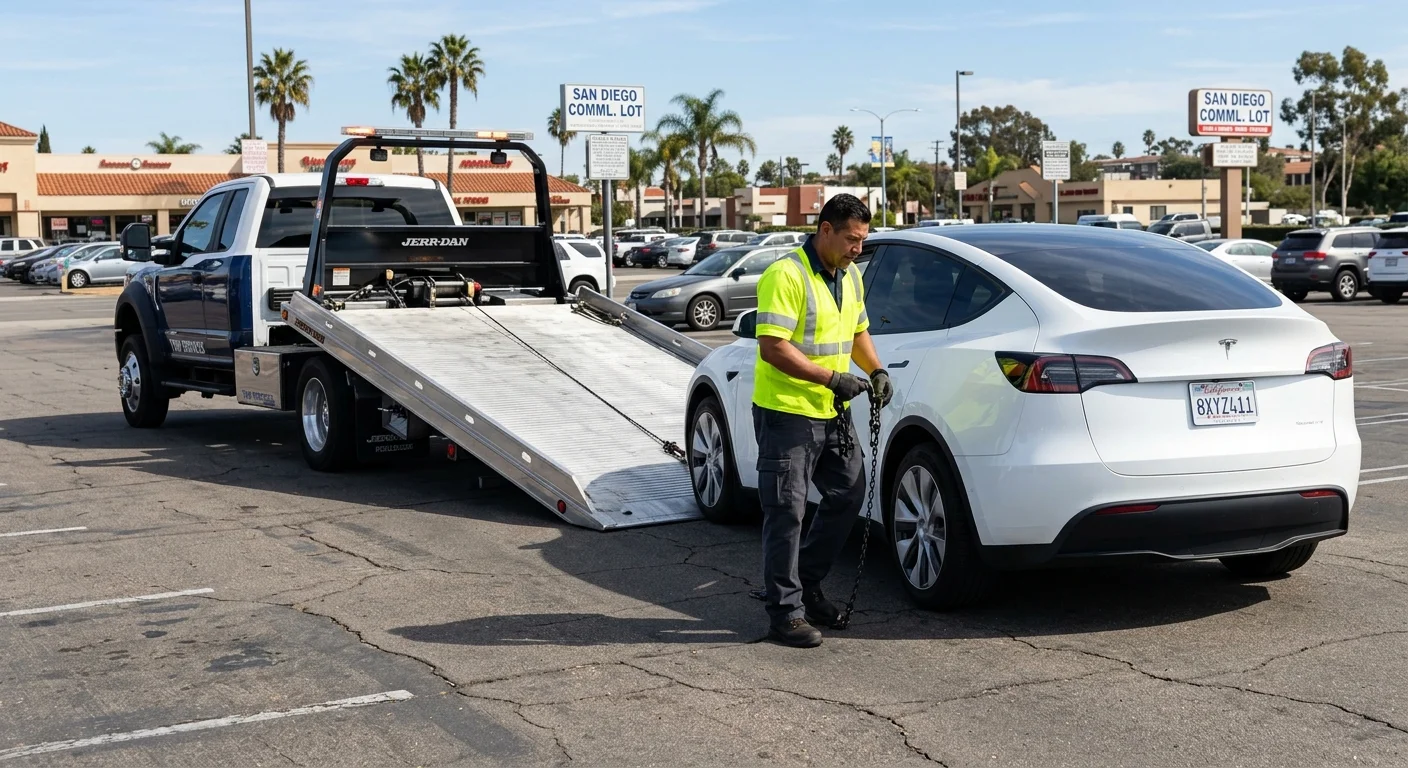
Knowing when your vehicle absolutely needs a flatbed tow can save you significant repair costs and stress. It’s about protecting your investment and ensuring your car gets transported safely. Let’s break down which cars and trucks must have a flatbed tow, and why it’s so important.
Why you can’t always use a standard wheel-lift tow truck
When you picture a tow truck, you might think of the classic wheel-lift model, which lifts two wheels of your vehicle off the ground, leaving the other two on the pavement. This method works perfectly well for many conventional front-wheel drive (FWD) or rear-wheel drive (RWD) cars in certain situations. For example, if you have a FWD car, lifting the front wheels and leaving the rear wheels on the ground means the drivetrain (transmission, axles) isn’t engaged or spinning. The same often applies to RWD cars when towed from the rear.
However, not all vehicles are designed to be towed this way. The critical factor is how your vehicle’s power train, the system that delivers power from the engine to the wheels, is configured. If any part of the drivetrain that’s connected to the ground wheels is forced to turn without proper lubrication or power, it can quickly overheat, grind, and cause severe damage. Modern vehicles are complex, and their mechanical and electrical systems are often very sensitive to how they’re moved when not under their own power. A flatbed tow truck completely lifts your entire vehicle onto a flat platform, ensuring all four wheels are off the ground. This eliminates any risk of drivetrain stress or damage. For a more detailed look at the differences, check out our guide on flatbed vs. wheel-lift towing.
All-wheel drive (AWD) and 4x4 vehicles: the transmission risk
One of the most common reasons a flatbed tow is essential is for vehicles equipped with all-wheel drive (AWD) or 4x4 systems. These vehicles are designed to send power to all four wheels, either constantly or on demand, to maximize traction. This capability comes from a sophisticated drivetrain that links all four wheels through components like a transfer case, differentials, and drive shafts.
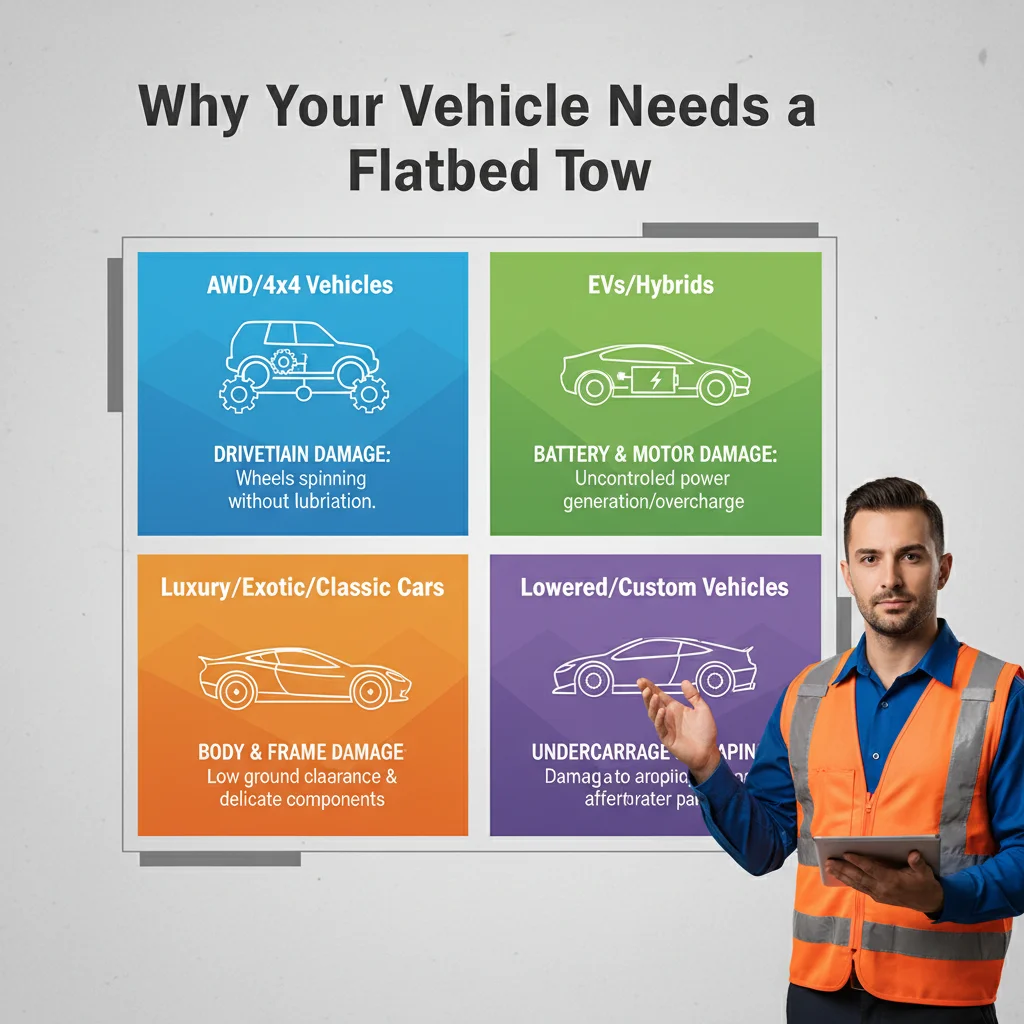
If an AWD or 4x4 vehicle is towed with only two wheels on the ground, those ground wheels will spin. Because they’re still connected to the rest of the drivetrain, this spinning forces components like the transmission, transfer case, and differentials to rotate without proper lubrication or the engine running. This creates immense friction and heat. Imagine trying to run a complex machine without oil – it wouldn’t last long. The result can be catastrophic damage to these expensive components, leading to thousands of dollars in repairs. To avoid this costly risk, any AWD or 4x4 vehicle must be transported on a flatbed tow truck, ensuring all four wheels are completely off the ground and no part of the drivetrain is forced to turn. Quick Tow SD offers dedicated flatbed towing to protect your specialized vehicle.
Electric vehicles (EVs) and hybrids: protecting the battery and motors
Electric vehicles (EVs) and hybrid cars represent another category where flatbed towing isn’t just recommended, it’s often a strict requirement from the manufacturer. These vehicles use electric motors and large battery packs as part of their propulsion system, and towing them incorrectly can have serious consequences.
Many EVs use regenerative braking, meaning that when the wheels turn, the electric motors can act as generators, sending power back to the battery. If an EV or hybrid is towed with its drive wheels on the ground (like with a wheel-lift), these motors can involuntarily generate electricity, even if the vehicle is powered off or inoperable. This uncontrolled energy generation can overcharge the battery, damage the motors, or overload the vehicle’s electrical system, potentially leading to overheating or even fire. Manufacturers like Tesla, for instance, specifically state in their manuals that vehicles must be transported on a flatbed to avoid damage to the high-voltage battery and powertrain components. To understand more about EV-specific towing needs, particularly for popular models, check out our guide on EV towing and Tesla flatbed requirements. For any electric or hybrid vehicle, the safest and only recommended method of transport is a flatbed tow.
Luxury, exotic, and classic cars: preventing body and frame damage
When you own a luxury, exotic, or classic car, you understand the value and delicate nature of your investment. These vehicles are not just transportation; they’re often collector’s items, high-performance machines, or works of art. Their design frequently includes specific features that make traditional wheel-lift towing risky.
Many high-end and older vehicles have very low ground clearance. This means the undercarriage, front bumper, or side skirts can easily scrape against the ground, the tow truck’s ramps, or even the tow bar itself during the loading process with a wheel-lift. Such scrapes or impacts can cause extensive and incredibly expensive cosmetic or structural damage. Furthermore, exotic and classic cars often feature specialized suspensions, delicate body panels, or unique frame designs that aren’t meant to endure the stresses of being lifted by just two wheels. Flatbed towing, by contrast, involves gently winching the entire vehicle onto a completely flat, stable platform. This method ensures no part of the vehicle’s body or undercarriage makes contact with anything other than the flatbed surface and the secure tie-down straps. It’s the method that keeps these vehicles off the ramps and off the tow bar entirely. For specialized care, Quick Tow SD offers exotic & classic vehicle towing services designed for these unique needs.
Lowered vehicles and cars with custom body kits
Similar to luxury and exotic cars, vehicles with custom modifications like lowered suspensions or aftermarket body kits also present unique challenges for towing. Owners often invest significant time and money into these aesthetic and performance enhancements, making their protection during transport a top priority.
A lowered suspension significantly reduces the distance between the vehicle’s undercarriage and the ground. This drastically increases the risk of scraping the front spoiler, side skirts, exhaust system, or oil pan when approaching the ramps of a standard wheel-lift tow truck. Even small inclines or bumps during transport can cause damage. Custom body kits, especially those with aggressive aero components, are often made from materials that can be brittle or easily cracked if stressed or scraped. A wheel-lift tow also requires specific hook-up points, which might not be accessible or safe on a heavily modified vehicle without risking damage to the bodywork or frame. A flatbed tow provides a perfectly level surface for loading and ensures that the entire vehicle is safely secured without any part contacting the ground or experiencing undue stress. This method is crucial for preserving the integrity and appearance of your custom ride.
Mention it up front if the car wears a wrap, a clear bra, or fresh paint, so the driver can plan the tie-down points. If the finish is what you’re protecting day to day, a San Diego shop like Paint Shield SD installs film on the front end and rocker panels, which is exactly where ramp scrapes and road debris land.
How to tell the tow company you need a flatbed
When you find yourself needing a tow, clear communication is your best defense against potential vehicle damage. Don’t assume the tow company will automatically send a flatbed; always be proactive. When you call Quick Tow SD, or any towing service, clearly state your vehicle’s make, model, and year, and specifically mention any relevant features like “all-wheel drive,” “electric vehicle,” “hybrid,” “lowered suspension,” or “custom body kit.”
Most importantly, explicitly request a “flatbed tow.” You can say something like, “I have an AWD SUV and need a flatbed tow, not a wheel-lift.” If your vehicle is in a particularly awkward position, or has a specific issue like a locked transmission or damaged wheels that prevent it from rolling, make sure to relay that information too. This helps the dispatch team send the correct equipment and the right kind of driver for your situation. At Quick Tow SD, we’re here to help you get the safest, most efficient transport for your vehicle, whatever its needs.
When to call us
If your vehicle needs towing in San Diego, especially if it falls into one of these categories requiring a flatbed, don’t hesitate. You need an experienced towing crew who understands how to properly transport your valuable asset. Call us at (858) 923-5787 for a same-day estimate.