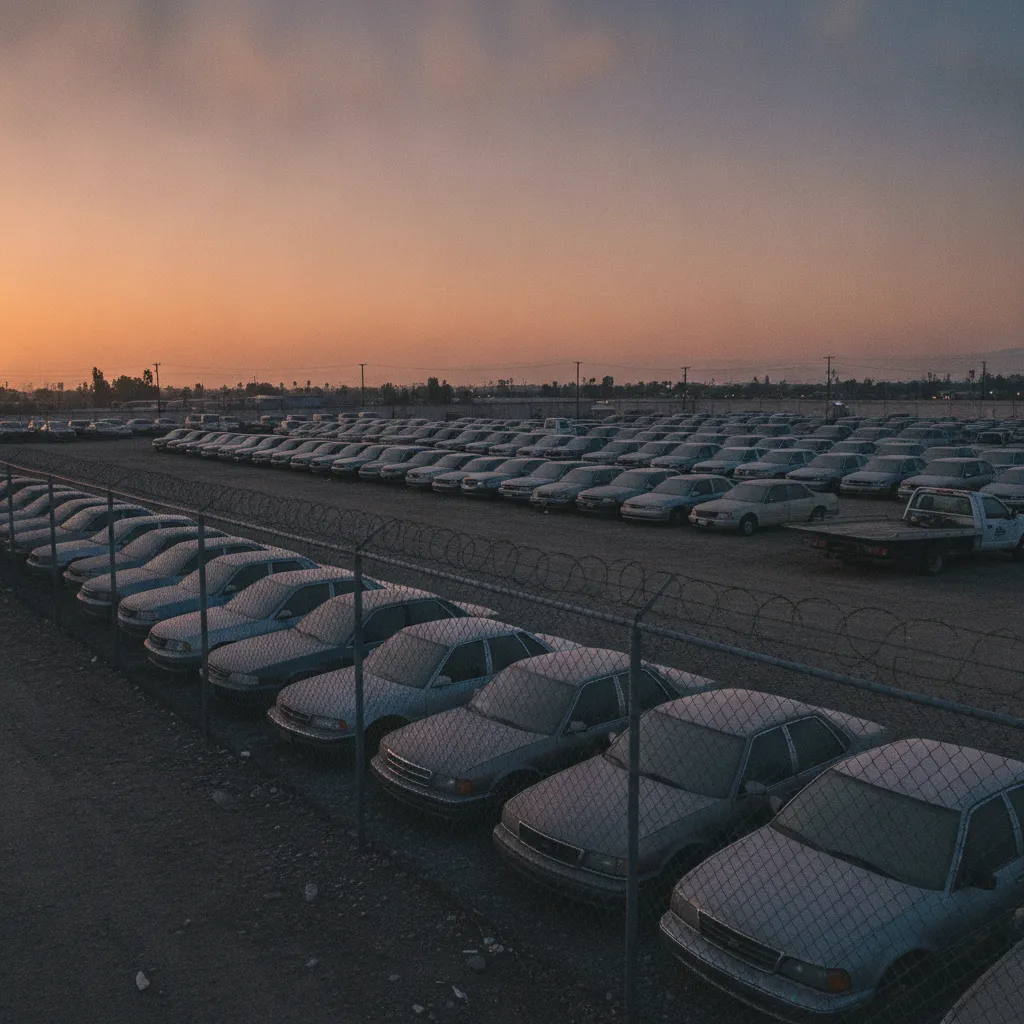
If you leave a car unclaimed at a California tow yard, storage charges may keep growing and the lienholder may begin a lien-sale process. Contact the yard now, request the current itemized bill, and act on the mailing date shown on any actual notice. California does not use one universal 30-day deadline for every vehicle.
A lien sale lets a business recover eligible repair, towing, or storage charges from a vehicle it possesses. It is not the same as a post-storage hearing about whether a tow was valid. It also does not mean a yard can sell the car without following the applicable notice process.
The procedure depends mainly on the vehicle’s assigned value. Vehicles valued at $4,000 or less follow one path. Vehicles valued over $4,000 generally follow another. Vehicles from self-service storage facilities use the higher-value procedure regardless of value.
Start with the yard, bill, and release requirements
Call the facility holding your car. Ask for the current total and an itemized invoice showing each charge. Also ask whether charges continue, how they are calculated, and what release documents remain outstanding.
California law requires covered storage facilities to provide an itemized invoice before payment. Paying the bill may not clear every hold. A release can also require identification, proof of ownership or authorization, and an applicable police release.
Do not rely on a general estimate from another San Diego yard. Check the actual itemized invoice from the facility holding your vehicle. The facility must explain the charges on that bill.
Gather these records before deciding what to do:
| Document or detail | What to check | Why it matters |
|---|---|---|
| Itemized invoice | Tow, storage, lien, and other listed charges | Shows what the yard says you currently owe |
| Release instructions | Identification, ownership papers, payment, and any agency release | Reveals what must happen before the car can leave |
| Lien-sale notice | Form number, vehicle value, sale date, and mailing date | Identifies the procedure and your response window |
| Envelope and postmark | The date the notice was mailed | Some deadlines run from mailing, not receipt |
| DMV vehicle record | Registered owner, legal owner, and address | Helps explain where required notices were sent |
| Sale paperwork | Proceeds, deductions, and any claimed balance | Needed if the vehicle has already been sold |
Photograph each document and keep copies of anything you send.
There is no universal 30-day waiting period
The California DMV’s lien-sale overview explains that vehicle value determines the procedure. Court judgment is one possible route in some disputed cases. It is not automatically required for every vehicle worth more than $4,000.
For towing and private-property impounds, the lien begins when the vehicle is towed. Separate filing and notice deadlines then apply. Those deadlines should not be confused with a guaranteed waiting period.
Special procedures can apply to certain abandoned vehicles, public-agency removals, and low-value vehicles. Read the form you received. If its procedure is unclear, ask the DMV which handbook section controls before assuming a general timeline applies.
Vehicles valued at $4,000 or less
For a vehicle valued at $4,000 or less, the lienholder does not need initial DMV authorization to begin the ordinary process.
The lienholder must request the vehicle record within 15 days after certain impound or private-property tows. A 30-day record-request period applies in other cases. These are filing deadlines for the lienholder, not promises that the vehicle will sit untouched for 15 or 30 days.
Under the DMV procedure for vehicles valued at $4,000 or less, the REG 668 notice is sent 31 to 41 days before the scheduled sale.
A person opposing the sale must sign and return the opposition to the DMV within 10 days of the notice’s mailing date. The clock does not start when you open the letter. Calling the yard alone is not the required DMV response.
A timely opposition stops the current authorization path. It does not erase the debt or permanently prevent every possible sale. The lienholder may pursue a court judgment, obtain a release of interest, or continue through another statutory route when permitted.
Vehicles valued over $4,000
A vehicle valued over $4,000 uses a DMV authorization process. The same procedure applies to vehicles from self-service storage facilities.
The initial DMV notice provides 10 days from its mailing date to oppose the sale. If authorization later moves forward, a REG 280 notice must be sent at least 20 days before the sale. These are different notices at different stages.
The DMV’s higher-value vehicle procedure also provides a 10-day redemption period after the sale. Redemption requires payment of the applicable costs and expenses, plus statutory interest. That after-sale right belongs to this procedure and should not be assumed for a vehicle in the lower-value process.
If you missed a deadline, get legal help promptly. Do not assume the debt disappeared or that no remaining option exists.
Personal belongings are handled separately
For an ordinary tow, California law generally allows the owner to retrieve personal property without paying towing or storage charges first. Retrieval is during normal business hours.
The facility must provide access information when requested. Exceptions apply, including different treatment for repossessed vehicles. The rule covers personal effects, not a promise that the vehicle itself will be released.
These protections appear in California Vehicle Code section 22651.07. Arrange access with the facility and bring identification or ownership documents.
What happens after a lien sale
Sale proceeds are applied under California’s lien-sale rules. A remaining balance may still be claimed in some towing cases, but liability is not automatic for every former owner.
Civil Code section 3068.2 sets conditions for tow-operator deficiency claims. It distinguishes registered owners and lessees, limits the storage included in certain claims, requires sale proceeds to be deducted, and includes protections involving prior transfers and insurers.
Ask for legal advice before accepting or disputing a claimed balance. Do not assume that paying one amount ends every possible obligation.
If a sale produces surplus money, the yard does not simply guarantee a refund to the former owner. The surplus is forwarded to the DMV. An interested person may submit a claim, and the DMV determines who is entitled to it. Civil Code section 3073 provides a three-year claim period from the date the money is deposited with the DMV.
Your next move
Request the bill, release conditions, and every lien-sale document today. Use the mailing date on the actual notice. Return any opposition through the method the DMV requires, not only through a call to the yard.
Quick Tow SD cannot release another facility’s vehicle, waive its lien, or manage the DMV process. Once the yard confirms the car is cleared for release, you can contact Quick Tow SD about possible transport by an independent licensed operator.