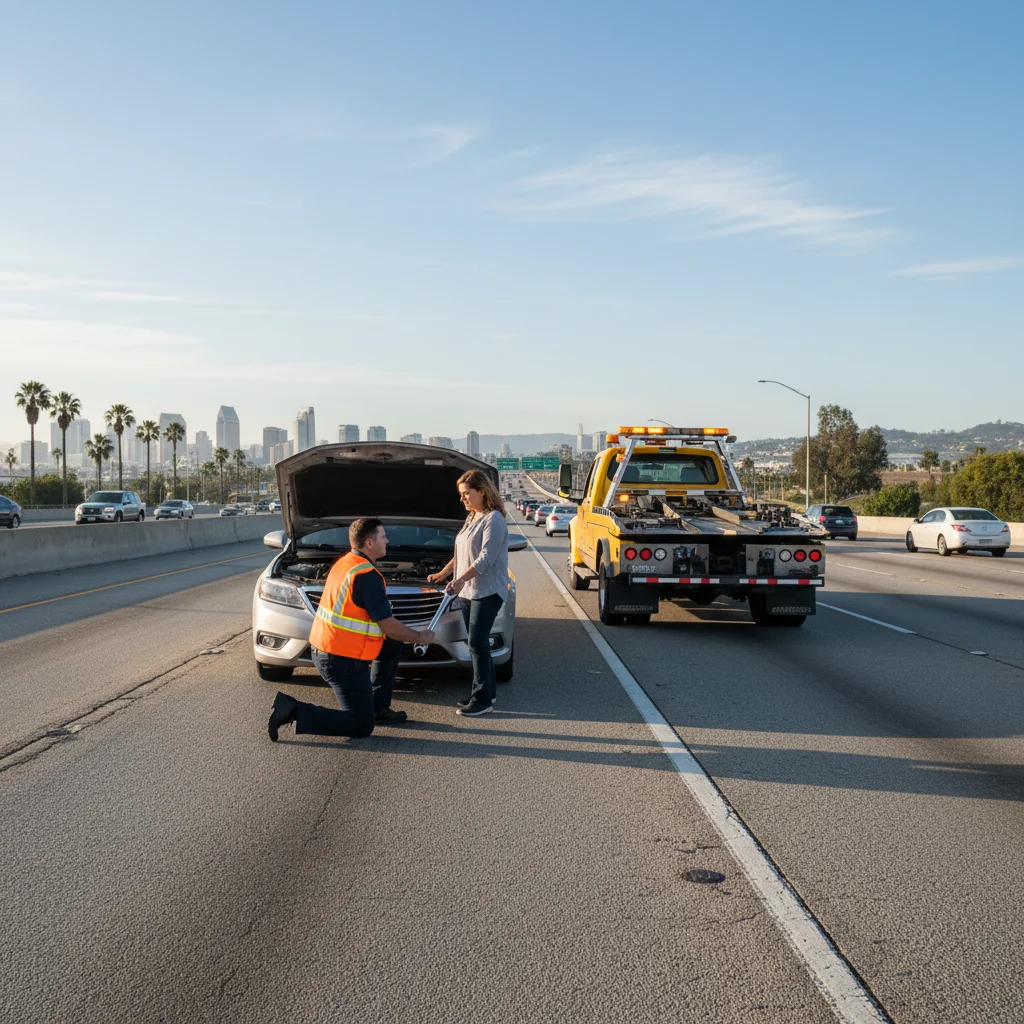
If your car breaks down on a San Diego freeway, turn on your hazard lights, steer to the right shoulder or the nearest exit, and get the car as far from traffic as you can. If you can’t safely get out, stay buckled inside the car. Then call for help: dial 911 or the California Highway Patrol if you’re in immediate danger, use San Diego 511 for traffic and roadside info, and watch for the Freeway Service Patrol, which assists disabled vehicles for free during busy hours. Once you’re safe, call a tow company for transport. Quick Tow runs 24/7 across San Diego County at (858) 923-5787.
That’s the short version. Below is the full plan, in the order you’ll actually need it.
What to do right now
- Turn on your hazard lights the moment you feel a problem.
- Steer right toward the shoulder or the nearest exit ramp.
- Get the car as far from moving traffic as the space allows.
- Put the car in park and set the parking brake.
- If you can’t safely exit, stay inside with your seatbelt on.
- If you can exit safely, get out on the side away from traffic.
- Stand behind a barrier or guardrail, never between your car and traffic.
- Call for help: 911 or CHP if you’re in danger, 511 for info.
- Call a tow company to get the car off the freeway.
Immediate safety steps
Your first job is to lower your exposure to fast traffic. Everything else waits.
Hit the hazard lights right away. They tell every driver behind you that your car is disabled, and they matter most in fog, rain, or after dark. San Diego freeways like the I-5, I-15, and I-805 move fast even in light traffic.
Steer to the right shoulder as you slow down. Aim for the widest part you can reach. If an exit is close and you can get there, a side street is safer than any shoulder. Some routes, like SR-52 and SR-56, have narrow shoulders, so get as far right as the space lets you.
Don’t brake hard in a live lane. Coast to a controlled stop instead. Once you’re stopped, set the parking brake and leave the flashers on.
Do and don’t on a freeway shoulder
| Do | Don’t |
|---|---|
| Turn on hazard lights immediately | Stand between your car and traffic |
| Get as far right as the shoulder allows | Try to repair the car in a live lane |
| Stay buckled if you can’t exit safely | Exit on the traffic side of the car |
| Exit on the side away from traffic | Walk along the shoulder in fast traffic |
| Stand behind a guardrail or barrier | Accept rides from strangers who stop |
| Call CHP or 911 if you’re in danger | Cross multiple freeway lanes on foot |
| Keep your phone charged for the tow call | Assume passing drivers can see you |
How to call for help in San Diego
San Diego gives you a few ways to get help on the freeway. Use the one that fits how urgent your situation is.
Freeway Service Patrol (FSP). San Diego freeways are covered by the Freeway Service Patrol, a network of roving tow and service trucks that help disabled vehicles during the busy commute hours at no charge. FSP drivers can change a flat, jump a battery, add coolant, or move your car to a safer spot. If you’re stuck during peak traffic, an FSP truck may reach you before anyone else. You don’t have to flag one down, but raising your hood signals that you need help.
San Diego 511. Dial 511 from any phone for San Diego’s regional traffic and roadside information line. It’s the quickest way to get current freeway conditions and point you toward the right roadside resource. Save it in your phone now, before you ever need it.
CHP and 911. If your car is stuck in a live lane, there’s a fire, someone’s hurt, or you feel unsafe, call 911 right away. The California Highway Patrol handles freeway emergencies and can dispatch help fast. When you’re safely on the shoulder and out of immediate danger, you can reach CHP or go straight to a tow company.
When you call any of them, have this ready: the freeway name, your direction of travel, the nearest exit or cross street, your car’s make and color, and a short note on what went wrong.
When to stay in the car vs get out
The safest place is usually inside the car with your seatbelt on, especially on a narrow shoulder. A buckled seatbelt protects you if another vehicle clips your car from behind. Lock the doors, stay calm, and watch traffic while you wait.
Get out only when staying in is more dangerous than leaving. That means fire, smoke, a fuel leak, or a stopped position where a rear-end hit looks likely. If you do exit, leave through the door on the side away from traffic, then move behind a guardrail or up an embankment. Never stand between your car and oncoming traffic, and never try to cross lanes on foot.
If your car dies in a travel lane and you can’t move it, leave the hazards on, call 911, and only step out if you can reach a barrier without walking into traffic.
Getting a tow off the freeway
Once you’re safe and help is on the way, you still need the car moved off the freeway. A tow company handles the transport that FSP and CHP don’t.
Call a 24/7 towing service and give your exact location. Quick Tow covers all of San Diego County, from the coast in La Jolla and Carlsbad to inland Escondido and El Cajon, and out to the mountains near Julian. The line takes calls around the clock at (858) 923-5787, and the operator taking the job gives you an arrival estimate when you call.
Tell the dispatcher what you’re driving. All-wheel-drive and four-wheel-drive cars, plus every electric vehicle, need a flatbed so the wheels stay off the ground. Towing those the wrong way can damage the drivetrain. A good dispatcher will send the right truck the first time. See our guides on emergency towing and accident recovery if your breakdown followed a crash, and our overview of towing service across San Diego County.
While you wait, stay buckled, keep your phone charged, and don’t attempt repairs on the shoulder. For more on this exact scenario, read our deeper guide on a freeway breakdown in San Diego and our rundown of who to call to tow your car in San Diego.
How to prevent freeway breakdowns
Most freeway breakdowns trace back to a few things you can catch early.
Keep your tires checked. Heat and worn tread cause blowouts, and the long grades on the I-8 east toward the desert are hard on tires. Check pressure monthly and replace tires before they’re bald.
Watch your temperature gauge. Inland heat on the I-15 drives overheating, especially on climbs in summer. If the gauge spikes, ease off and pull over before the engine fails.
Stay on top of the basics. Fresh oil, a healthy battery, and a working alternator prevent most roadside stalls. Batteries fade fast in San Diego summers.
Keep a small kit in the trunk: a phone charger, water, a flashlight, and reflective triangles. Save (858) 923-5787 and 511 in your phone now, so you’re not searching for a number on the shoulder.
Frequently asked questions
What should I do if my car breaks down on a San Diego freeway?
Turn on your hazard lights, steer to the right shoulder or nearest exit, and get as far from traffic as you can. Stay buckled inside if you can’t exit safely. Then call 911 or CHP if you’re in danger, dial 511 for roadside info, and call a tow company to move the car.
Should I stay in my car on the freeway?
Usually yes. Staying buckled inside is safest on a narrow shoulder, since a seatbelt protects you if another vehicle hits your car. Get out only for fire, smoke, a fuel leak, or if a rear-end hit looks likely, and then exit on the side away from traffic and stand behind a barrier.
Who do I call when stranded on the freeway in San Diego?
Call 911 or the California Highway Patrol if you’re in immediate danger or stuck in a lane. Dial 511 for San Diego traffic and roadside info, and watch for a Freeway Service Patrol truck during busy hours. For a tow off the freeway, call Quick Tow at (858) 923-5787, available 24/7 countywide.
Is Freeway Service Patrol free?
Yes. The Freeway Service Patrol helps disabled vehicles on San Diego freeways at no charge during peak traffic hours. Its drivers can change a flat, jump a battery, add coolant, or move your car to a safer spot. They don’t provide long-distance towing, so you’ll still call a tow company to get the car home or to a shop.
How do I find my location on the freeway to give the tow company?
Note the freeway number, your direction of travel, and the nearest exit, cross street, or green mile-marker sign. Many phones can share a live location pin with the dispatcher. The more exact your spot, the faster the tow truck reaches you.
When your car breaks down on a San Diego freeway, get safe first, call for help, and then get the car towed off the road. Quick Tow is here 24/7 across the county. Call (858) 923-5787 or see our emergency towing service.