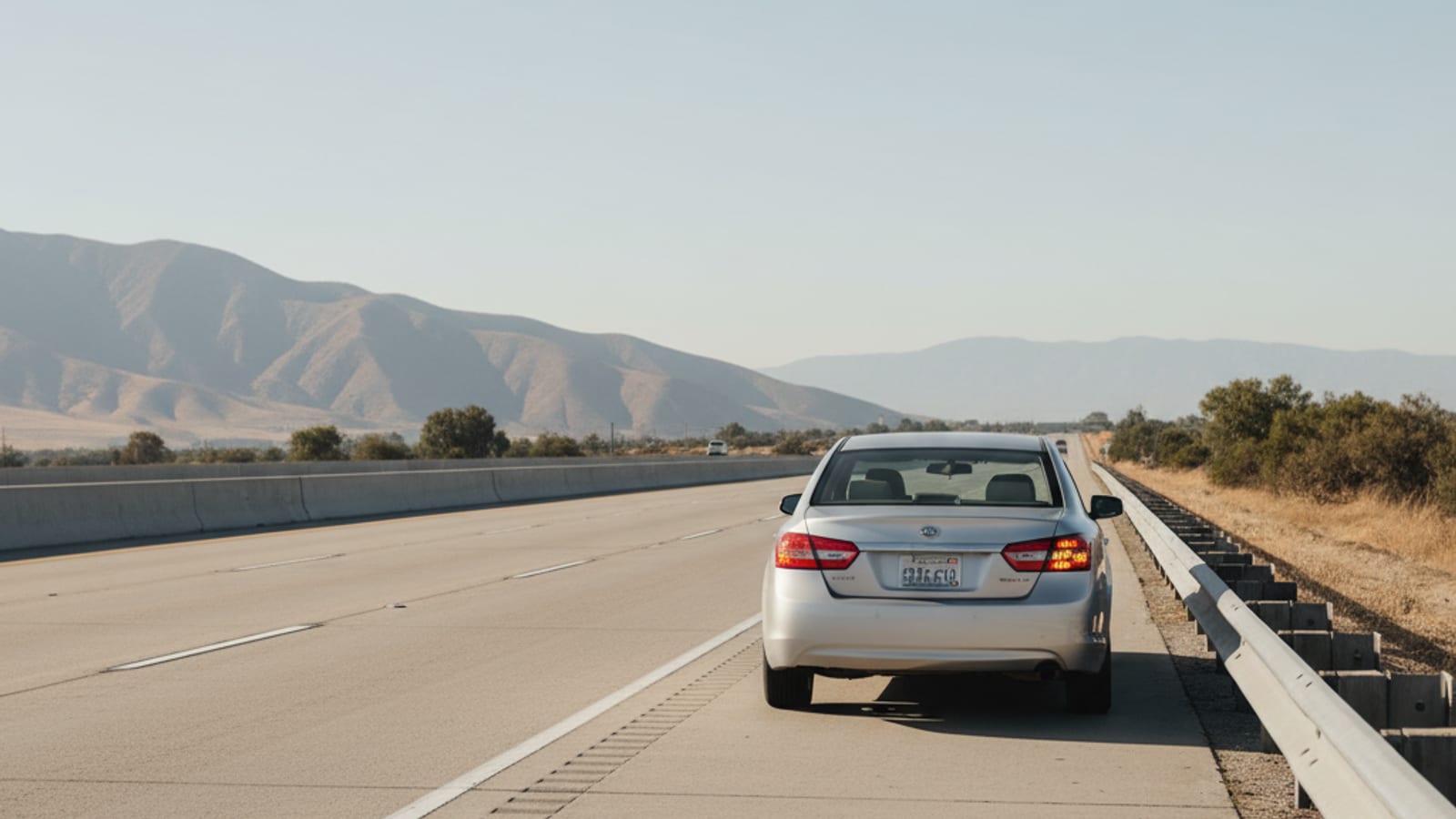
TL;DR
- If your car will still move, take the nearest exit. A surface street is 10x safer than a freeway shoulder.
- If you’re stuck on the shoulder: hazards on, steer as far right as possible, stay inside the car with seatbelts on. Most injuries happen when people get out on the traffic side.
- Call 911 for emergencies, #399 for non-emergency CHP on California freeways, or your insurance/tow company. Have your mile marker and direction of travel ready.
- Save a tow company number in your phone now. Googling from a shoulder at 70 mph is its own danger.
San Diego has some of the busiest freeway shoulders in the country. I-5 through downtown, I-15 through the inland corridor, I-8 over the grade, I-805 along the border - every one of them sees a dozen breakdowns a day, and every year dozens of people get seriously hurt trying to do the right thing on the shoulder. Here’s the sequence that keeps you safe.
Minute 1: Get off the travel lane
If the car will still move and there’s an exit within a mile, take the exit. A dead battery that cranks weakly will usually get you off the freeway. A flat tire will survive a mile of limp-mode driving if you keep it under 30 mph and stay off the shoulder. A check-engine light or overheating alert gets at least a mile before it matters.
An exit onto a surface street is 10x safer than the shoulder.
If you can’t make an exit, aim for the widest possible shoulder. The right shoulder on I-5 through SD is 10 feet wide. The right shoulder on I-15 narrows to 6 feet in some spots. Cross traffic to the right shoulder if it’s wider than the left. In a real emergency - imminent fire, brake failure, engine smoke - stop wherever you can and call 911 before a tow.
Minute 2: Hazards on, position the car
- Turn on hazard lights immediately. Not after you stop, while you’re still rolling to a stop.
- Steer as far right (or left) on the shoulder as possible. Every foot matters. Tuck the car against the guardrail or wall.
- Turn the front wheels toward the shoulder. If the car gets rear-ended, you don’t want it launched into traffic.
- Leave the engine running if you can. Running engine means running hazards. If the battery is dead, switch the headlights on - any light is better than none.
Minute 3: Stay in the car. Stay in the car. Stay in the car.
This is where most injuries happen. People get out to “check the damage,” stand behind the open trunk, or try to change a tire on the traffic side of the vehicle.
Don’t.
- If you are on an interstate freeway shoulder in SD, stay inside the vehicle with seatbelts on.
- Seatbelts on in case of rear-end impact.
- Do not stand on the traffic side of the car. Period.
- Do not try to change a flat tire on the traffic side.
- Do not walk along the shoulder unless you are 100% certain there is no safe way to wait.
Vehicles pass you at 70+ mph three feet from your door. The safest place is the drivers seat.
Minute 4: Call for help
In this order:
- 911 if there’s any injury, fire, smoke, or immediate danger. CHP will respond.
- #399 from any cell phone for non-emergency CHP on California freeways. They can dispatch FSP (Freeway Service Patrol) or route a tow.
- Your insurance/motor club if you have roadside coverage. They’ll dispatch a tow.
- A private tow company if you don’t have coverage. Call a company that offers 24/7 emergency towing and can confirm truck type and ETA on the phone.
If you’re driving an EV and simply ran out of charge, you may not need a tow at all. Charge Pro SD offers mobile EV charging across San Diego County and can sometimes get you back on the road faster than a flatbed.
Have these ready when you call:
- Your exact location. Mile marker (on the green shoulder signs) is best. “Southbound I-5 at mile 16.2” pinpoints you. “Near the Genesee exit” is second best.
- Which direction you’re traveling (north, south, east, west)
- Vehicle year, make, model
- What happened (dead battery, flat, engine, accident)
Minute 5-6: Deploy a triangle - if safe
If you have a roadside emergency triangle and the shoulder is wide enough to stand safely 30+ feet behind your car, deploy it. That buys other drivers 200 extra feet of warning.
If the shoulder is narrow or you’d be standing near traffic, skip this step. A triangle isn’t worth your life.
Never try to “wave drivers over” with a flashlight or shirt. Drivers at 70 mph don’t process those signals. A triangle with reflective tape does.
Minutes 7-10: Wait safely
- Stay buckled. Leave the engine running. Keep hazards on.
- Lock the doors on both sides. Crack a window on the non-traffic side if you need air.
- Check mirrors every 30 seconds. If traffic behind you is slowing too late, you can honk and flash high beams as a warning. Most freeway rear-ends on shoulders happen because a distracted driver doesn’t see a parked car until they’re on top of it.
- Keep your phone charged. The dispatcher will call back with updates; missing the call can add 30 minutes to your wait.
What should you tell the tow driver when they arrive?
The driver will pull up in front of or behind you with their work lights on. When they arrive:
- Stay in the car until they come to your window.
- They’ll walk through the situation with you - vehicle year/make/model, where it’s going, how you’re paying.
- Roll the window down to talk; don’t get out on the traffic side. They’ll either come to you or direct you to their cab.
- They’ll load the car with soft straps (flatbed) or wheel-lift yoke. Most standard FWD sedan hookups take 5-8 minutes on a shoulder; flatbed on AWD/EV runs 10-15.
During loading, you can get out on the non-traffic side only and stand well off the shoulder - up on the grass or berm beyond the white line. Watch from there, not from behind the car.
What are the red flags of an unsafe shoulder tow?
A legit tow operator won’t:
- Ask you to help push, steer, or signal from the traffic side
- Tell you to step onto the shoulder
- Refuse to use soft straps on your AWD or EV (“chains are fine” - no they aren’t). Proper roadside assistance always uses the right equipment
- Quote you a different price at the shoulder than what dispatch said
Push back. If anything feels off, call dispatch and ask for a different driver.
What should you do after the tow?
Get to a safe surface-street lot. From there:
- Verify the destination is correct (shop, dealer, home address)
- Photograph the vehicle again - all four sides
- Get the driver’s ID, company name, and receipt
- Call your insurance to document the tow for reimbursement if applicable
One number to save in your phone
SD County 24/7 towing: (858) 923-5787. Not because we want all the calls - but because if you don’t have a number before you need it, you end up Googling from the shoulder, which is its own danger.
Whatever company you save, make sure:
- They answer live, 24/7
- They’ll quote flat on the phone
- They’ll tell you which truck is coming and why
We respond to freeway breakdowns across San Diego County: I-5 through Oceanside and Carlsbad, I-15 through Escondido and Poway, I-8 through El Cajon and La Mesa.
Related reading: If the breakdown started with a collision, our post-accident checklist covers every step from the scene through the insurance claim. Think the battery might just be dead? How to jump-start a car walks you through the process safely - and when to skip it and call for a tow instead. Want to avoid this scenario entirely? Our winter roadside prep guide covers the kit and checks that prevent most shoulder calls. For pricing on the tow itself, see our San Diego tow cost guide.
Frequently asked questions
How long does it take for a tow truck to reach me on a San Diego freeway?
Response time in San Diego County depends on where you are and what is on the road. Freeway breakdowns during rush hour on I-5 or I-15 can take longer due to CHP coordination and traffic. Having your mile marker ready when you call speeds up dispatch.
Is it safe to change a flat tire on the freeway shoulder?
Generally, no. Standing on the traffic side of your car with vehicles passing at 70+ mph is extremely dangerous. Unless the shoulder is very wide and you can work entirely on the non-traffic side, call a tow instead. The cost of a tow is far less than the risk.
What does CHP Freeway Service Patrol do?
FSP is a free CHP-sponsored service that patrols busy San Diego freeway segments during peak commute hours. They can help with minor issues like dead batteries, flat tires, and overheating. Dial #399 from any cell phone to reach CHP non-emergency and ask about FSP availability on your corridor.
Should I get out of my car on the freeway shoulder?
Stay inside with your seatbelt on. Most shoulder injuries happen when people exit the vehicle and stand near traffic. Only get out on the non-traffic side if directed by a tow driver or officer, and move well beyond the white line onto grass or berm.
Save ours now so it’s there when you need it.