A crash or slide-off on a Poway road is disorienting. You’re on the shoulder, or worse, down an embankment, and you’re not sure who to call or what happens next. Here’s exactly what to expect when you reach out for accident recovery and winch-out services.
What accident recovery actually involves
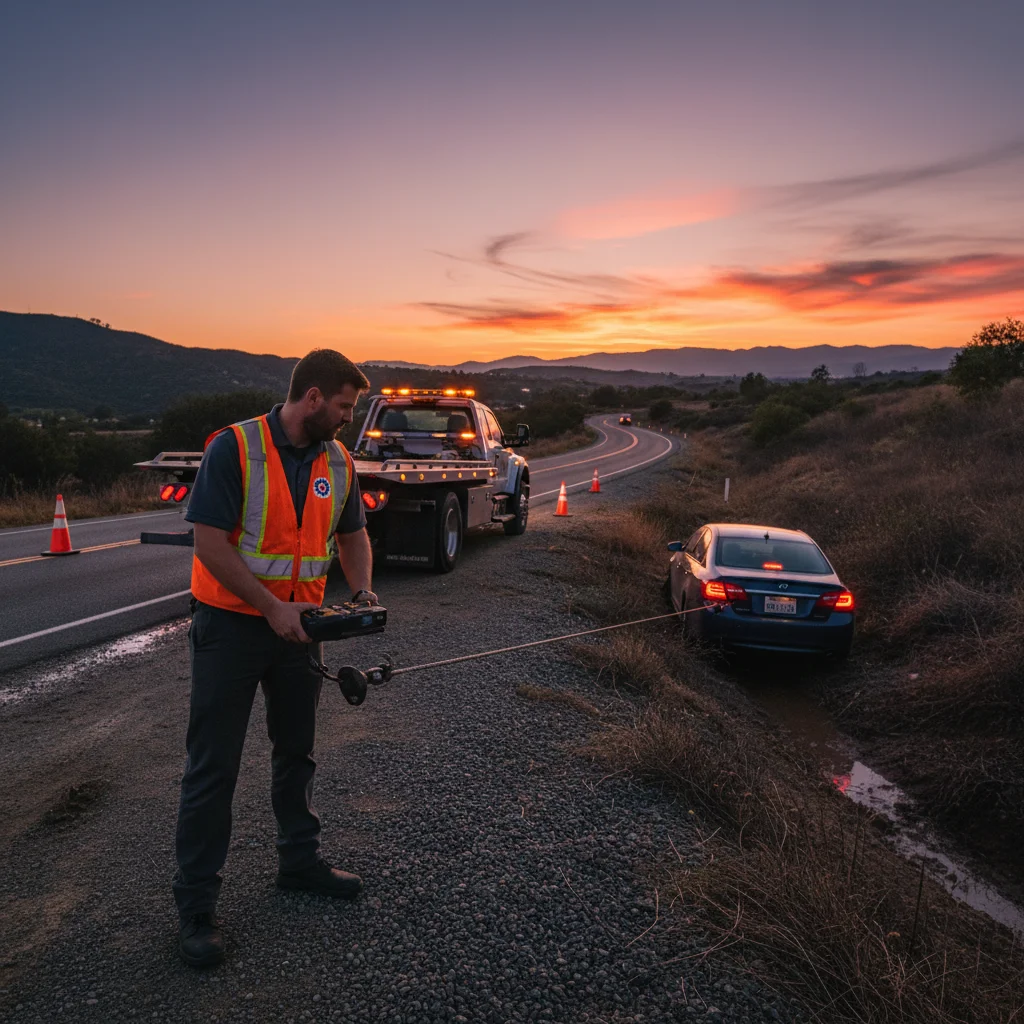
“Accident recovery” covers more than just towing. It’s the process of safely extracting a vehicle from an uncontrolled position, a ditch, a curb, a hillside, another lane, and making it ready to either drive or transport.
A standard tow assumes the vehicle is on pavement, facing forward, with all four wheels accessible. Accident recovery doesn’t get that luxury. The car might be on its side, nose-down in a drainage channel, or wedged against a guardrail. The driver might still be in it.
The process typically looks like this:
- Scene assessment. The operator checks stability, is the ground soft? Is the vehicle on a slope? Are there fuel leaks or live airbags?
- Rigging. Straps or chains attach to the vehicle’s frame recovery points, not bumpers or tow hooks.
- Extraction. The winch or wrecker pulls the vehicle to a stable surface.
- Secondary inspection. Once upright and on flat ground, we check whether it can be driven or needs to be loaded.
Depending on severity, recovery can take 20 minutes or over an hour. Complex jobs, vehicles down steep canyon walls, for example, may require a heavy-duty wrecker rather than a standard flatbed. If you’re not sure what you’re dealing with, our emergency towing team can triage by phone before we dispatch.
Poway hot spots: Scripps Poway Pkwy, Poway Rd, and the canyons
Poway’s road layout creates specific problem zones that show up repeatedly on recovery calls.
Scripps Poway Parkway runs fast, 55 mph through stretches that narrow and curve without warning. The shoulder drops away in places, and wet pavement after even light rain makes the transition from asphalt to dirt abrupt. If a vehicle slides off here, it often lands in shallow brush with at least one wheel off the ground.
Poway Road between Espola and Poway Town Center sees heavy stop-and-go traffic that leads to rear-end collisions, particularly near the Midland Road and Community Road intersections. Impact speeds are low, but vehicles routinely end up on curbs or against center medians in positions that require winching rather than driving out.
The canyons off Garden Road and Twin Peaks Road are the most serious. The grades exceed 10% in spots. If a vehicle drifts off the road edge on one of these canyon routes, it can travel a significant distance downhill before stopping. These jobs need a wrecker with a long-line winch, sometimes 200 feet or more, and a spotter on the slope.
Aubrey Street near Poway High and the Old Poway Park area see parking-related incidents: drivers misjudging driveway transitions, rolling over raised curbs, or getting a wheel stuck in a drainage inlet. These are typically straightforward, but the tight residential streets make equipment access tricky.
If you’ve had a prior issue somewhere in Poway and want general towing information for the city, our Poway towing guide covers the broader picture.
Winch-out vs. full recovery: knowing the difference
These two terms get used interchangeably, but they mean different things, and the difference affects cost and time.
A winch-out is a simple extraction. The vehicle is stuck but otherwise intact and undamaged by the incident. Think: drove off the road on soft ground, slid into a ditch at low speed, or got a wheel over a curb edge. The winch pulls the vehicle back onto the road. A quick inspection, and you may be able to drive away. Total time on scene: 15–25 minutes.
Full accident recovery is more involved. The vehicle has been damaged, may be in an unstable position, and almost certainly needs to be transported rather than driven. Airbags may have deployed. Fluid leaks are possible. The operator has to rig carefully to avoid making structural damage worse. Once extracted, the vehicle goes on a flatbed. You’re not driving it anywhere that day.
The practical test: if the car was drivable before it left the road and nothing hit it, you probably need a winch-out. If there was a collision, rollover, or significant drop, you need full recovery.
What to do in the first 10 minutes after a crash
The decisions you make right after impact affect everyone’s safety, including the tow crew arriving later.
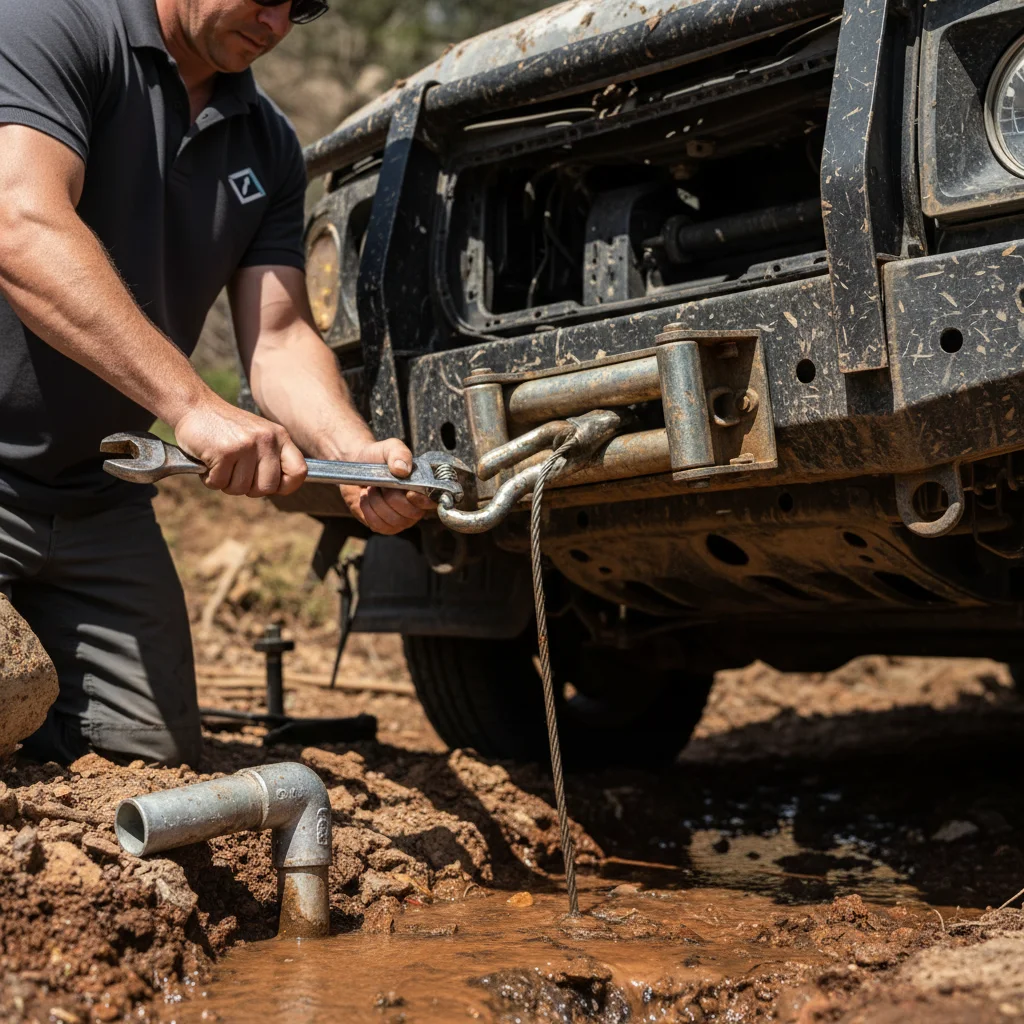
1. Check yourself and passengers first. Don’t move the car yet. If anyone is injured, call 911 before anything else. The NHTSA’s roadside safety guidelines are clear: get people away from traffic before you deal with the vehicle.
2. Hazard lights on immediately. Even if the car is severely damaged, try the hazard switch. Visibility buys you time.
3. Get off the road if it’s safe. Move to a guardrail side, not toward traffic. Stay behind the vehicle, not in front of it.
4. Don’t try to move the car yourself. If it’s stuck or in an unstable position, shifting it without proper rigging can cause additional damage, or tip it further. Wait for the recovery crew.
5. Photograph everything before the tow. Position of the vehicle, road conditions, any damage to barriers or markers. Your insurance adjuster will want this.
6. Call the tow company directly. You don’t have to wait for law enforcement to dispatch a tow. In California, you have the right to choose your own tow provider. If you’re on a Poway surface street, not a CHP-managed freeway, that choice is entirely yours. See the CHP tow service policy for how rotation calls work on state highways.
For a more detailed post-crash checklist specific to California, our guide on what to do after a car accident in San Diego walks through insurance and documentation steps.
Costs, insurance, and who pays
Recovery towing costs more than a standard tow. That’s not padding, it reflects equipment wear, rigging time, and crew risk.
A basic winch-out in Poway typically runs $150–$250 depending on how deep off-road the vehicle is and how long the setup takes. Full accident recovery, wrecker deployment, extended winch work, flatbed transport to a shop, can run $350–$600 or more for complex extractions.
Who pays? That depends on fault and your coverage.
- If the accident was the other driver’s fault, their liability insurance covers your tow under property damage.
- If you’re at fault (or it’s a single-vehicle incident), your collision coverage usually includes towing and recovery. Check your declarations page for “towing and labor”, this is a separate add-on some people drop to save money.
- If you have AAA or a similar roadside program, they cover some towing costs up to a mileage limit. Complex recoveries sometimes exceed what AAA dispatches for, call ahead to confirm.
One thing worth knowing: if CHP or a sheriff’s deputy dispatches a tow on a public road, California law caps certain fees through the rotation program. But if you call a tow company directly, rates are set by the company. Ask for a written estimate before authorizing work. Our post on who pays for a tow after an accident covers the insurance side in detail.
How fast we reach Poway calls
Poway sits roughly 25 miles northeast of downtown San Diego. How quickly a Poway location gets reached depends on the time of day and where exactly the call originates, and the operator taking the job tells you what to expect.
Scripps Poway Pkwy calls near SR-67 run a little longer during the evening commute, that interchange backs up. Calls closer to Poway Road and the 15 corridor are generally faster.
We’re available around the clock for 24/7 roadside assistance in Poway. Night calls don’t carry a different rate, dispatch time is roughly the same regardless of hour because Poway’s roads clear out significantly after 9 p.m.
We’ll give you an honest ETA when you call. If a job ahead of yours is running long, we’ll tell you rather than guess.
When to call us
Accident recovery and winch-outs aren’t DIY jobs, improper rigging tears bumpers off, pulls suspension components loose, and can tip an already-unstable vehicle further. If your car is off the road, down a grade, against a barrier, or otherwise stuck after any kind of impact, you need an experienced recovery operator with the right equipment.
Call us at (858) 923-5787 for a same-day estimate.