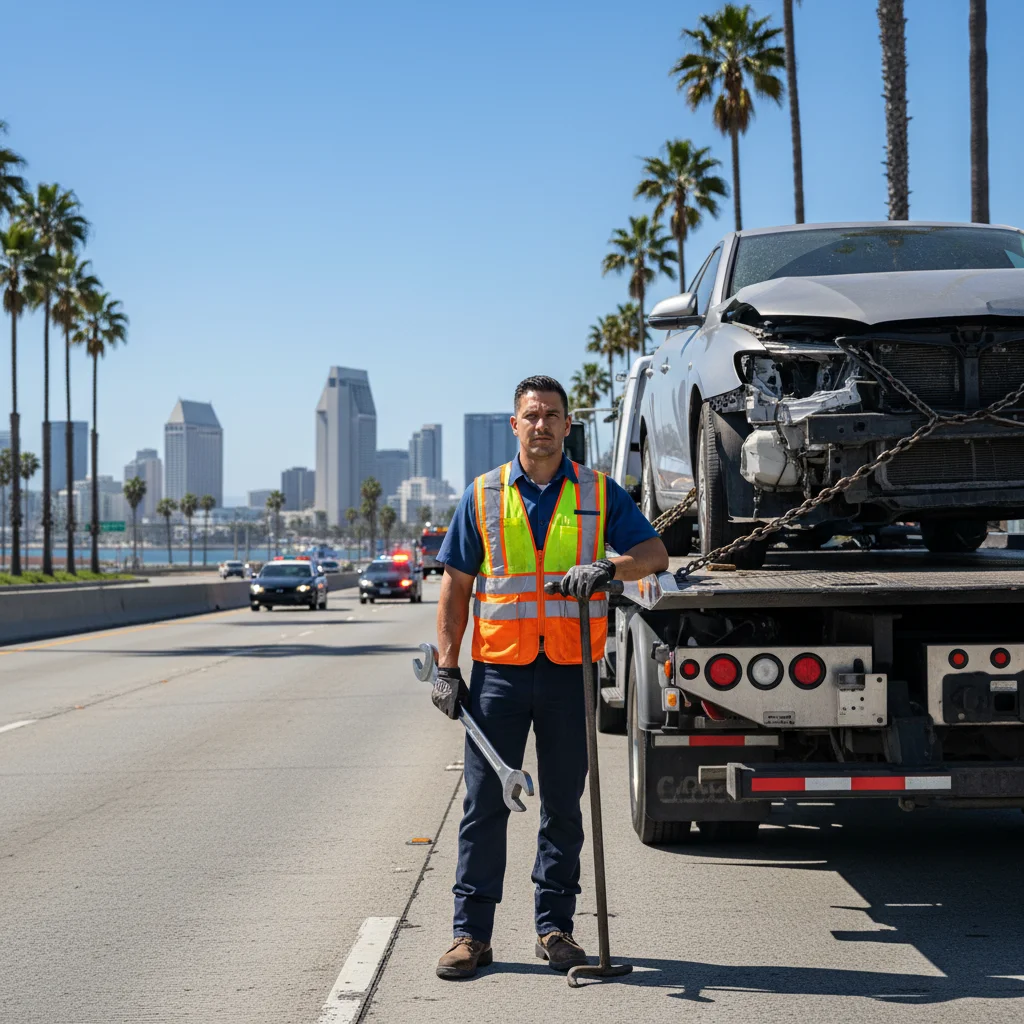
You’ve just been in a car accident on I-5 near La Jolla, or maybe on the I-8 grade heading out to East County. Your vehicle is damaged, maybe undrivable. Beyond the immediate shock and concern for safety, a pressing question quickly comes up: who pays for the tow after an accident? It’s a common point of confusion for San Diego drivers, especially when emotions are running high. Getting your vehicle safely off the road is a priority, but the bill for that service can feel like an unexpected burden.
This guide breaks down the financial responsibilities for accident towing in San Diego County. We’ll cover how insurance plays a role, what happens if you’re at fault or not, and what to expect from tow companies on the scene. Understanding these details now can save you stress and money later.
Immediate aftermath: Who calls the tow truck?
When an accident happens, several parties might call for a tow. This often depends on the severity of the accident and whether law enforcement is involved.
Police or California Highway Patrol (CHP) involvement
If your accident is serious, involves injuries, or blocks traffic on a major freeway like I-15 in North County or I-805 in the South Bay, the California Highway Patrol (CHP) or local police will likely respond. Once they’ve assessed the scene and determined the vehicle is unsafe to drive, they’ll often call for a tow.
In San Diego, the CHP operates on a rotation system for tow companies. This means they have a pre-approved list of local towing services that respond to accident scenes on a rotating basis. You usually don’t get to choose the first tow truck that arrives if the police call it in. This tow service will move your vehicle to a safe location, often their impound lot, or a repair shop of your choosing if it’s nearby.
Driver or insurance company arrangement
If the accident is minor, and you’re able to move your vehicle to a safe shoulder or side street, you might have more control. You can then contact your insurance company directly. They might have preferred towing services or instruct you to call one and submit the bill for reimbursement. Alternatively, you can call a tow company yourself, like Quick Tow SD, and arrange for the service. We’re available 24/7 for emergency towing across all of San Diego County.
Understanding accident towing costs in San Diego
Towing fees aren’t always straightforward. Several factors influence the final cost, especially after an accident. Knowing these can help you understand the bill.
Common tow charges
- Hook-up fee: This is the basic charge for connecting your vehicle to the tow truck. For light-duty vehicles (most cars, SUVs, pickups), this typically ranges from $95 to $175 flat in San Diego. Heavy-duty hook fees for commercial trucks or large RVs start at $285 and go up.
- Mileage fee: This is a per-mile charge for transporting your vehicle from the accident scene to its destination. The rate varies but is usually added on top of the hook-up fee.
- Storage fees: If your vehicle isn’t picked up immediately from the tow yard, you’ll incur daily storage fees. These can add up quickly, so it’s wise to arrange for pickup or transfer as soon as possible.
- Winch-out/recovery fee: If your vehicle went off the road, into a ditch, or rolled over, extra equipment and time are needed to recover it. This involves specialized winching and can significantly increase the cost.
- Special equipment/labor: Some situations require more than a standard tow. For instance, if your vehicle is heavily damaged and needs to be carefully extracted, or if it’s a large vehicle requiring a heavy-duty wrecker.
Why vehicle type matters for accident recovery
The type of vehicle you drive directly impacts the towing method and cost. This is particularly important for modern vehicles.
- AWD vehicles: Cars with All-Wheel Drive (AWD), like many Subarus, Audis, and Teslas, MUST be towed on a flatbed truck. Using a wheel-lift or “two-wheel” tow can damage the drivetrain, leading to expensive repairs ranging from $2,500 to $5,000.
- Electric Vehicles (EVs): All EVs, regardless of brand (Tesla, Rivian, Ford Lightning, etc.), MUST be transported on a flatbed. Their drive motors remain engaged even when the vehicle is off, and dragging them on their wheels can fry the motor and inverter system. This can result in repair costs between $8,000 and $18,000.
- Motorcycles: Motorcycles also require specialized care and are best transported on a flatbed or with a dedicated motorcycle towing setup to prevent damage.
Quick Tow SD operates a fleet of both flatbed towing and wheel-lift towing trucks, as well as heavy-duty towing wreckers, ensuring we have the right equipment for any accident recovery in San Diego.
Ask about surge pricing before you agree
Some operators charge more for a tow in the middle of the night, on a weekend, or during a holiday. Ask if the quote you’re given holds at any hour. Transparency in pricing is a hallmark of a trustworthy service. You can learn more about general towing costs in our post on /blog/tow-cost-san-diego/.
Typical San Diego Towing Costs (Light Duty, Estimated)
| Service Type | Description | Estimated Cost Range (2026) |
|---|---|---|
| Hook-up Fee | Basic connection to tow truck | $95 - $175 |
| Mileage Fee | Per mile charge (after initial distance) | $4 - $7 per mile |
| Flatbed Upgrade | For AWD/EVs, often included in hook-up or slight premium | Included or priced separately, ask dispatch |
| Winch-out | Vehicle recovery from ditch, embankment | $150 - $400+ (hourly) |
| Daily Storage | Per day fee at tow yard | $50 - $100 per day |
| After-hours Release | Fee for releasing vehicle outside business hours | $50 - $100 (if applicable) |
Note: These are estimates for San Diego County and can vary based on specific circumstances and tow company.
The role of insurance in paying for accident towing
Your car insurance policy is the primary factor in determining who pays for a tow after an accident. Understanding your coverage is key.
Collision coverage
This coverage pays for damage to your own vehicle resulting from a collision with another car or object, regardless of who is at fault. If you have collision coverage, it will typically cover the cost of towing your vehicle from the accident scene to a repair shop or tow yard. This is often subject to your deductible. So, if the tow bill is $200 and your deductible is $500, you’d pay the tow bill yourself. However, if the total damage (including the tow) exceeds your deductible, your insurance would pay the difference.
Liability coverage
Liability coverage pays for damages you cause to other people’s vehicles or property if you are at fault in an accident. It does not cover your own towing costs or vehicle damage. If you’re deemed at fault and only have liability coverage, you’ll be responsible for your own tow bill.
Comprehensive coverage
While less common for accident towing, comprehensive coverage protects your vehicle from non-collision incidents like theft, vandalism, fire, or hitting an animal. If your vehicle needs a tow due to one of these events (e.g., hitting a deer on Sunrise Highway in East County), comprehensive coverage might pay for it, again subject to your deductible.
Roadside assistance coverage
Many insurance companies offer roadside assistance as an add-on to your policy. This often includes towing for breakdowns or accidents up to a certain distance or dollar amount. If you have this, it’s usually your best bet for covering tow costs directly, often without a deductible impacting your claim. Checking your policy for this feature is always a good idea. Organizations like AAA Southern California also provide roadside assistance plans that include towing.
When you’re at fault for the accident
If you are determined to be at fault for an accident, the responsibility for your tow bill usually falls to you or your insurance company.
- Your collision coverage: If you have it, your collision coverage will pay for your tow and vehicle repairs, minus your deductible.
- Your roadside assistance: If you have this add-on, it’s often the easiest way to cover the tow without impacting your collision deductible.
- Out-of-pocket: If you only have liability insurance or your tow bill is less than your collision deductible, you’ll likely pay for the tow yourself.
It’s important to remember that even if you’re at fault, getting your vehicle safely off the road is necessary. For example, if you’re involved in a fender bender on SR-52 in Kearny Mesa, even if it’s your fault, you can’t leave your disabled vehicle blocking traffic.
When you’re not at fault for the accident
If another driver is found to be at fault for the accident, their liability insurance should cover the damages to your vehicle, including the towing costs.
- Direct billing: In some cases, your tow company might be able to directly bill the at-fault driver’s insurance company.
- Reimbursement: More commonly, you’ll pay for the tow upfront, and then your insurance company will seek reimbursement from the at-fault driver’s insurer through a process called subrogation. They will then reimburse you for your out-of-pocket expenses, including your deductible if you used your own collision coverage.
- Uninsured motorist property damage (UMPD): If the at-fault driver is uninsured, and you have UMPD coverage on your policy, it can cover your vehicle damage and towing costs. This coverage is designed specifically for situations where the other driver doesn’t have insurance.
Navigating insurance claims after an accident can be complex. For more details on what to do after a car accident in San Diego, check out our blog post on /blog/after-car-accident-san-diego/.
Uninsured motorist accidents: What happens then?
San Diego, like the rest of California, has its share of uninsured drivers. If you’re involved in an accident with an uninsured motorist, the situation for towing costs changes.
- Your UMPD coverage: If you carry Uninsured Motorist Property Damage (UMPD) coverage, it will typically cover the cost of towing your vehicle, along with repairs. This coverage usually has a smaller deductible than collision coverage, or sometimes no deductible at all.
- Your collision coverage: If you don’t have UMPD, your own collision coverage would kick in, subject to your deductible.
- Out-of-pocket: Without either of these, you would be responsible for the tow bill yourself. Pursuing the uninsured driver for costs can be a lengthy and often unsuccessful process.
This is why having adequate insurance, including UMPD, is so important for San Diego drivers, especially with traffic on busy corridors like I-805 or I-5.
Police-ordered tows vs. private arrangements
The distinction between a police-ordered tow and one you arrange yourself is important for both cost and process.
CHP-rotation freeway response
As mentioned, if the CHP or local police deem your vehicle a hazard on a freeway like I-8 near Alpine or SR-78 in North County, they’ll call a tow from their rotation list. This tow company is obligated to respond and move your vehicle. While they must adhere to state-regulated rates, you typically don’t have a choice in which company arrives first. They’ll take your car to a safe location, usually their impound lot. You then have to arrange for its pickup or transfer.
Your right to choose a tow company
Once your vehicle is off the immediate freeway or accident scene and no longer a hazard, you generally have the right to choose your preferred tow company. The initial police-ordered tow might be expensive, but you can request that your vehicle be towed from the impound lot to a repair shop or your home by a company you trust, like Quick Tow SD. This is often where your insurance or roadside assistance can come into play.
Choosing a tow company after an accident in San Diego
When you’re dealing with the aftermath of an accident, you need a reliable, professional towing service. Quick Tow SD is a trusted partner for San Diego drivers.
Why Quick Tow SD stands out
- A line that takes calls 24/7: Accidents don’t keep business hours. The line takes calls around the clock, every day of the year, and routes the job to an operator covering your area, whether it’s a late-night incident on SR-163 or a holiday fender bender in Coronado.
- A straight arrival estimate: Arrival time depends on where you are and what is on the road. More remote areas like Julian or Mt Laguna take considerably longer because of distance, and getting to you safely still comes first.
- Flat rate: ask for a clear number for the tow before the truck rolls. The operator sets the price and bills you directly.
- Experienced operators: The drivers we send are skilled in accident recovery. They know how to safely handle damaged vehicles, including specialized needs for EV towing and AWD vehicles.
- Full county coverage: From the coastal cities of Del Mar and Encinitas, through the inland communities of Poway and San Marcos, to the East County areas like El Cajon and Lakeside, and down to the South Bay cities of Chula Vista and National City, we cover all 67 cities and communities in San Diego County. This includes the Camp Pendleton corridor, a 20-mile stretch on I-5 where military families often need prompt POV breakdown response.
- Variety of services: We offer a full range of towing services, including accident recovery, flatbed towing (essential for AWD, EVs, and delicate vehicles), wheel-lift towing, heavy-duty towing for larger vehicles, and even long-distance towing if your vehicle needs to go beyond San Diego.
Choosing a reputable tow company can make a difficult situation much smoother. For tips on avoiding issues, read our post on /blog/choosing-tow-company-red-flags/.
What to do at the accident scene in San Diego
Knowing the right steps immediately after an accident can help protect you, others, and your financial interests regarding towing.
- Ensure safety: Move yourself and any passengers to a safe location, away from traffic. If possible and safe, move your vehicle to the shoulder of the road. On busy freeways like I-5 or I-805, this is critical. Use your hazard lights.
- Check for injuries: Assess yourself and others for injuries. Call 911 immediately if anyone is hurt.
- Call the police/CHP: Even for minor accidents, especially on freeways or major roads, call law enforcement. They will create an official report, which is vital for insurance claims. The CHP website has resources on what to do after an accident: https://www.chp.ca.gov/
- Exchange information: Get contact and insurance details from all drivers involved. Take photos of the scene, vehicle damage, and license plates.
- Do not admit fault: Stick to the facts when talking to other drivers or police.
- Contact your insurance: Notify your insurance company as soon as possible. They can guide you on towing and claims.
- Call for a tow: If your vehicle is undrivable, call a trusted tow company like Quick Tow SD, or follow your insurance company’s instructions. If police are on scene, they may arrange the initial tow. Be clear about where you want your vehicle taken. If it needs to go to a specific repair shop in Escondido, or your home in Chula Vista, tell the driver.
Remember, your safety is the absolute top priority. The National Highway Traffic Safety Administration (NHTSA) offers excellent guidelines for roadside safety: https://www.nhtsa.gov/road-safety.
San Diego specifics and accident recovery
San Diego’s diverse geography and traffic patterns mean accident recovery can vary significantly across the county.
- Freeway accidents: Accidents on major arteries like I-5 (especially the Camp Pendleton corridor between Oceanside and San Clemente), I-15 (the busy commuter route through North County Inland), I-8 (particularly the grades to East County), SR-163, SR-52, and I-805 often involve CHP response and quick clearance requirements.
- Coastal areas: Incidents in La Jolla, Del Mar, Encinitas, Carlsbad, Ocean Beach, Pacific Beach, or Coronado might occur in tight parking lots or on dangerous PCH shoulders.
- Inland North County: San Marcos, Escondido, Vista, and Poway see heavy I-15 traffic, and hot weather can lead to overheating breakdowns, which can contribute to accidents.
- East County: El Cajon, La Mesa, Santee, Lakeside, and Alpine frequently experience I-8 grade-related incidents (overheating, brake fade) and challenges on winding canyon roads.
- South Bay: Chula Vista, National City, and Imperial Beach have high traffic volumes along I-5 and I-805, including commercial truck routes to Otay Mesa.
- Mountain areas: Julian, Pine Valley, Ramona, Mt Laguna, and Borrego Springs have longer response times. Winter conditions on Sunrise Highway can require chains and specialized recovery.
- Vehicle types: With a large military population, many residents own trucks and SUVs. The growing number of Teslas and other EVs in San Diego means a high demand for flatbed towing, which Quick Tow SD is equipped for.
No matter where your accident occurs in San Diego County, Quick Tow SD is ready to provide prompt and professional accident recovery services.
Frequently asked questions
Who pays for the tow if I don’t have insurance?
If you don’t have insurance, you will be responsible for paying the tow bill directly out-of-pocket. Without collision or roadside assistance coverage, there’s no insurance provider to cover the cost for you.
Can I choose my own tow company after an accident if the police call one?
Yes, you usually can. While police may call the first tow truck to clear the scene, you can often request that your vehicle be towed from their impound lot to a location of your choice by your preferred tow company, like Quick Tow SD. You’ll likely pay for the initial police-ordered tow yourself, then arrange the transfer.
What if my car is totaled? Do I still pay for the tow?
If your car is totaled, your insurance company (if you have collision coverage) will typically cover the tow to their designated salvage yard or a repair shop, minus your deductible. They will factor the tow cost into the total loss settlement.
How quickly do I need to get my car from the tow yard after an accident?
You should arrange for your vehicle to be moved from the tow yard as quickly as possible. Tow yards charge daily storage fees, which can accumulate rapidly and add significant costs to your bill. Contact your insurance company immediately to coordinate the next steps.
Does my roadside assistance cover accident towing?
Most roadside assistance plans, whether through your insurance provider or an organization like AAA, do include towing after an accident. Check your specific policy for limits on distance or dollar amounts for accident-related tows. Using roadside assistance often helps avoid dipping into your collision deductible.
Get reliable accident recovery in San Diego
Dealing with the aftermath of a car accident is stressful enough without worrying about who pays for the tow. Understanding your insurance coverage and knowing your rights can help you navigate the situation with more confidence. For San Diego drivers, Quick Tow SD is here to provide fast, reliable, and transparent accident recovery services, 24/7.