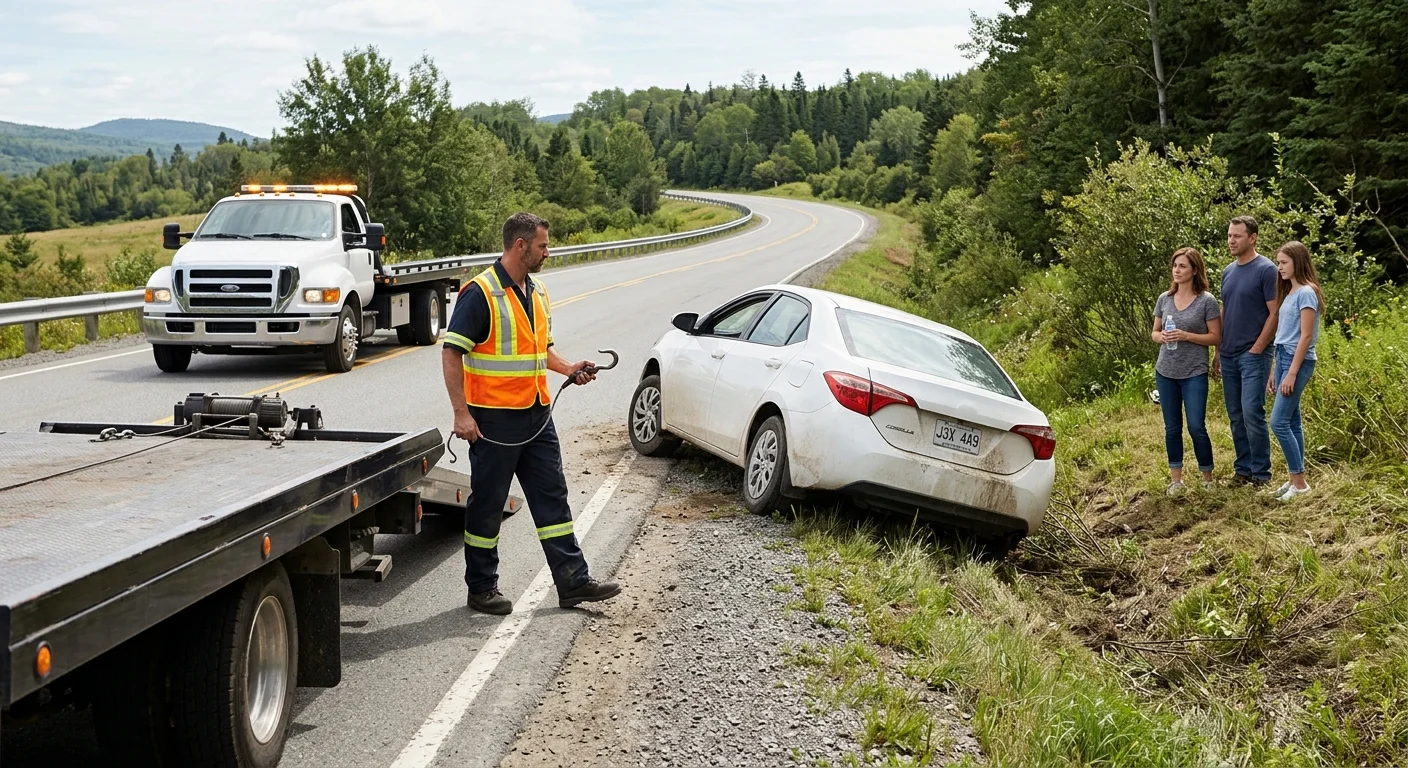
A car that has left the pavement may need recovery, towing, or both. For car ditch recovery, dispatch needs to understand the position, hazards, access, and vehicle condition before matching the call with an operator.
Handle immediate hazards before arranging recovery
Check people before checking the car. If anyone is injured, trapped, or in immediate danger, call 911. Do the same when the vehicle blocks traffic or creates an active roadway hazard.
Move away from traffic if you can do so safely. Don’t stand between the car and the road. Don’t wait directly downhill from a vehicle that may shift. If leaving the vehicle would put you closer to moving traffic, follow instructions from emergency authorities.
Turn on the hazard lights when they still work. Use a phone from a safer position. Don’t walk into a traffic lane to inspect damage, take photos, or direct approaching drivers.
Tell dispatch about hazards before describing cosmetic damage. Important details include smoke, leaking fluid, broken glass, traffic exposure, and an unstable position. Mention if the car is leaning, resting against something, or sitting near a drop. These details help dispatch decide whether the call is ready for an operator or first needs emergency control.
Conditions at the scene control what’s safe. A narrow road near Jamul can present different risks than a wide surface street in Chula Vista.
Wait for instructions before moving closer. A car that looks settled may not be stable. Leave recovery decisions to the responding professionals.
Describe the vehicle’s position without moving it
A useful description starts with where the pavement ends and the car begins. Tell dispatch whether all four wheels are off the road, two wheels crossed the edge, or only one wheel dropped below the shoulder.
Next, describe the car’s direction. Is its nose pointed downhill, uphill, toward traffic, or away from traffic? Is the car upright? Does one side sit lower than the other? You don’t need to measure an angle. Plain descriptions are more useful than guesses.
Report what you can see without climbing around the vehicle. Mention buried wheels, visible wheel damage, loose body panels, or airbags that opened. Say whether the engine runs, but don’t restart it just to test. Tell dispatch if the steering, brakes, or transmission seemed damaged before the car stopped.
The surface matters too. Use simple terms such as dry dirt, mud, gravel, sand, grass, or standing water. Recent rain can change access along an unpaved shoulder. A paved drainage edge in central San Diego presents a different recovery problem than open ground near Alpine.
Photos may help if dispatch requests them. Take them only from a safe standing point. Useful views show the entire car, the road edge, and the space around it. Close photos of a bumper won’t explain the overall position.
Don’t try rocking, pushing, or driving the car out while arranging help. That can change the position and make your earlier description inaccurate.
How a tow differs from a recovery request
A routine tow begins with a vehicle that an operator can prepare for transport from an accessible position. A recovery request begins with another problem. The car first needs to be moved from a ditch, slope, soft shoulder, or similar position.
That difference affects dispatch. Saying “I need a tow truck” doesn’t explain whether the vehicle is beside the road or several feet below it. Describe the scene as a car in a ditch, then let dispatch classify the work.
Some calls involve recovery only. Others require recovery followed by transport. The final decision depends on the car’s condition and the destination after it reaches stable ground. A vehicle that starts isn’t automatically ready to drive. Damage to a wheel, tire, steering, suspension, or underside may not be obvious from the driver’s seat.
Our accident recovery and winch-out service page explains how we connect these calls with local operators. For a closer look at service terminology, read what a winch-out service is.
A ditch beside a maintained street also differs from backcountry terrain. Our guide to off-road recovery in East County covers broader access issues around remote and unpaved locations.
Avoid choosing the recovery method yourself. Dispatch needs the scene facts, not a requested technique. The operator sent out makes the practical recovery decision after reviewing the vehicle and its surroundings.
What location and access details dispatch needs
Start with a precise location. A street address works when one is nearby. Otherwise, provide the road name, travel direction, closest cross street, and a visible landmark. A dropped map pin can help on rural roads where addresses are far apart.
San Diego County includes dense city streets, coastal corridors, mountain roads, and desert approaches. “East County” alone won’t identify the scene. Say whether you’re near SR-94 by Jamul, I-8 east of Alpine, SR-67 near Ramona, or another specific route.
Describe which side of the road holds the car. Include your direction of travel before it left the pavement. Divided roads can make a location that looks close on a map difficult to approach from the opposite side.
Dispatch also needs to know what separates the road from the vehicle. Mention a curb, guardrail, fence, drainage channel, steep bank, locked gate, or narrow shoulder. State whether traffic is passing close to the scene. Don’t enter traffic to check clearance.
Give basic vehicle information. Share the make, model, approximate size, color, and drive type if you know it. Mention a trailer, cargo load, roof box, modified ride height, or missing wheel. Don’t guess when you’re unsure.
Tell dispatch whether emergency responders are present. If law enforcement has restricted access, say so. The operator may need scene directions from the authority managing traffic.
Good details reduce back-and-forth. They also help distinguish a roadside recovery from a remote access call before an operator accepts the job.
Confirm the destination after the vehicle is recovered
Recovery answers one question: how the vehicle returns to an accessible position. It doesn’t answer where the car goes next. Confirm that destination while arranging the call.
A repair shop may be the right destination when the car has visible damage or uncertain steering. A home or another private address may fit a vehicle awaiting later inspection. If the incident followed a collision, an insurer or law enforcement agency may also have instructions. Dispatch should know about those instructions before transport begins.
Check whether the destination is open and able to receive the vehicle. If you can’t confirm access, tell dispatch. Don’t assume a shop has an unlocked after-hours entrance or accepts unattended vehicles.
Share any access details at the destination. A parking garage, steep driveway, gated lot, or tight residential street can affect delivery. The operator sets the price and is paid directly by the customer, so confirm the scope and rate with that operator.
If the vehicle doesn’t need recovery but remains unsafe to drive, emergency towing may be the more direct request. If both services are needed, describe the ditch position first and the desired destination second.
Keep your keys, identification, and essential belongings with you when it’s safe to retrieve them. Don’t enter an unstable vehicle for nonessential items. Once the scene is controlled, confirm where the car is going and how you’ll continue your trip.
When to call us
Call when a car has left the pavement, sits at an unsafe angle, or can’t return to the road without professional recovery. We’ll connect you with an independent operator who can review the scene and determine the appropriate next step. Call (858) 923-5787 to reach dispatch.