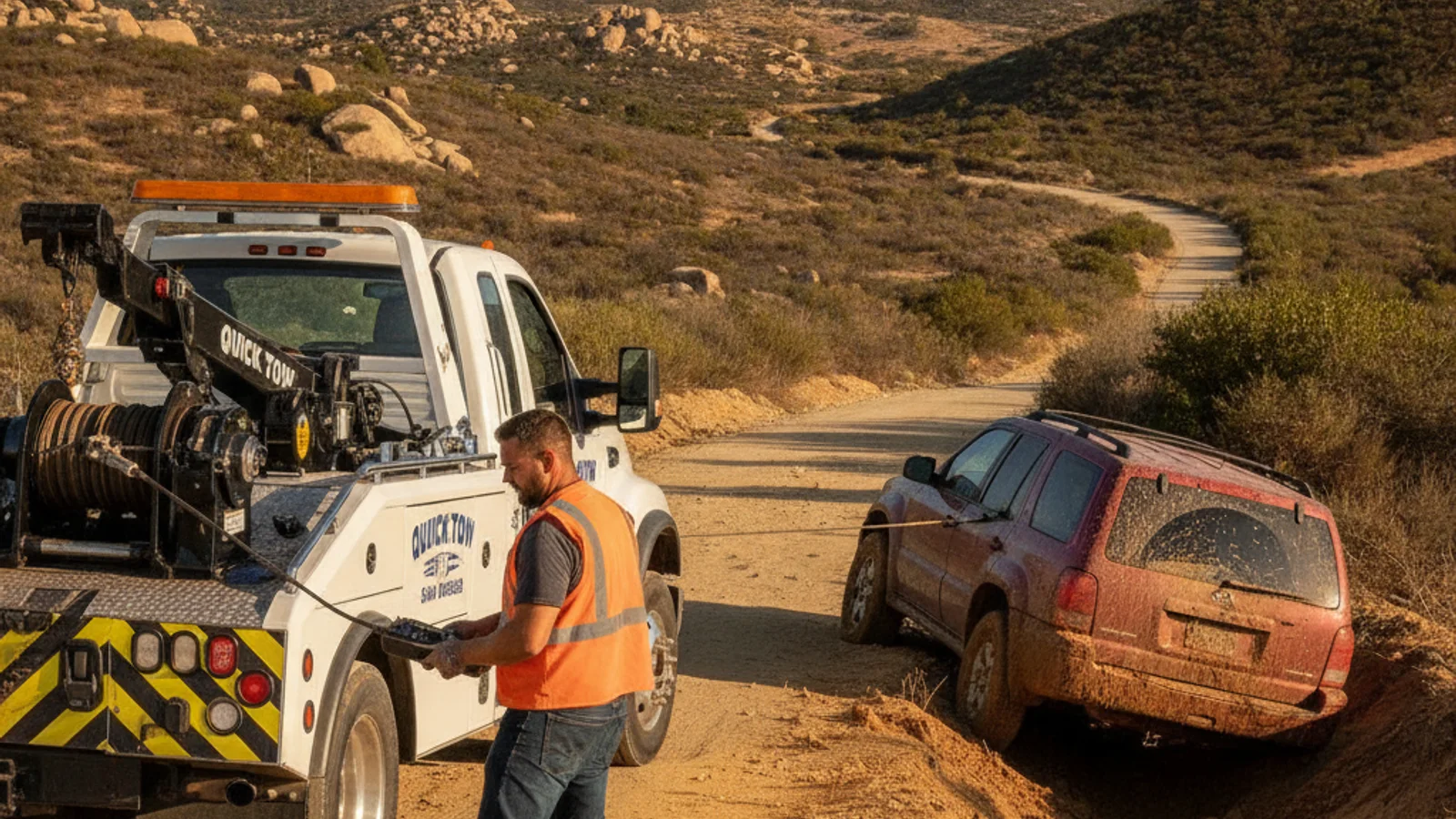
A sedan that drove ten miles down a graded dirt road into Anza-Borrego is a different call than a fender-bender on I-8. It didn’t crash. It sank, spun, or slid off the hard-packed track, and now it needs a pull, not a hook.
The terrain that produces these calls
East County isn’t one kind of backcountry. Anza-Borrego Desert State Park covers open desert floor, and the sand washes that branch off Split Mountain Road turn soft and deep the moment a vehicle leaves the graded surface. Further south and west, Lark Canyon and the McCain Valley OHV areas mix rock, loose granite sand, and steep grades built for dirt bikes and side-by-sides, not a stock sedan. Otay Mountain Truck Trail climbs through switchbacks with drop-offs on one side and no cell signal for long stretches. Up in the mountains, the forest roads branching off Sunrise Highway near Laguna Mountain add pine duff, exposed roots, and washboard gravel that looks solid until a tire breaks through it.
Each of these places fails a vehicle differently. A desert wash swallows a tire in soft sand. A truck trail drops a wheel off the shoulder into loose scree. A forest road hides a rut under pine needles. The recovery has to match the ground, not just the vehicle.
The most common call: a two-wheel-drive car on a graded road
Most calls out here aren’t off-roaders who pushed too far. They’re two-wheel-drive sedans and crossovers that followed a graded dirt road, maybe chasing a trailhead or a shortcut shown on a map app, and found the grading ends where the sand gets soft. A car with power going to only two wheels loses traction fast once the surface changes, and once it’s dug in, spinning the tires only packs sand tighter around them. That’s the call that comes in from Split Mountain Road and the washes near Ocotillo Wells more than any other kind out here.
What a winch pull actually needs
A winch-out isn’t a strap and a tug. It needs an anchor, a rated recovery point on the stuck vehicle, and enough distance between the two to pull in a straight line without side-loading the cable. The anchor might be another vehicle, a properly rated ground anchor, or in some terrain a tree or boulder the operator judges sound enough to hold the load. The recovery point matters just as much: pulling from a tow hook that isn’t rated for a straight-line winch pull, or from a bumper with no rated point at all, risks tearing the mount off the car instead of moving it. Distance and cable angle decide whether the pull is controlled or a snap risk. This is why a winch-out is a judgment call made on scene, not a job you talk yourself through over the phone. For the general mechanics of how a winch-out works, see what a winch-out service is. For soft-sand recovery specifically, including snatch blocks and anchor choice, see stuck in sand recovery in San Diego County.
Why a heavy carrier often can’t reach the vehicle at all
A flatbed or heavy carrier needs a road wide enough to turn around on and firm enough to carry its own weight plus the load. A lot of these backcountry spots don’t offer either. A wash off Split Mountain Road can be too soft for a carrier’s tires even where a sedan managed to drive in. Lark Canyon and McCain Valley have grades and rock ledges a carrier’s low clearance won’t clear. Otay Mountain Truck Trail is narrow enough in places that a carrier can’t turn around without backing a long way. In those cases the job is a winch pull to firmer ground first, sometimes with a smaller 4x4 recovery vehicle, and only then a load onto a truck that can actually get in and out. Anyone dispatching a carrier without asking about the road first is setting up a second trip. For jobs that do need a heavy carrier once the vehicle is on solid ground, see heavy-duty towing.
The heat and water reality of waiting in Anza-Borrego
Anza-Borrego and the desert washes around it run hot enough in summer that waiting with a stuck car is its own hazard, separate from the vehicle problem. Desert washes also flash flood with little warning when a storm builds over the mountains miles away and sends water down a channel that was bone dry an hour earlier. NHTSA’s road safety guidance on carrying water and staying with a disabled vehicle applies here more than almost anywhere else in the county. Cell service is spotty through much of this terrain, so telling dispatch your exact location, a landmark, a mile marker, a dropped pin, before you lose signal matters more than it does on a city street.
Telling dispatch where you actually are
None of these areas have a street address. “Anza-Borrego” by itself covers hundreds of square miles, and “somewhere off Split Mountain Road” isn’t much narrower. Before you lose cell signal, give dispatch the closest named feature: a mile marker, a trailhead sign, a fork in the road, or a dropped pin from a maps app while you still have a bar or two. Mention which direction you came from and roughly how far off the graded road the vehicle sits. Say whether the surface underneath the car is sand, gravel, loose rock, or dry mud, since that changes which anchor and recovery gear the operator brings. If you’re in Lark Canyon or McCain Valley, note whether you’re near a staging area or a numbered route, since those are the landmarks other drivers and rangers use too. The same goes for Otay Mountain Truck Trail: a gate number or a switchback count from the bottom is more useful than “partway up.”
Vehicles that get stuck out here aren’t all the same
A stock sedan that wandered too far down a graded road is a different recovery than a lifted truck that rolled a tire off a rock ledge on Otay Mountain, and both are different from an overlanding rig buried to its axles in a wash near Ocotillo Wells. The operator needs to know the vehicle type up front: ride height, whether it’s two-wheel or four-wheel drive, and whether the undercarriage is likely resting on the ground. A car that’s high-centered, sitting on its frame or belly pan with wheels spinning free in the air, needs a different lift and pull angle than one that’s simply lost traction on all four tires. Saying “it won’t move” doesn’t tell the operator which of those two situations they’re driving out to solve, and guessing wrong means bringing the wrong gear on a trip that can already take a while to reach.
When to call us
If the vehicle is stuck off pavement anywhere in East County’s desert, OHV areas, or forest roads, that’s a winch-out job for an operator with the right recovery gear, not a standard tow. Call dispatch, describe the terrain and how the vehicle got stuck, and share your exact location while you still have signal. Call (858) 923-5787 to reach dispatch.