The invoice is on the table and the car is already at a yard. Maybe it’s AutoReturn after an SDPD impound. Maybe it’s a shopping-center hook from Mission Valley or a Chula Vista lot. You need a dispute path you can actually follow, not a guess about what the law probably says.
This page is how to assemble that dispute in California, with the San Diego County agencies named. It is not a promise that charges get reversed.
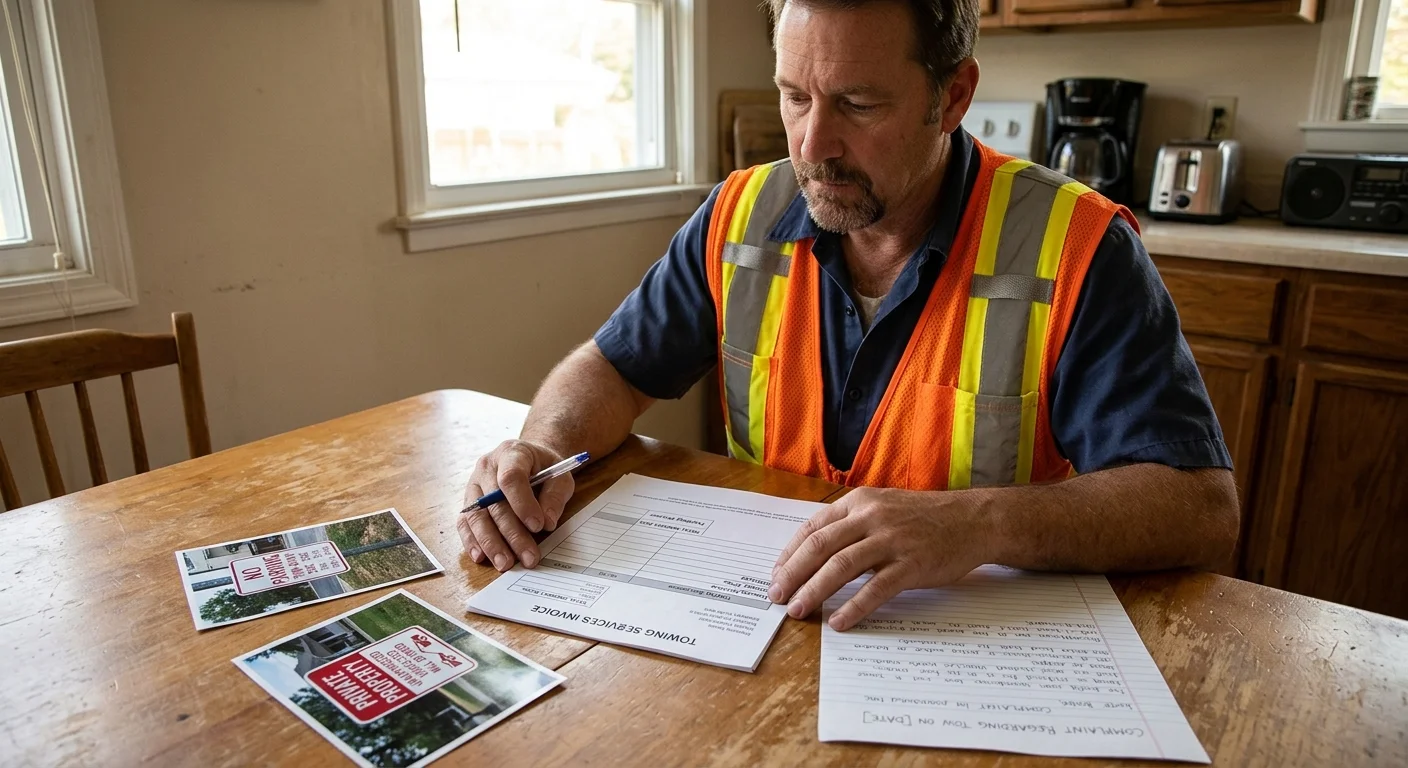
Collect the tow notice, photos, and payment records
Start with paper and photos, not an argument at the gate.
Keep every notice the yard or the police mailed. For a City of San Diego impound, that mailed notice starts the post-storage hearing clock under California Vehicle Code 22852. You request the hearing within 10 days of the mailed notice. Miss that window and a strong fact pattern still dies on timing.
Photograph what you can still see. Signs at every entrance you used. Stall paint, curb color, a hydrant, a fire-lane stencil. The stall from far enough back that the layout is clear. If you caught the truck on the lot, photograph the truck, the hook, and whether it had left the property. Phone timestamps help.
Ask for an itemized invoice of actual charges before you pay. California Vehicle Code 22651.07 gives you that right. It also lets you inspect the vehicle at no charge during normal business hours, and retrieve personal property at no charge during those hours. You do not have to pay tow or storage first to do those two things.
Save receipts, card statements, and any cash-only refusal. Storage facilities must accept cash, an insurer’s check, or a valid bank credit card. If a yard refused a valid card, write the date, what they said, and any name you were given.
If you already paid, keep the receipt. For a City of San Diego tow later ruled invalid, refunds of fees already paid go through the city’s Public Liability Division. You will want the payment record.
Skip internet formulas that are not in the statute. An “80% rule” for towing could not be confirmed against the California Vehicle Code sections this site uses. Your file is the notice, the photos, the invoice, and who authorized the tow.
Identify who authorized the tow
A dispute aimed at the wrong desk goes nowhere. San Diego County is not one towing system.
City of San Diego police impounds run through AutoReturn, the city’s official towing and impound contractor. Search the vehicle at search.autoreturn.com. That is a city-contract tow: the city’s published fee schedule, SDPD Tow Administration for hearings, and a city refund desk if the tow is later ruled invalid.
Harbor Police tows sit on Port of San Diego tidelands in San Diego, Chula Vista, National City, Coronado, and Imperial Beach. Release paperwork comes from Harbor Police headquarters on their posted weekday hours. Fees are paid at the towing yard. The Port’s published vehicle release fee is $232, subject to change per the Port. That is a different chain than SDPD.
A CHP tow, or a police tow in El Cajon, Oceanside, Escondido, or National City, is another chain still. The agency that ordered the impound is the one that can talk about a hearing. Do not send a City of San Diego hearing request for a car that never entered the city contract.
Private property is different. A Mission Valley shopping center, a City Heights apartment lot, a Pacific Beach stall: those tows live under California Vehicle Code 22658. The property owner or their agent authorizes the removal. Signs at all entrances have to meet the statute: at least 17 by 22 inches, one-inch letters, the towing company name and phone, and notice that unauthorized vehicles are towed at the owner’s expense. Other 22658 grounds besides signage include a parking-violation notice issued 96 hours or more earlier, an inoperable vehicle after the owner notified law enforcement and waited 24 hours, or a lot improved with a single-family dwelling.
General authorization without a per-tow signoff is a short list: within 15 feet of a fire hydrant, in a fire lane, or blocking an entrance or exit. Disabled stalls and expired registration are not on that private-property list. Registration expired over six months is a police ground on public roads under Vehicle Code 22651(o), not a lot-owner ground.
If you came back while the truck was still on the lot, 22658 requires an immediate release on request. The driver may charge up to half the regular tow fee if the vehicle was already hoisted, and may pursue that charge. Storage after a private-property removal has to be within a 10-mile radius unless law enforcement approved a farther yard. The company must notify law enforcement within 60 minutes of removal or 15 minutes after reaching storage, whichever is less.
If the signs, the authorization, or the drop rule look wrong, read what makes a private-property tow illegal in California and your towing rights in San Diego. For how a lawful lot tow is supposed to be set up, see private property towing.
What a written dispute usually needs to include
Write it so a clerk who was not there can follow it.
Your name, phone, and mailing address. Vehicle year, make, plate, and VIN if you have it. Date and time of the tow, and the exact address or lot. The yard name and the invoice number.
State who you believe authorized the tow: SDPD, Harbor Police, another department, or a named property manager. Attach the notice.
State what you contest in one sentence, then the facts. Validity (the car should not have been taken) is a different claim from line items (the tow was lawful but a fee is wrong). Mixing them without labels makes both weaker.
Attach photos of signs and the stall. Attach the itemized invoice, or write that you asked for one and did not get it. Quote the line you dispute. For a City of San Diego contract tow, compare those lines to the city’s published fee schedule as of the date you check it. That schedule is not a statewide cap. It is the city’s own list, and it changes. As of the August 2026 city schedule this site last verified, examples include a regular-duty tow fee of $178 (GVWR under 9,500), daily storage of $41 for regular duty, a $54 Tow/Impound Cost Recovery Fee per release, $47 for a flatbed or dolly, and $48 for an after-hours release after 5 p.m. and on weekends. If your invoice is from another city or a private lot, do not use those numbers as a ceiling.
Ask for a written response and a corrected invoice. Keep a copy. Send it in a way you can prove: email plus a saved PDF, or certified mail when a hearing deadline is running.
Civil remedies in the Vehicle Code are not automatic refunds. For private-property failures of signage or notice, 22658 allows recovery of double the tow and storage charges. For removal without proper authorization, it allows four times those charges. Separately, 22651.07 puts violators on the hook for up to two times the amount charged, with a $500 maximum per vehicle. The City of San Diego also points owners toward Small Claims Court for amounts up to $12,500. None of that replaces the hearing clock.
Where San Diego drivers can take a storage or rate question
Match the desk to the tow.
For a City of San Diego impound, the post-storage hearing is the validity path. Request it within 10 days of the mailed notice through SDPD Tow Administration, listed on the city’s vehicle impounds page at sandiego.gov/police/services/vehicle-impounds-towing. The hearing must be conducted within 48 hours of the request, excluding weekends and holidays. The steps live in our San Diego post-storage hearing guide. If the hearing says the tow was invalid and you already paid, the city’s Public Liability Division is the refund desk named on that same page.
To report a towing violation inside the City of San Diego, the City Attorney’s Affirmative Civil Enforcement Unit takes a Towing Complaint Form. The city publishes it at sandiego.seamlessdocs.com/f/acetowingcomplaint.
Rate questions on a city-contract tow go back to that published fee schedule, with the as-of hedge above. For whether California caps tows in general, use the regulated-fees explainer. Statewide dollar caps for every county are not something this site can verify from the statutes on file. 22651.07 says public tow rates are set by agreement between the law enforcement agency and the towing company. Private-property rates cannot exceed the approved rates for the law enforcement agency with primary jurisdiction. Owner-requested tows are generally a mutual agreement. If a yard will not show you the rate authority it is using, put that in the dispute.
If the car sat on Port tidelands, use Harbor Police contacts on portofsandiego.org. Do not treat AutoReturn or SDPD hearing staff as the Port’s desk.
East County and North County cities run their own police tows. An El Cajon street impound is not a City of San Diego AutoReturn file. Ask the impounding agency which office handles storage challenges. If that office is not on the notice, ask the yard which agency authorized the tow and write it down. This site could not confirm a single countywide hearing board that covers every city.
If the car stays unpaid, California lien-sale rules can take over. The DMV explains the two tracks, split at a $4,000 vehicle value, in its lien sales handbook. That is a reason to retrieve the car when you can, then keep disputing, rather than let storage outrun the vehicle.
What to confirm before you pay or refuse payment
Storage is the clock that does not care about your dispute.
On a private-property tow under 22658, if the vehicle is released within 24 hours of towing, only one day’s storage charge may be applied. Under 22651.07 you can retrieve the vehicle within the first 72 hours of storage without paying a lien fee. Those are not the same rule. Neither one freezes daily storage while you wait.
You can inspect and pull personal property during normal business hours without paying first. The car itself is a different question. Ordinary release still needs payment, ID, and proof you are the owner or an authorized person, plus any police hold. A yard can refuse to roll the car out if those are missing. The on-lot drop rule is the main verified exception: if you arrive before the truck leaves the property, the driver must release the vehicle on request and cannot demand payment as a condition of that release.
City of San Diego storage facilities must remain open Monday through Friday, 8 a.m. to 5 p.m. except holidays, and must release vehicles after hours upon request. An after-hours fee may appear on a city-schedule invoice. Confirm the current figure on the city’s published schedule before you treat a line as padded.
If you cannot pay today, ask the yard what they need for a release and what they will charge tomorrow. This site has no verified city or statewide hardship waiver that wipes a tow bill. Leaving the car in place can lead to a lien sale. Paying also does not kill a timely post-storage hearing, or a later refund claim if the hearing rules the tow invalid.
Do not refuse payment at the gate as a tactic unless you are in the on-lot drop situation or a qualified attorney has told you to. The honest sequence for most San Diego drivers is: document, retrieve if you can so storage stops, then file the hearing or the written dispute with the agency that actually authorized the tow.
When to call us
If the car is still on the street, in a stall, or disabled, and you need it moved by a licensed operator rather than leaving it to a lot tow, call dispatch. Quick Tow SD is a referral line. We match you with an independent licensed operator who does the work and sets the price. Call (858) 923-5787 to reach dispatch.