Your semi is blocking the right lane on I-8 near El Cajon, or your 40-foot Class A just lost air pressure on the 5 near Oceanside. A standard tow truck won’t cut it, the wrong equipment makes a bad situation worse and can void your cargo insurance. Here’s exactly what heavy-duty towing involves, what it costs in San Diego County, and how to get the right rig on scene fast.
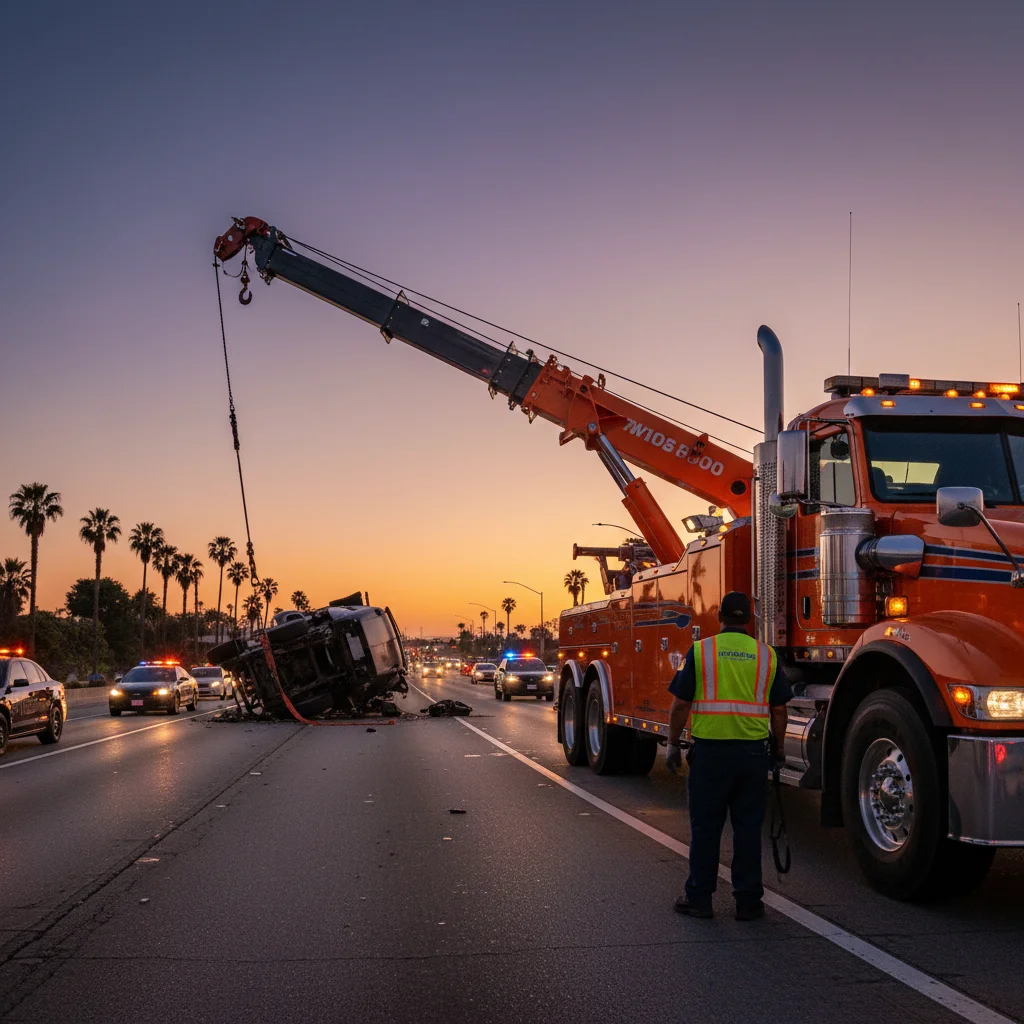
What counts as heavy-duty towing
The line between medium and heavy-duty towing is GVWR, gross vehicle weight rating. California breaks it down this way:
- Light duty: up to 10,000 lbs GVWR (most passenger cars, small pickups)
- Medium duty: 10,001–26,000 lbs GVWR (box trucks, large pickups, sprinter vans)
- Heavy duty: 26,001 lbs GVWR and above (semi-tractors, combination units, large motorhomes)
If your vehicle or combination unit exceeds 26,000 lbs, a standard flatbed or wheel-lift truck doesn’t have the boom capacity, axle ratings, or braking capability to move it legally or safely. Heavy-duty work requires equipment rated for the load, period.
There’s also a regulatory layer. CHP-permitted tow service operators who work commercial corridors must meet additional equipment and driver certification requirements. That affects who can legally respond to a freeway incident involving a commercial vehicle in California.
One more distinction worth knowing: recovery and towing aren’t always the same job. Moving an upright, drivable semi from Point A to a shop is a tow. Righting an overturned trailer, extracting a rig from a ditch, or repositioning a jackknifed unit so it can be towed, that’s recovery. Recovery is almost always more expensive and time-intensive than the tow that follows it.
Vehicles that need a heavy-duty wrecker
Not every big vehicle automatically falls into this category. Here’s a practical rundown of what typically crosses the 26,000 lb threshold:
Commercial trucks and trailers
- Class 7 and Class 8 semi-tractors (think Kenworth, Peterbilt, Freightliner)
- Combination units, tractor plus loaded or empty trailer
- Tanker trucks and flatbed semis
- Dump trucks and concrete mixers
Recreational vehicles
- Class A diesel pushers and gas motorhomes over roughly 30 feet
- Large Class C motorhomes, especially dually-based units
- Fifth-wheel trailers over 20,000 lbs loaded GVWR
Municipal and construction equipment
- Transit buses and coach buses
- Large construction equipment on lowboys
- Heavy farm equipment being transported on public roads
If you’re unsure where your RV lands, check the door placard or owner’s manual for the GVWR. Many Class B and smaller Class C motorhomes come in under 26,000 lbs and can be handled by a medium-duty unit. Our RV and trailer towing page has more detail on where different RV classes fall. For a broader look at RV-specific breakdowns in San Diego, see our post on RV towing in San Diego.
How heavy-duty rates are calculated
Heavy-duty towing doesn’t have a flat rate. Dispatchers build the quote from several variables:
Hook fee (or call-out charge) This covers truck mobilization and the first mile or first hook. For heavy-duty work in San Diego County, expect roughly $350–$600 as a starting point. Recovery jobs, rollovers, off-road extractions, often carry a separate recovery fee on top.
Per-mile rate Heavy-duty tow rates typically run $15–$30 per loaded mile. A tow from a Chula Vista breakdown to a Kearny Mesa fleet yard, about 20 miles, can land between $650 and $1,200 total before ancillary charges.
Equipment tier An integrated wrecker (like a heavy Jerr-Dan or Miller) costs less to dispatch than a 50-ton or 75-ton rotator. If your situation requires a rotator, a jackknifed combo unit, an overturned tanker, that equipment runs significantly higher. Some rotator jobs in San Diego bill by the hour: $350–$600/hr is a reasonable range, though complex recoveries on commercial corridors can exceed that.
Waiting time and traffic control If the wrecker sits while CHP manages traffic, or if the operator needs to wait for a cargo transfer before moving the trailer, those hours add up. Ask whether your quote is all-in or whether wait time is billed separately.
Cargo and load considerations Hazmat-certified recovery, load transfer, or cargo securing each add to the total. Your motor carrier insurance or fleet policy may cover some of these, confirm before you authorize work.
For a general look at how towing costs are structured in San Diego, the post on tow cost in San Diego covers the baseline math well.
Common scenarios: jackknifed trailers, semi recovery, RV breakdowns
Jackknifed trailer on I-15 or I-8
Jackknifing usually happens on grades or in wet conditions. In San Diego, the grade changes on I-8 eastbound and the curves on I-15 near Miramar are common spots. A jackknifed combo unit typically blocks multiple lanes and requires a rotator to push or pull the trailer back into alignment before the unit can be towed. CHP will stage traffic control. Expect 2–4 hours on scene minimum.
The wrecker operator assesses the king pin angle, trailer brake condition, and ground clearance before rigging. If the trailer is loaded, a load broker or second unit may be required to transfer freight before the combination can be legally moved.
Semi breakdown on a freeway shoulder
This is more straightforward, a mechanical failure, blown tire, or fuel issue that leaves a Class 8 truck disabled but upright. An integrated heavy-duty wrecker handles most of these. The tow destination is usually a fleet shop or truck stop with service bays. On San Diego freeways, CHP’s Freeway Service Patrol (FSP) assists light-duty vehicles, but FSP does not handle commercial vehicles, that’s private dispatch. And if the rig just needs a jump, fuel, or a winch-out rather than a haul, start with semi truck roadside assistance before paying for a tow.
Our accident recovery and winch-out service covers situations where the semi has left the roadway and needs extraction before towing.
Class A motorhome breakdown
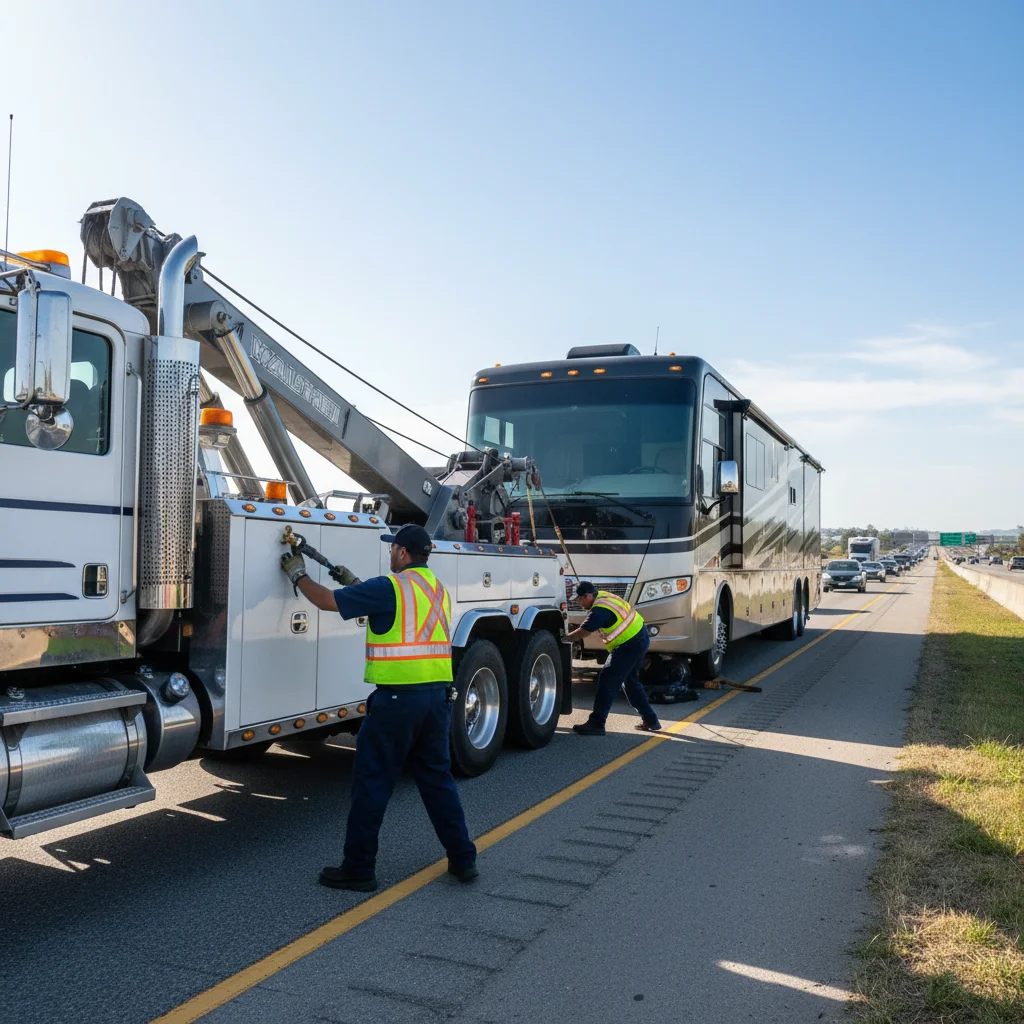
Most Class A breakdowns in San Diego happen on the 5 or 8 corridors, drivers heading to or from the Mexico border crossings, Baja trips, or camping in the mountains. A diesel pusher in the 35,000–40,000 lb GVWR range needs a proper heavy wrecker. Using an undersized truck risks damage to the motorhome’s rear tag axle or tow points.
RV owners should confirm their roadside assistance plan covers heavy-duty equipment. Many AAA plans cap towing benefits at a dollar amount that falls short of actual heavy-duty rates in Southern California.
What to expect when the rotator arrives
A rotator is a specialized wrecker with a 360-degree rotating boom, typically rated at 50 to 75 tons. It’s the tool of last resort for complex recoveries, overturned semis, vehicles over embankments, loads that can’t be moved with a standard under-lift.
When the rotator pulls up, here’s the sequence:
- Scene assessment. The operator walks the vehicle, checks ground conditions, identifies anchor points, and confirms the rigging plan before touching anything. This takes 15–30 minutes for a complex scene.
- Rigging. Heavy chains, straps, and spreader bars are attached to rated recovery points on the vehicle. The operator communicates with any ground crew assisting.
- Lift or drag. The boom does the work. For an overturned trailer, this is a controlled rotation back onto the wheels. For a vehicle over a retaining wall, it’s a slow vertical lift.
- Secure and transport. Once upright and stable, the unit is rigged for tow. The rotator may tow the unit itself or hand off to a standard heavy-duty wrecker for the road portion.
Bystanders and non-essential personnel should stay well clear, a minimum of 50 feet is standard practice. If you’re the driver, stay with the CHP officer or in a safe area away from the recovery zone. NHTSA’s roadside safety guidance is worth reviewing if you’re not familiar with move-over requirements.
How to book and what to tell dispatch
Heavy-duty calls aren’t like standard light-duty dispatches. The more information you give upfront, the faster the right equipment gets rolling.
Tell dispatch:
- Vehicle type and approximate GVWR (or make/model/year so we can look it up)
- Whether the vehicle is upright, on its side, or off the roadway
- Current location, highway, direction, nearest cross street or mile marker
- Whether there’s cargo, and if so, whether it’s hazmat
- Whether CHP or SDFD is already on scene
- Your motor carrier number or fleet account if you have one
For commercial drivers, having your company’s fleet towing account number ready speeds up authorization. If you’re an RV owner and don’t know your GVWR, the door jamb sticker will have it.
Our heavy-duty towing service page has the equipment list and service area. We run heavy equipment throughout San Diego County, from the border crossings in San Ysidro up through Escondido and out to the El Centro corridor on I-8.
If you’re managing a breakdown at night or on a holiday, our 24/7 availability means the line takes that call at any hour and routes it to the operator covering your zone.
When to call us
Heavy-duty recovery is not a job for an undersized truck, an inexperienced operator, or a company that handles it once a month. If your commercial vehicle or large RV is disabled in San Diego County, upright or otherwise, you need certified heavy equipment and an operator who runs this equipment regularly. Call us at (858) 923-5787 for a same-day estimate.