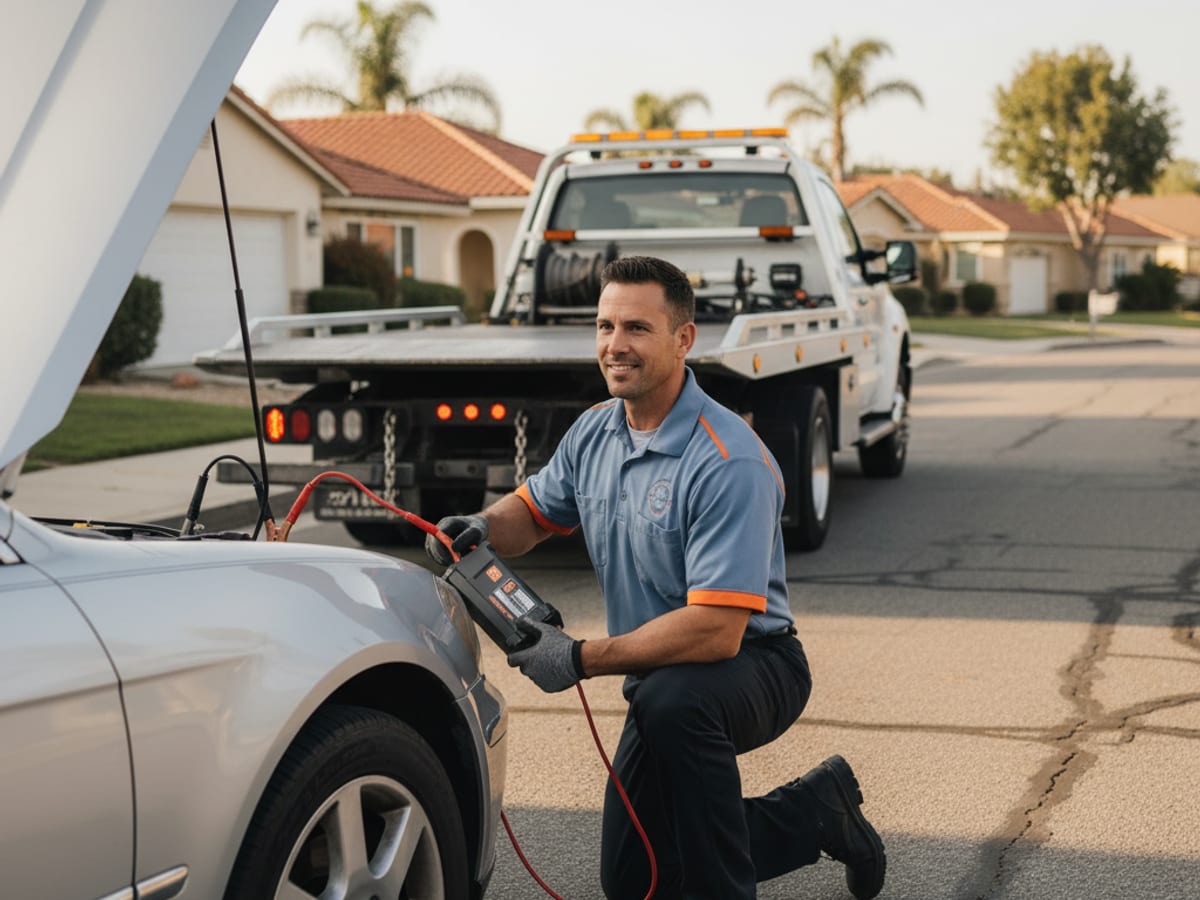
If you’re stuck on the shoulder right now, here’s the short answer. How long roadside assistance takes in San Diego swings with where you are and what time of day it is - the only number that means anything is the live estimate from the operator taking your job. Coastal and central neighborhoods tend to move faster, the backcountry runs longer, and freeway rush hour stretches everything. Below is how to read your real wait and a few things you can do to shrink it.
National blogs love to quote a flat “30 to 60 minutes.” That number isn’t wrong, but it ignores the thing that actually decides your wait: geography. A tow in Hillcrest at 10 a.m. is a different animal than a tow on Sunrise Highway near Julian at 6 p.m. San Diego County is huge, and the spread between the fast areas and the slow ones is wide.
What actually affects your wait
Five things move the number more than anything else.
Your location. This is the biggest one. A truck has to physically drive to you. If you’re near a dense area with lots of operators, that drive is short. If you’re up a mountain road with one provider covering a giant zone, it’s long.
Time of day. San Diego traffic is real. The I-5, I-15, and I-805 corridors clog hard from roughly 6 to 9 a.m. and 3:30 to 7 p.m. A truck stuck in the same jam you’re stuck in can’t teleport. Off-peak and overnight calls usually arrive faster, even though fewer trucks are out, because the roads are open.
Weather and conditions. Santa Ana wind events, the rare heavy rain, and wildfire-season road closures all spike demand at the same moment everyone needs help. When a hundred people call in the same hour, the queue grows and ETAs slide. A hot inland day can do the same thing by causing more overheats and blowouts at once.
The type of help you need. A jump-start or a lockout is quick once the truck arrives. A tire change is fast too. A tow needs the right truck, and a winch-out from a ditch or a low-clearance situation needs specialized equipment that might be farther away. The drive plus the job is your real wait.
Who you called and how they dispatch. A membership service like AAA dispatches your call to a contracted local operator, then that operator slots you into their queue. During a big surge event, that queue can run long because everyone hits the same line at once. Calling a local company directly often skips a layer, and dispatch can give you a live ETA based on where their nearest truck actually is.
San Diego area-by-area expectations
Here’s roughly what to expect by region. We don’t publish arrival numbers, because your actual wait depends on truck availability the minute you call - but the geography follows a clear pattern. Coastal and central neighborhoods (downtown, Hillcrest, Mission Valley, North Park, Pacific Beach) are the quickest to reach, slowed mainly by rush hour on I-5 and I-8. Inland suburbs like El Cajon, Santee, Poway, Chula Vista, and Escondido add drive distance and I-15/I-805 congestion. Outer inland areas (Alpine, Ramona, Valley Center) have fewer trucks per area and winding roads. Backcountry and mountain addresses (Julian, Pine Valley, Descanso, Borrego) run longest: remote roads and real distance to the nearest truck. A breakdown on any freeway at peak adds time, because the truck sits in the same congestion you do.
The pattern is simple. The closer you are to dense coastal and central San Diego, the faster help reaches you. The farther out toward the mountains and the desert, the longer the drive, and there’s no way around the math of distance.
How to get help faster
You have more control over your wait than you’d think. Most of it comes down to giving dispatch what they need so the truck heads straight to you instead of hunting.
Pin your exact location. This is the single biggest time-saver. On the freeway, read the small green mile-marker sign and tell dispatch the number plus the direction you’re heading, like “I-15 north near mile marker 12.” On surface streets, give the nearest cross streets. A precise location can shave real minutes off your wait because the driver isn’t circling.
Use the freeway tools if you have no signal. California freeways still have call boxes on many stretches, and dialing 511 connects you to the regional traffic and roadside line. Both are useful if your phone is dead or you’re in a coverage gap out east.
Stay with your vehicle when it’s safe. Dispatch and the driver are looking for the car, not for you walking down the road. If the car is in a safe spot, stay near it so the driver finds you on the first pass. If you’ve wandered off, you’ve added a search to the job.
Tell them exactly what you need. “Flat tire, I have a spare” gets a different truck than “won’t start, needs a tow.” The more specific you are, the more likely the right equipment shows up the first time. For a fuller breakdown of what to do while you’re stranded, see our guide on what to do if your car breaks down on the freeway.
Call direct during a surge. When there’s a Santa Ana event or a holiday weekend pileup, membership queues back up. A direct call to a local company can get you a live ETA right then instead of an open-ended “someone will be assigned.”
When to call 911 instead
Roadside assistance is for a car that’s stopped in a safe place. It is not for an emergency. Call 911 first, before anyone else, if any of these are true.
You’re blocking a live traffic lane and can’t move the car. A stalled vehicle in a freeway lane is one of the most dangerous places to be in San Diego, and CHP can shut down or slow traffic to protect you. You’ve been in a collision with injuries. There’s smoke or fire. Or you simply don’t feel safe where you’ve stopped, whether that’s a blind curve, a narrow shoulder on the I-805 merge, or a spot with no room to stand clear.
CHP can also call a rotation tow for you when a car is creating a hazard, and that often moves faster than a standard roadside call because it’s an active safety problem. Our freeway breakdown guide for San Diego walks through the safe-shoulder steps in more detail. Once you and the car are safe, then you sort out the tow.
A realistic way to think about it
Don’t anchor on the national “30 to 60 minutes” as a guarantee. Treat it as the middle of a range that bends with your zip code and your clock. If you’re central and it’s mid-morning, you’re probably on the fast end. If you’re in the backcountry during a wind event at rush hour, give yourself a buffer and settle in safely. The honest move is to get a live ETA when you call, because that’s the only number tied to where a real truck is right now.
If you want a live San Diego ETA instead of a guess, call Quick Tow SD at (858) 923-5787. Dispatch will tell you where the nearest truck is and roughly how long it’ll take to reach you. You can also read more about our roadside assistance service and what roadside assistance costs in San Diego before you call.
FAQ
How long does a tow truck take in San Diego?
It depends heavily on where you are. Coastal and central neighborhoods are the quickest to reach, while the backcountry around Julian or Pine Valley runs considerably longer because trucks have farther to drive. Freeway congestion during rush hour adds time on top of that, so get a live estimate for your exact spot when you call. For round-the-clock options, see our guide on 24 hour towing near me.
Why is AAA so slow sometimes?
AAA dispatches your call to a contracted local operator, then you join that operator’s queue. On a normal day that works fine. During a surge, like a Santa Ana wind event, a holiday weekend, or a multi-car freeway backup, everyone calls the same line at once and the queue stacks up. That’s when wait times stretch well past the usual estimate, and it’s not really about distance, it’s about volume.
How can I get a tow faster?
Give dispatch your exact location, including the freeway mile marker and direction or the nearest cross streets. Tell them precisely what you need so the right truck comes the first time. Stay with your vehicle so the driver finds you fast. During a busy event, calling a local company directly can get you a live ETA instead of waiting for an open-ended membership assignment.
What do I do while I wait on the freeway?
If you can, get the car onto the right shoulder or an exit, well clear of live lanes. Turn on your hazard lights. Then get yourself out of the car and behind the barrier or guardrail, away from traffic, never standing between your car and moving vehicles. If you’re blocking a lane or you feel unsafe, call 911 first. Our freeway breakdown guide covers the full safe-shoulder routine.
Does the type of problem change the wait?
Yes. A jump-start, lockout, or tire change is quick once the truck arrives, so your wait is mostly drive time. A tow needs the right truck, and a winch-out from a ditch or a tight spot needs special equipment that may be farther away. When you call, describe the situation accurately so dispatch sends the right vehicle and gives you an ETA that matches the actual job.