A legal private property tow in California needs three things to hold up. You need one of the four grounds in CVC 22658(a), which for most properties means compliant posted signage. You need written authorization, normally from someone present who verified the violation. And you need law enforcement notified within one hour of authorizing the tow. Miss any of the three and the tow can be reversed at your expense.
This is general information about a public statute, not legal advice. For a specific situation, talk to a California attorney.
This guide is for property managers and HOA boards who want to understand the compliance side before they ever call a tow company. If you already know the rules and need a tow dispatched now, go straight to our practical guide to getting an illegally parked car removed and call us at (858) 923-5787.
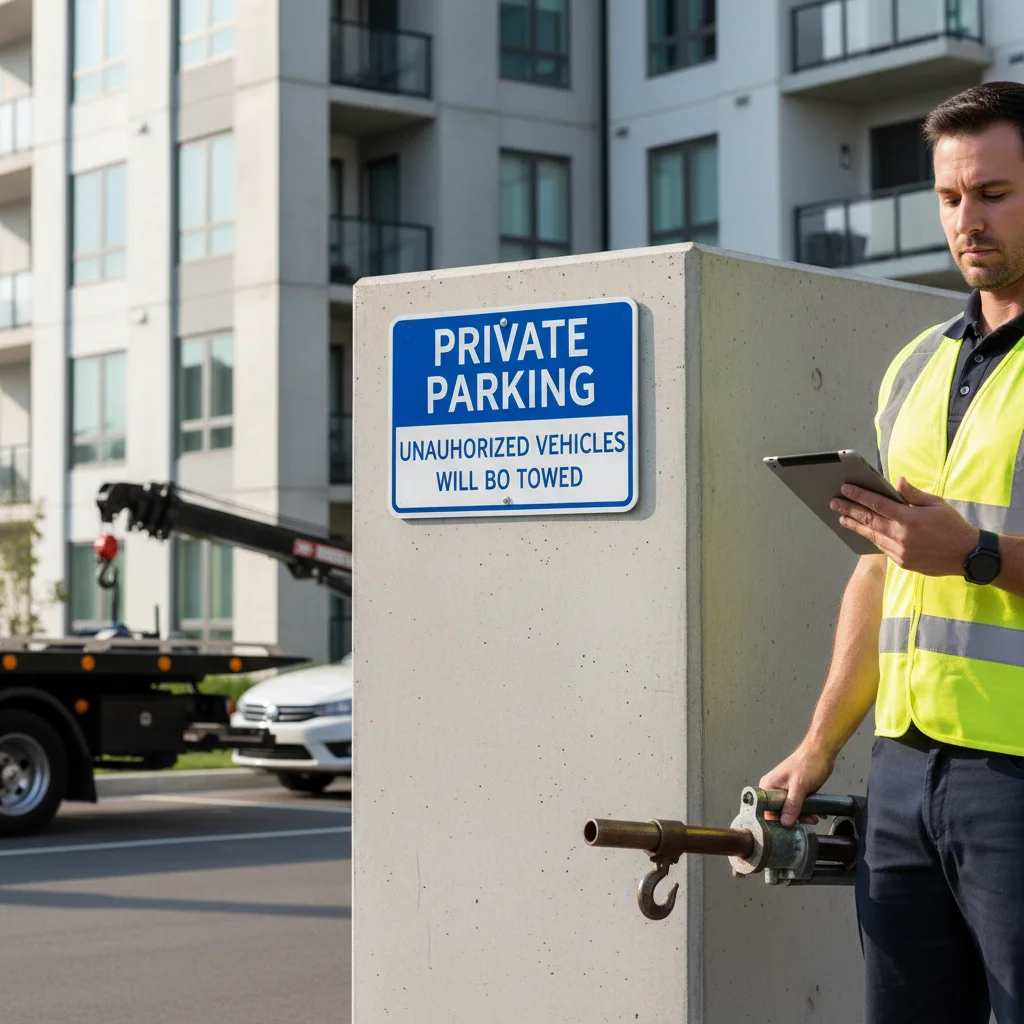
Understanding your rights as a property owner or manager
California Vehicle Code 22658 gives property owners and their authorized agents the right to remove unauthorized vehicles. That authority applies to apartment complexes, HOAs, retail centers, commercial lots, and private driveways. But CVC 22658 is also consumer-protective: it sets specific obligations you must meet before a tow is legal.
The statute’s goal is to balance your right to control your property against a vehicle owner’s right not to have their car removed without cause. When you follow the process correctly, the law is firmly on your side. When you skip steps, the vehicle owner can recover their tow and storage fees from you.
For a plain-English breakdown of exactly what the statute requires at each stage, see our CVC 22658 private property towing explainer.
The pre-tow compliance checklist
Run through this before you authorize any tow. A missed item here is what generates wrongful-tow disputes later.
1. Signage audit
Is every vehicle entrance to your property posted with a compliant sign? CVC 22658 requires:
- Signs at every entrance, including secondary access points
- Minimum size of 17 x 22 inches
- Text that includes the towing company’s name and 24/7 phone number
- Statement that unauthorized vehicles will be towed at the owner’s expense
- Your enforcement hours if not 24/7
- For properties with 25+ residential units: the initial tow fee or a reference to call for current rates
A single sign at the front gate doesn’t cover a property with multiple driveways. A hardware-store “No Parking” sign doesn’t satisfy the statute. Our full guide on private property towing sign requirements in California covers dimensions, lettering, height, and the most common deficiencies we see.
There are a few situations where you can tow without posted signage:
- The vehicle is blocking a fire lane
- The vehicle is blocking a driveway or entrance
- The vehicle is in an ADA space without a placard
- The vehicle is on a single-family driveway and blocking access
For everything else, the sign comes first.
2. Confirm a valid violation exists
Towing is authorized for actual parking violations, not disputes between neighbors, HOA rule conflicts, or personal disagreements. Valid violations include:
- Unauthorized vehicle in a reserved or permit-only space
- Vehicle in a fire lane, ADA space, or blocking an exit
- Vehicle parked in a common area for more than 24 continuous hours
- Vehicle blocking a driveway or access point
If the violation is ambiguous, document it and wait. Acting on an uncertain violation is how property managers end up liable.
3. Check whether a waiting period applies to you
This is where most guides go wrong, so read it carefully.
CVC 22658 imposes no general waiting period. If your basis for towing is compliant signage, you don’t owe the vehicle a grace period under that statute.
The one-hour wait people cite comes from a different statute, CVC 22953, and it only covers private property “held open to the public” for parking “at no fee.” Retail lots and shopping centers. CVC 22953 expressly exempts residential property parking, so it does not apply to apartment, condo, or HOA resident lots. Even where it does apply, a vehicle can be removed immediately if it’s within 15 feet of a fire hydrant, in a fire lane, blocking an entrance or exit, or in a space designated for disabled persons.
Two waiting periods do live inside CVC 22658, and each one is an independent ground for towing rather than a delay attached to signage:
- 96 hours after a notice of parking violation was issued to the vehicle
- 24 hours after notifying local traffic law enforcement about a vehicle that’s missing an engine, transmission, wheels, tires, doors, windshield, or another major part needed to drive safely
If you’re towing on signage, neither clock is yours to run.
4. Document with timestamped photos
Before making the call, photograph the vehicle showing the license plate, the violation, and the relevant signage. These photos are your proof if the tow gets disputed. Note the date, time, and exact location.
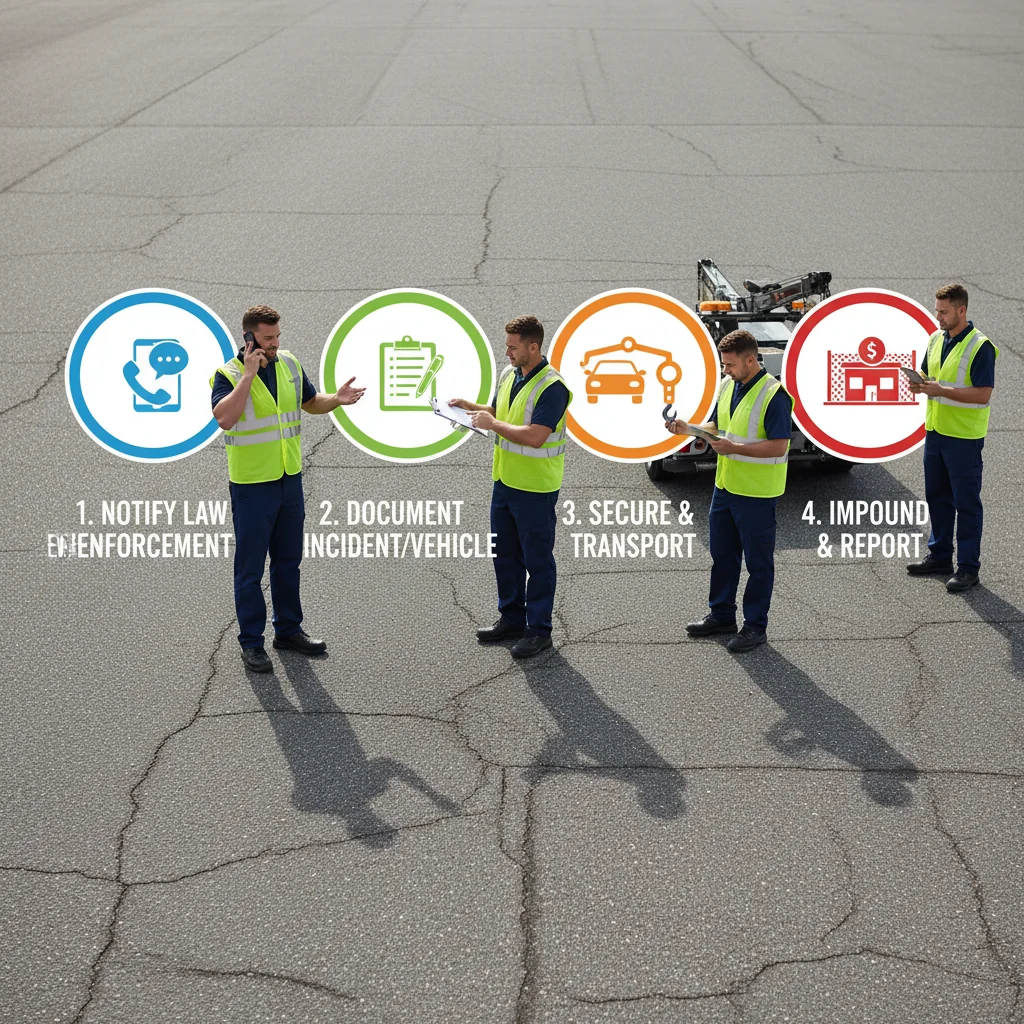
The 4 steps to initiate a legal tow in San Diego
Once you’ve confirmed compliance, authorizing the tow is straightforward.
Step 1: Provide written authorization
CVC 22658(l) requires written authorization before the vehicle is moved. Your authorization must include the vehicle’s make, model, VIN, and plate; your name, signature, job title, address, and working phone number; the grounds for removal; and the times the vehicle was first observed and the tow was authorized. A reputable tow company won’t move a vehicle without this form signed and on file.
The person authorizing generally has to be there. CVC 22658(l)(1)(A) requires that the owner, lessee, employee, or agent signing the authorization be present at the time of removal and verify the violation. There’s one narrow exception: a residential rental of 15 or fewer units with no onsite owner, agent, or employee, where a tenant verified the violation and requested the tow from their own assigned space by signed request or email, delivered to the tow company within 48 hours.
You also can’t hand the decision over. Under CVC 22658(l)(1)(E)(i), general authorization to remove vehicles at the tow company’s discretion is limited to vehicles within 15 feet of a fire hydrant, in a fire lane, or blocking an entrance or exit.
A standing service agreement is still worth having, but be clear about what it does. It sets terms, patrol expectations, documentation, and insurance. It does not replace the per-tow written authorization, and it does not let you approve a tow by phone with nobody on site.
Step 2: Contact a licensed towing company
Use a professional towing service that specializes in private property impounds and knows CVC 22658. Give them the vehicle information and the violation. The towing company’s name must match what’s on your posted signs.
Quick Tow SD handles private property towing for properties across San Diego County. We carry the required service agreements, provide documentation on every tow, and include a free signage audit when we start working with a new property.
Step 3: Law enforcement notification
Within one hour of authorizing the tow, the local traffic law enforcement agency has to be notified, by phone or the fastest available means:
- SDPD for properties inside the city of San Diego
- Sheriff’s Department for unincorporated areas
- The city police department for incorporated cities like Chula Vista, Escondido, or Oceanside
The notification is how the vehicle owner finds their car instead of reporting it stolen. It’s a statutory duty with a clock on it, and it’s one of the first things examined when a tow gets disputed. We handle this step on every tow we run.
Step 4: Confirm the vehicle owner can retrieve the car
The vehicle owner must be able to retrieve their car during normal business hours, which CVC 22658 defines as Monday through Friday, 8 a.m. to 5 p.m., except state holidays. The yard has to accept a valid bank credit card or cash, so cash-only isn’t compliant. If the vehicle is released within 24 hours, only one day of storage may be charged.
CVC 22658 sets no dollar cap on release or storage fees. Instead, subdivision (i) treats a charge as excessive when it exceeds what the law enforcement agency with primary jurisdiction would have been charged for the same tow or storage. Rates vary by operator and jurisdiction, so be wary of any guide quoting a flat “legal maximum” figure.
Who pays, and when you might be liable
The registered vehicle owner pays towing and storage fees. You pay nothing, as long as every step above was followed correctly.
If the tow is later found to be unauthorized (bad signage, invalid violation, no written authorization, missed police notification), the property owner can be held jointly liable for tow and storage fees under CVC 22658(h). That’s the financial risk of skipping steps.
This is different from a wrongful tow situation, where the vehicle owner’s car was removed incorrectly. That scenario, and how vehicle owners can dispute an improper removal, is covered in our post on when a private property tow is illegal in California.
Setting up ongoing compliance for your property
For property managers who handle frequent violations, a standing service agreement with a licensed tow company makes the process consistent. Understand its limits, though.
What a standing agreement does well:
- Sets the patrol schedule, documentation standard, insurance, and indemnification
- Keeps signage audited and current
- Makes sure every tow comes with a photo record
- Names who on your staff is authorized to verify a violation and sign
What it does not do:
- It does not let staff authorize a tow by phone with nobody present. CVC 22658(l)(1)(A) still requires written authorization from someone present who verified the violation, outside the narrow 15-or-fewer-unit residential exception.
- It does not let the tow company patrol and pull cars at its own discretion. Under CVC 22658(l)(1)(E)(i) that’s limited to fire hydrants, fire lanes, and blocked entrances.
An agreement that promises otherwise is selling you the exact exposure you’re trying to avoid. The CVC 22658 explainer covers what a properly structured agreement should include.
When to call us
Quick Tow SD partners with apartment complexes, HOAs, and commercial lots throughout San Diego County on private property enforcement. We provide standing service agreements, signage audits against the actual statutory elements, and per-tow documentation with the verifying person named on the form. Call us at (858) 923-5787 to discuss your property’s setup.
Frequently asked questions
What does CVC 22658 require before a property owner can legally tow a car?
One of the four grounds in CVC 22658(a), plus written authorization, plus notice to law enforcement within one hour of authorizing the tow. The four grounds are alternatives, not a checklist: compliant posted signage, a parking violation notice issued 96 or more hours earlier, an inoperable vehicle 24 or more hours after notifying law enforcement, or a lot improved with a single-family dwelling. For most apartment and HOA properties, signage is the ground being used.
Can an HOA tow a car without posted signs?
In most cases, no. Signs are required for virtually every private property towing situation except vehicles blocking fire lanes, ADA spaces, or driveway access. An HOA that tows without compliant signage risks being held liable for the vehicle owner’s tow and storage costs.
How long does a vehicle have to be parked before you can tow it from a common area?
CVC 22658 sets no general waiting period, so if you’re towing on compliant signage there’s no statutory clock to run. The one-hour rule in CVC 22953 covers property held open to the public for free parking and expressly exempts residential parking, so it doesn’t apply to a resident common area. Documenting how long a vehicle has sat is still good practice, and it’s what supports you if the tow gets disputed.
What happens if a car is towed and the process wasn’t followed correctly?
The vehicle owner can dispute the tow and potentially recover their costs from the property owner. Under CVC 22658(h), property owners can be jointly liable when a tow was unauthorized. Working with a licensed operator who documents every step is the best protection.
Do I need a written service agreement with my tow company?
A standing agreement is strongly recommended for any property that handles violations regularly, because it sets documentation standards, insurance, and who on your staff can verify and sign. It does not, however, create blanket pre-authorization. CVC 22658(l)(1)(A) still requires written authorization from someone present who verified the violation, except for a residential rental of 15 or fewer units with no onsite staff.