A car in a vacation rental’s parking space can disrupt an entire stay. The person who should arrange the tow depends first on whether the car sits on private rental property, in a shared lot, or along a public curb.
Guests should usually contact the host or property manager before requesting removal. Owners and managers should confirm their authority and the property’s compliance with California towing rules.
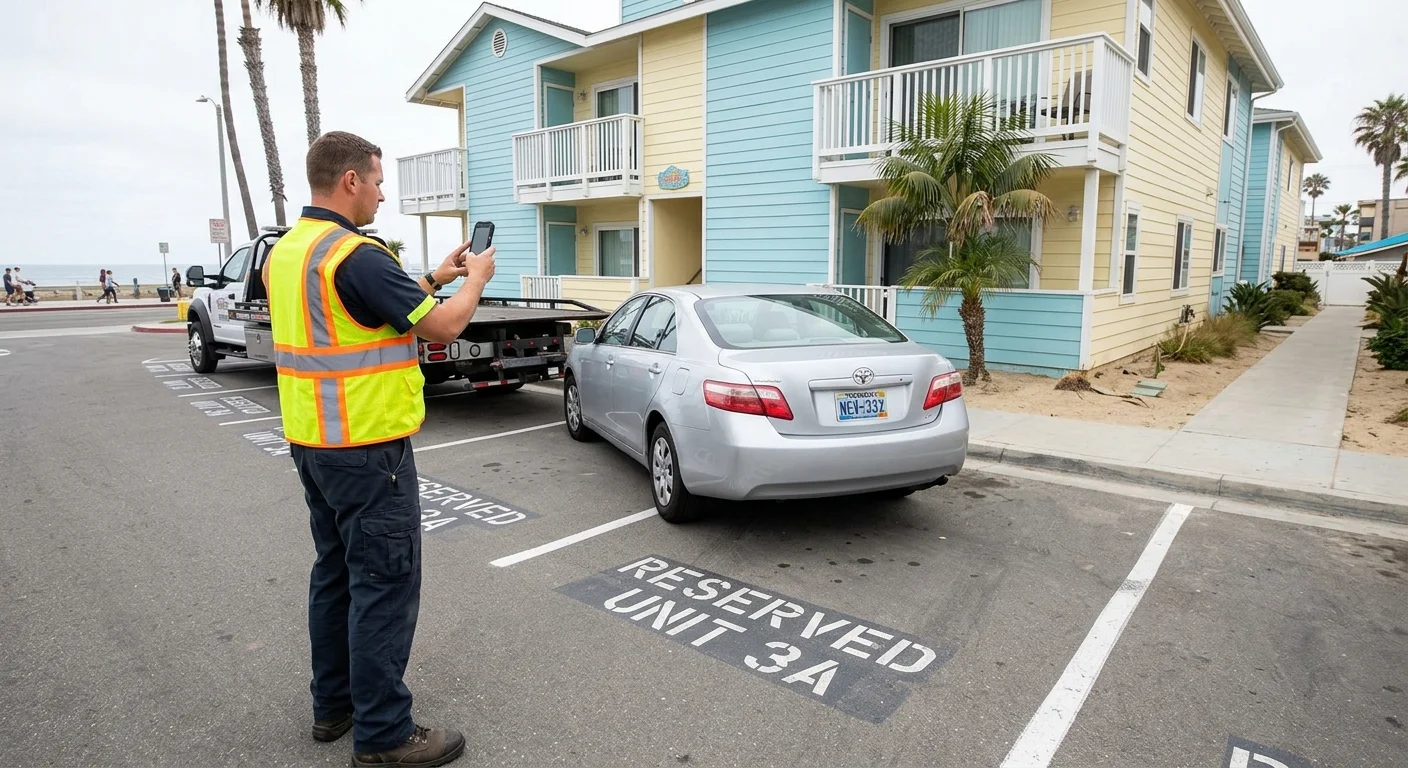
Separate the public curb from the rental property
Start by locating every tire and the property boundary. A car can look like it’s blocking rental parking while remaining entirely on a public street. The correct contact changes when the vehicle crosses that line.
Private areas may include a driveway, marked rental space, garage entrance, or private lot. Public areas generally include the street and curb. Shared parking may belong to a condominium association, apartment property, or another manager rather than the individual rental owner.
This distinction matters in Mission Beach. Homes, vacation rentals, alleys, and curb parking sit close together. A vehicle near a narrow driveway may occupy public roadway, private paving, or both. Don’t decide based only on where guests usually park.
California Vehicle Code section 22500(e) prohibits parking in front of a public or private driveway. Section 22651(d) provides police authority to remove a vehicle blocking a private driveway from the street. That means a private towing request isn’t the right starting point when the problem vehicle remains on the public roadway.
For a curbside vehicle, contact the public agency responsible for that location. Describe the obstruction and let that agency decide what action is available. Don’t tell an operator that the car is on private property unless you’ve confirmed it.
If the vehicle sits inside the rental boundary, different rules apply. Our guide to private property towing explains the service, while the location-specific steps below help you avoid calling the wrong party.
Confirm who manages or controls the parking area
A guest’s reservation may include one parking space. That doesn’t necessarily establish who can authorize removal of another vehicle. The booking, house rules, lease, management agreement, or association documents may identify who controls the parking area.
Guests should contact the host or listed property manager first. Send the address, space number, photos, and booking details. Ask whether the space belongs exclusively to the rental or forms part of a shared property.
Owners should check whether a management company, homeowners association, or lot operator controls towing decisions. A property manager should confirm that the management agreement covers the affected area. When several rentals share one lot, one owner shouldn’t treat the entire lot as personally controlled space.
California’s private-property towing law includes detailed requirements for removal authorization. It also limits when a standing towing authorization can replace approval for an individual removal. Those situations are a vehicle within 15 feet of a fire hydrant, in a fire lane, or blocking an entrance or exit.
Don’t assume a tow-company sign or an old service agreement settles every case. The person controlling the property should verify the current requirements for that exact location and reason for removal.
If the dispute concerns an assigned space, read our guide about a car parked in your space. It explains why assigned parking, shared parking, and blocked access need different handling.
Document the vehicle and posted information
Create a clear record before anyone moves the vehicle. Photograph the full car, its license plate, and its position within the parking area. Include wide shots showing the driveway, painted space lines, curb, garage entrance, and nearby property features.
Take separate photos of every entrance to the lot. Capture any towing signs closely enough to read their wording. Keep wider images showing where each sign appears relative to the entrance.
Under California Vehicle Code section 22658, a compliant-sign route has specific requirements. Signs must appear in plain view at all property entrances. Each sign must measure at least 17 by 22 inches, name the authorized towing company, provide telephone numbers, and state that unauthorized vehicles will be towed at the owner’s expense.
Signage isn’t the only possible ground listed in the statute. However, that doesn’t mean every unsigned property permits immediate removal. The available route depends on the property, the vehicle’s condition, prior notice, and other facts. Our guide to California private-property towing signs covers the approved sign details.
Also save messages between the guest, host, and manager. Note when the vehicle was first observed, but don’t invent an arrival time. Record any attempt to identify the driver through the through the rental’s normal communication channels.
Don’t enter the vehicle, move it with another car, block it in, or confront the driver. Documentation should preserve facts without creating a new safety or property dispute.
Contact the authority responsible for the location
Once the location and property control are clear, contact the party responsible for that space. For private rental property, that may be the owner, authorized manager, association, or lot operator. For a vehicle on the public street, report the obstruction to the responsible public agency.
Give the responsible party a concise set of facts:
- The complete Mission Beach address
- Whether the car is on private paving or the public street
- The plate number and vehicle description
- The affected space, driveway, entrance, or exit
- Who manages the property
- What signs are posted at each entrance
- Whether the driver is present
Avoid labeling the vehicle abandoned unless the responsible authority has made that determination. “Unknown vehicle in assigned space” or “vehicle blocking the driveway entrance” describes what you can actually see.
If private removal appears appropriate, the controlling party can review the authorization requirements before contacting an operator. Our guide on legally towing a car from private property in San Diego walks through that decision without treating every parking conflict alike.
Quick Tow SD is a referral service. We take the call and connect customers with an independent towing operator. The operator performs the work, sets any applicable price, and receives payment directly. We don’t own an impound yard or make legal decisions for a property owner.
Tell dispatch immediately if ownership, location, or authorization remains disputed. The operator may need more information before accepting the request.
Verify the current rule before arranging a tow
California towing law is detailed, and property facts can change the answer. Verify the current version of Vehicle Code section 22658 before authorizing a private-property removal. Check the actual signs and documents at the rental rather than relying on a neighboring property’s setup.
The statute lists several alternative grounds for private-property towing. These include compliant entrance signs, a parking-violation notice issued at least 96 hours earlier, an inoperable vehicle after the required law-enforcement notification and waiting period, and property improved with a single-family dwelling. Each route has its own facts. One route shouldn’t be presented as proof of another.
A standing towing agreement also doesn’t create unlimited authority. Outside the statute’s narrow hydrant, fire-lane, and blocked-access situations, don’t assume a general authorization removes the need for approval tied to that tow.
Current private-property charges for a specific Mission Beach removal couldn’t be confirmed from the approved sources for this page. Confirm current charges and release details with the operator or storage facility before acting.
If ownership documents, association rules, or rental agreements conflict, pause. Ask the property manager, responsible public agency, or qualified California counsel to review the situation. A parking inconvenience isn’t a reason to guess about legal authority.
The careful sequence is simple: identify the boundary, confirm control, document the facts, and verify the applicable rule. That protects the guest, property manager, vehicle owner, and operator.
When to call us
Call when the vehicle is confirmed on private property, the responsible person has verified their authority, and a professional towing operator is needed. Quick Tow SD can connect you with an independent operator serving Mission Beach.
Call (858) 923-5787 to reach dispatch.