A motorcycle that dies in San Marcos still has to leave the pavement somehow. You either get limited help on the spot, or you arrange a professional tow to a shop, a garage, or home. Say where you stopped first, then describe the bike as it sits, without guessing at the part that failed.
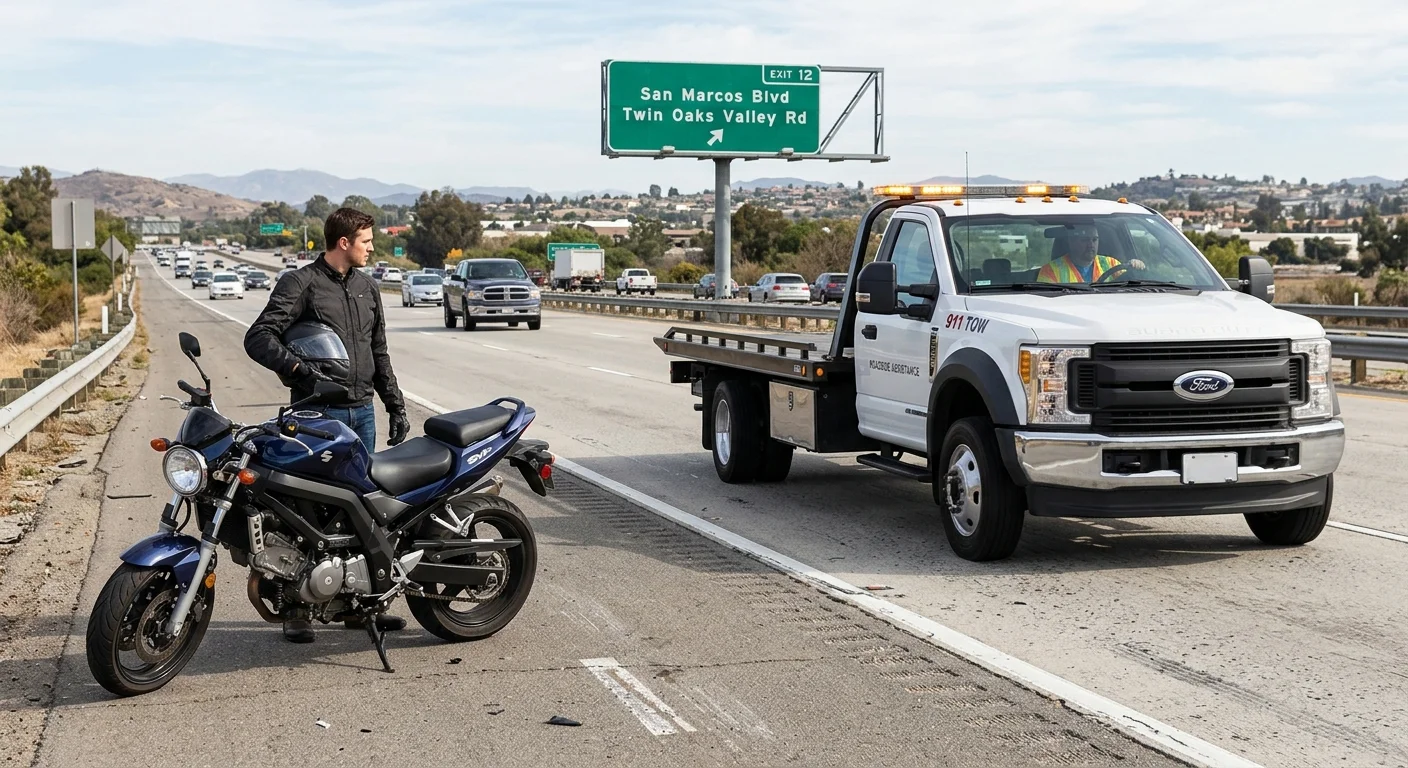
Share whether you’re on SR 78 or a local road
SR 78 is the east-west freeway through inland North County. In San Marcos it runs between Vista on the west and Escondido on the east, with ramps at Rancho Santa Fe Road, San Marcos Boulevard, Twin Oaks Valley Road, and Nordahl Road. That stretch is a commute corridor, not a quiet surface street. A bike on the shoulder sits next to faster traffic than you’ll see on San Marcos Boulevard or Twin Oaks Valley Road.
If you’re in a live lane, on a blind curve, or anyone is hurt, call 911. The California Highway Patrol handles the freeway. Stay out of the travel lanes if you can move the bike a short distance by hand without stepping into traffic. NHTSA roadside safety guidance is simple: get clear of moving traffic when it is safe, make yourself visible, and wait in a protected spot.
On weekdays and weekends, SANDAG’s Freeway Service Patrol runs free motorist aid on San Diego freeways with Caltrans and the CHP. SANDAG publishes an average dispatch of about nine minutes. Hours are weekdays 5:30-9:30 a.m., 9:30 a.m.-2:30 p.m., and 2:30-6:30 p.m., and weekends 10 a.m.-6 p.m. It does not run on federal holidays. Request it by calling 511 and saying “Roadside Assistance.” That program is built around common car problems. Do not assume a patrol truck will load a motorcycle.
City streets change the picture. Palomar College sits on Mission Road near San Marcos Boulevard. CSU San Marcos sits off Twin Oaks Valley Road. San Elijo Hills climbs south of the freeway. Lake San Marcos uses gated neighborhood streets. Those are San Marcos Police matters, not CHP, unless an officer asks you to move. Tell dispatch the exact ramp, cross street, or campus lot. “Near the 78” is not an address. “Eastbound 78, shoulder past Twin Oaks Valley, before Nordahl” is.
Once a tow truck is on the shoulder with amber lights, California’s move-over rule applies. Drivers must change lanes away from the stopped truck when it is safe, or slow to a reasonable speed if a lane change is not possible. That is Vehicle Code 21809. You cannot control other drivers. You can stay behind a barrier, off the fog line, and out of the lane.
For a broader San Marcos pickup picture, see our note on a tow truck in San Marcos.
Describe the motorcycle without guessing at the failure
Don’t diagnose it. “It died” plus a guess at the stator wastes the call. The operator we dispatch needs the facts you can see.
Give the year, make, and model if you know them. Say whether it is a sportbike, cruiser, dual-sport, scooter, or trike. Say if it has hard bags, a top case, a windshield, or a trailer hitch. Say if a passenger is with you.
Then describe motion. Will it roll in gear or in neutral. Do both wheels turn. Is a wheel locked, bent, or off the ground. Is the sidestand down and stable, or is the bike on its side. Are you on asphalt, a dirt shoulder, decomposed granite in Twin Oaks Valley, or a steep San Elijo Hills driveway.
Keys, steering lock, and alarm matter because they change how the bike is moved. Say whether you have the key. Say if the forks are turned and locked. Do not try to force the steering.
If there was a crash, say so. A bike that will not roll, a bent wheel, leaking fluids, or fork damage is a transport job, not a jump. If fuel is leaking or the bike is on its side in traffic, treat it as a hazard and call 911 first.
Keep the call short. Location, bike type, whether it rolls, whether you can wait with it, and where you want it to go. Quick Tow SD connects you with local licensed operators. The driver sent out sets the price for that job and gives you an arrival estimate for that exact pin. We do not publish a rate card or a countywide wait time.
When roadside assistance may fit
Motorcycle roadside assistance is the right lane when the bike can stay where it is and a simple on-scene service gets you riding again. A spare tire or tube you already carry, a fuel can you can legally accept, or a battery that takes a jump on a bike designed for it, are the usual cases. Even then, the operator taking the call has to confirm the work is possible at your spot.
A parking lot at Palomar College, a wide pullout on San Marcos Boulevard, or a quiet side street near Old California Restaurant Row is easier than the SR 78 shoulder. If you can push the bike a few feet into a lot without entering traffic, say that. Access is half the job.
Roadside help still has limits on two wheels. Many motorcycle problems are not a dead car battery. A snapped cable, a seized engine, a locked rear wheel, or a bike that will not stay on the stand is not a short service. If you already know you need a shop in Escondido, Vista, or along San Marcos Boulevard, skip the hope-and-wait loop and ask for a tow.
Membership roadside from an auto club is a separate product. AAA of Southern California includes up to four roadside service calls per membership year at every tier, with the difference in tow distance, not in the number of calls. Confirm with your club whether your policy covers motorcycles, and what the operator is allowed to do on a bike. If the club cannot complete the job, you still need a local motorcycle tow.
For countywide motorcycle roadside context, read motorcycle roadside assistance in San Diego. That page is the wider picture. This one is San Marcos and SR 78.
If you are on the freeway during Freeway Service Patrol hours, you can try 511 first for a patrol stop. If they cannot help a motorcycle, you are in the same place you started. Call us and we will match you with an operator who handles bikes.
When arranging a motorcycle tow makes more sense
Arrange motorcycle towing in San Marcos when the bike should not be ridden, cannot roll, or sits where a long roadside stay is unsafe.
That includes a motorcycle on the SR 78 shoulder after dark, a bike down in a gore point, a locked or damaged wheel, crash damage, a seized drivetrain, or a steep San Elijo Hills street where you cannot hold the bike. It also includes a dual-sport that left the pavement on a Twin Oaks Valley dirt shoulder and cannot get back to asphalt without being loaded.
Inland North County heat is not coastal Encinitas weather. A blacked-out bike on a San Marcos Boulevard lot in the afternoon is a different wait than a foggy Coast Highway stop. If you cannot wait with the motorcycle, say that. Do not leave it unattended in a travel lane. If you have to leave, lock what you can and tell dispatch you will not be standing with it.
A tow is also the cleaner call when the destination is a dealer or independent shop. Pushing a wounded sportbike across a campus lot at CSU San Marcos to “see if it fires” usually costs more time than a planned pickup. Tell the operator the destination address, not just “a shop in town.”
Loading method is the operator’s call. Different bikes and different damage need different equipment. Do not ask a friend to strap the motorcycle in a pickup. Do not give the driver homemade tie-down instructions. Describe the bike, the ground, and any low fairings or aftermarket parts. The driver sent out decides how to secure it.
If other drivers need to be warned, keep your hazard lights on if they work, and stay behind a barrier. You are not directing traffic. CHP or San Marcos Police can close a lane if the scene requires it.
Confirm pickup access and the destination
A motorcycle tow fails on access more often than on the hitch. Freeway shoulder, surface street, gated Lake San Marcos community, CSUSM parking structure, and a San Elijo Hills driveway with a steep grade are five different jobs. Say which one you have.
Name the gate code if there is one. Name the parking level and the nearest stairwell if you are in a structure. Name the dirt versus pavement. If the bike is behind a locked garage, the operator cannot take it until you can open that space.
Give a destination that a truck can actually enter. A home on a cul-de-sac in San Elijo Hills, a service bay on San Marcos Boulevard, a shop in Vista, and a dealer in Escondido all work if the address is real and someone can receive the bike. If the shop closes before you arrive, say so. After-hours drop rules belong to that shop, not to us.
If you want the motorcycle taken home instead of to a shop, confirm driveway slope and whether a truck can sit without blocking a neighbor. Parking in front of a public or private driveway is illegal under Vehicle Code 22500(e). Do not ask the driver to leave the truck across someone else’s apron.
Keys and payment are between you and the operator. Quick Tow SD is a referral line. We take the call, match you with a licensed and insured operator in the network, and the operator is paid directly by you. Call any time, day or night. The line takes calls around the clock.
Have the pin ready. Cross streets beat landmarks. “By Palomar College” is weaker than “Mission Road at Palomar College, south side lot.” “Off 78” is weaker than the ramp name.
When to call us
Call when the motorcycle cannot be ridden safely, cannot roll, or is sitting on SR 78 or a tight San Marcos street where waiting is the hazard. We connect you with local pros for motorcycle towing and roadside work. The operator we dispatch handles the bike, sets the price, and gives you an arrival estimate for that location. Call (858) 923-5787 to reach dispatch.