You’re on the shoulder of SR 67 above Lakeside, or sitting in a driveway off Dye Road, and the car is done. The next call is whether a jump, a spare, or a gallon of gas gets you moving, or whether you need a tow truck in Ramona to a shop you name. Share the highway, the surface, and the drop. That is what dispatch uses to send the right operator.
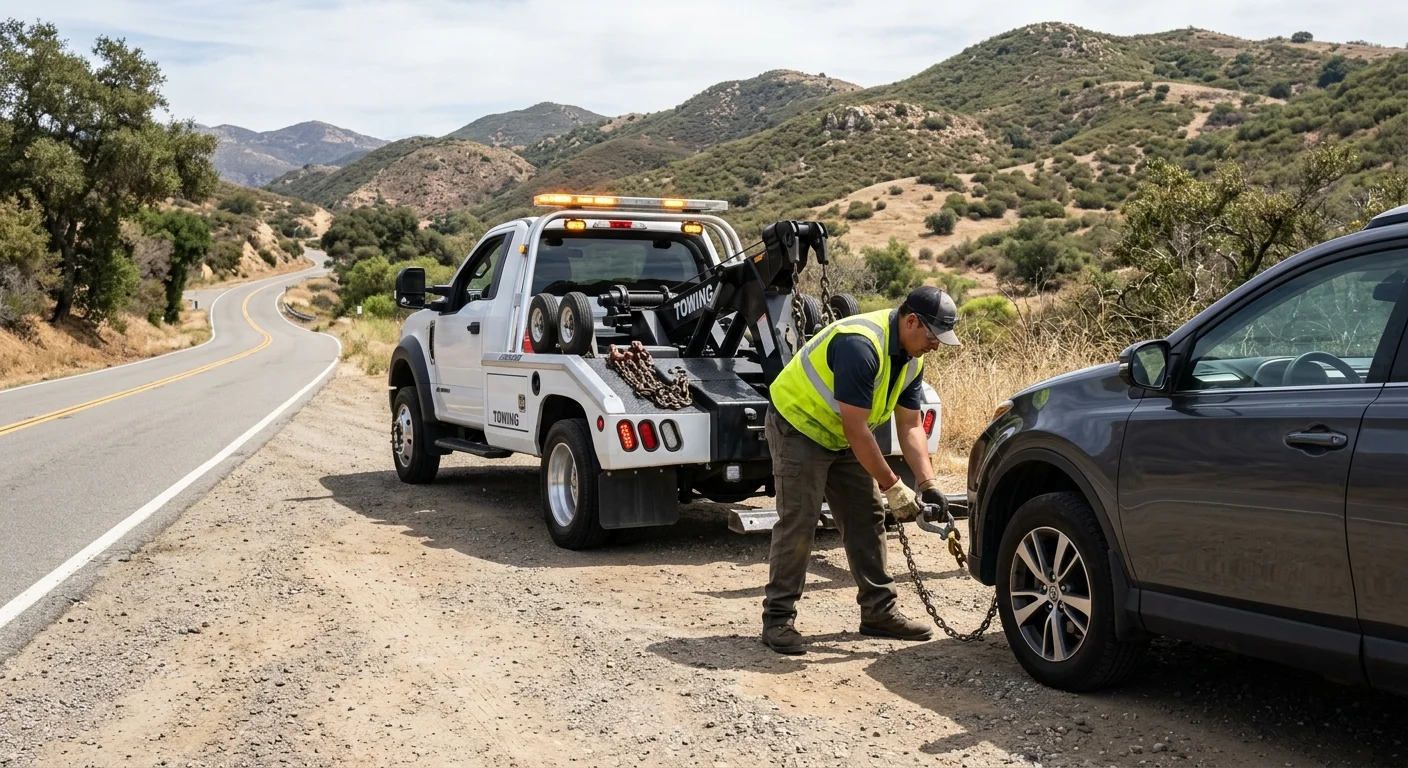
Share whether you’re on SR 67, SR 78, or a local road
Ramona sits in the Santa Maria Valley in unincorporated East County, inland of Poway and well above the coastal plain. Two state highways meet in town. SR 67 comes north from El Cajon and Lakeside, climbs the two-lane grade past Mount Woodson, and becomes Main Street. SR 78 comes east from Escondido through San Pasqual Valley as Julian Road, then continues past town toward Santa Ysabel and Julian.
That split matters. A disabled car on the 67 grade is a highway problem. Shoulders get thin on the curves. Traffic still moves at highway speed. Call 911 first if you’re in a live lane, if someone is hurt, or if the car is blocking traffic. The California Highway Patrol handles the state routes. The San Diego County Sheriff covers local streets in unincorporated Ramona.
If you’re on SR 78 west of town, you’re on the San Pasqual approach: orchards, ranch fencing, and little lighting after dark. East of the 67 and 78 junction, the road heads toward Santa Ysabel. A local street is a different job. Highland Valley Road west of SR 67, Dye Road, and San Vicente Road toward San Diego Country Estates all change access, turnaround room, and how a wrecker lines up.
Give the nearest cross street, mile marker, or a business you can see. “Near Ramona” is not enough. “Southbound 67, past the grade, before Main Street” is. “San Vicente Road heading toward the Country Estates” is. Same for a pin on Highland Valley Road. Ramona towing starts with that map, not a city name.
A freeway breakdown in San Diego is a different setup than this. SR 67 and SR 78 through Ramona are conventional highways, not urban freeways. SANDAG’s Freeway Service Patrol, the free 511 roadside program on patrolled freeways, does not apply to these stretches. Don’t wait on 511 here.
Describe the shoulder, driveway, or unpaved access
Where the car sits decides what the driver sent out can do. A paved shoulder on Main Street is one job. A two-track ranch driveway off a dirt spur is another. Say which one you have.
Tell dispatch whether you’re on pavement. Decomposed granite, washboard, and ranch gates are common around Ramona. If the car is past a locked gate, in a wash, or down a slope, say so. Some operators decline those pickups. That’s why tow companies refuse some San Diego calls: access, distance, or a destination they can’t serve.
If you’re on a driveway, say whether a truck can turn around. Narrow tree lanes and long private roads off Dye Road or out toward the Country Estates don’t always have a place to reverse. A car nosed into a fence with no roll is a different load than a car sitting straight on asphalt with the wheels unlocked.
NHTSA roadside safety guidance is the same here as anywhere. Get out on the side away from traffic when you can. Stay with the car if leaving is more dangerous. Use flashers. On the 67 grade, staying in the vehicle with seat belts on can be the safer choice when there is no real shoulder.
Don’t walk the highway at night looking for a better bar of cell signal. Stay put, stay visible, and give the surface, the slope, and whether another vehicle can get around you. If you can send a pin, send it. If you can’t, name the last signed road you passed.
When roadside assistance may solve the problem
Roadside assistance is the right call when the car can leave under its own power after a short on-scene fix. A dead battery, an empty tank, a flat with a usable spare, and a lockout are the usual cases.
A tire swap is usually a 15-minute job once the operator is on scene. Most car doors open in 5 to 10 minutes. Those figures describe the work, not how long it takes someone to arrive. The operator taking the job gives you an arrival estimate for your exact location. Inland and backcountry addresses take considerably longer to reach than the urban core.
If you have an Auto Club of Southern California membership, use it. Every AAA tier includes up to four roadside service calls per membership year. The difference is tow distance, not the number of calls. Classic is a short tow of about 5 to 7 miles. Plus goes up to 100 miles. Premier includes one 200-mile tow, with remaining calls at 100. That is often the cheapest path when the membership is already paid.
Insurance roadside add-ons work the same way: the insurer’s network, their rules, their destination limits. Ask them before you authorize a separate dispatch if you’re trying to keep the bill on the policy. There is no verified public free-tow program for a private breakdown on Ramona streets. Don’t count on one.
Ramona heat and the 67 grade work against a “just keep driving” plan. An overheating car on the climb toward town is not a jump-start problem. If the engine is steaming, the transmission won’t go into gear, or a tire is shredded with no spare, skip the roadside fix and go to a tow.
When a tow may make more sense
You need emergency towing when the car cannot move safely, or when moving it would make the damage worse. No drive gear. A broken axle. A wheel that won’t roll. Steering that doesn’t. Collision damage. A car in a ditch or off the pavement on Highland Valley Road. Those are tow jobs.
A tow also makes sense when a roadside fix would only get you a mile down SR 78 before it fails again. The operator we dispatch can take the car to a shop you name. Confirm that shop is open, that it takes your vehicle, and that it is the place you actually want.
People search for the cheapest tow, a free tow, and California towing rates. There is no statewide dollar cap in the Vehicle Code for an owner-requested tow. Owner-requested rates are set by agreement with the operator. The City of San Diego’s published impound fee schedule applies to City contract tows, not to a private breakdown in unincorporated Ramona. We don’t publish a rate card. The operator quotes the job once they know the pickup and the drop.
A free haul is membership, insurer, or a shop that includes the trip. If none of those apply, you’re paying the operator directly. Ask for the destination in the quote, not a vague “Ramona towing” number. Mileage, surface, and whether the car rolls all change the work.
An EV or AWD that the maker wants loaded with all four wheels off the ground is a tow, not a push. Give year, make, and drivetrain so the driver sent out brings the right truck.
Confirm the repair destination before dispatch
Name the drop before anyone hooks the car. “Tow truck near SR 67” is the pickup. The bill, and the night you have, live on the destination.
Ramona has independent shops along Main Street and SR 78. Many drivers still want a dealer or a chain in Poway, Escondido, El Cajon, or Kearny Mesa. That is a longer haul. Say the street address, not “a shop in town.” If the shop is closed, say where the car should sit overnight. The operator we dispatch sets that plan with you. They cannot store it at a Quick Tow lot. We don’t run a yard.
If you don’t have a shop yet, say that. You can still choose a facility before the truck leaves. Have the year, make, drivetrain, and whether it rolls. A locked steering wheel, a lowered car, or an EV changes how it’s loaded. Give gate codes, dogs, and whether the car is facing in or out.
Quick Tow SD is a referral line. We connect you with a licensed, insured operator. That operator performs the work, sets the price, and is paid by you. We serve Ramona and every city in San Diego County. The line takes calls any time, day or night. If the car is in a live lane on 67 or 78, lead with that. Hazard first, destination second.
When to call us
Call when the car is staying put, the highway is unsafe, or a jump and a spare won’t get you home. Quick Tow SD takes the call and matches you with an independent licensed operator who does the work. Call (858) 923-5787 to reach dispatch.