The car is on a lower level of a downtown San Diego garage, and it is not rolling out on its own. That is a planning job, not a curb-side hook. The operator we dispatch needs the vehicle, the structure, and the drop-off before they pick a method.
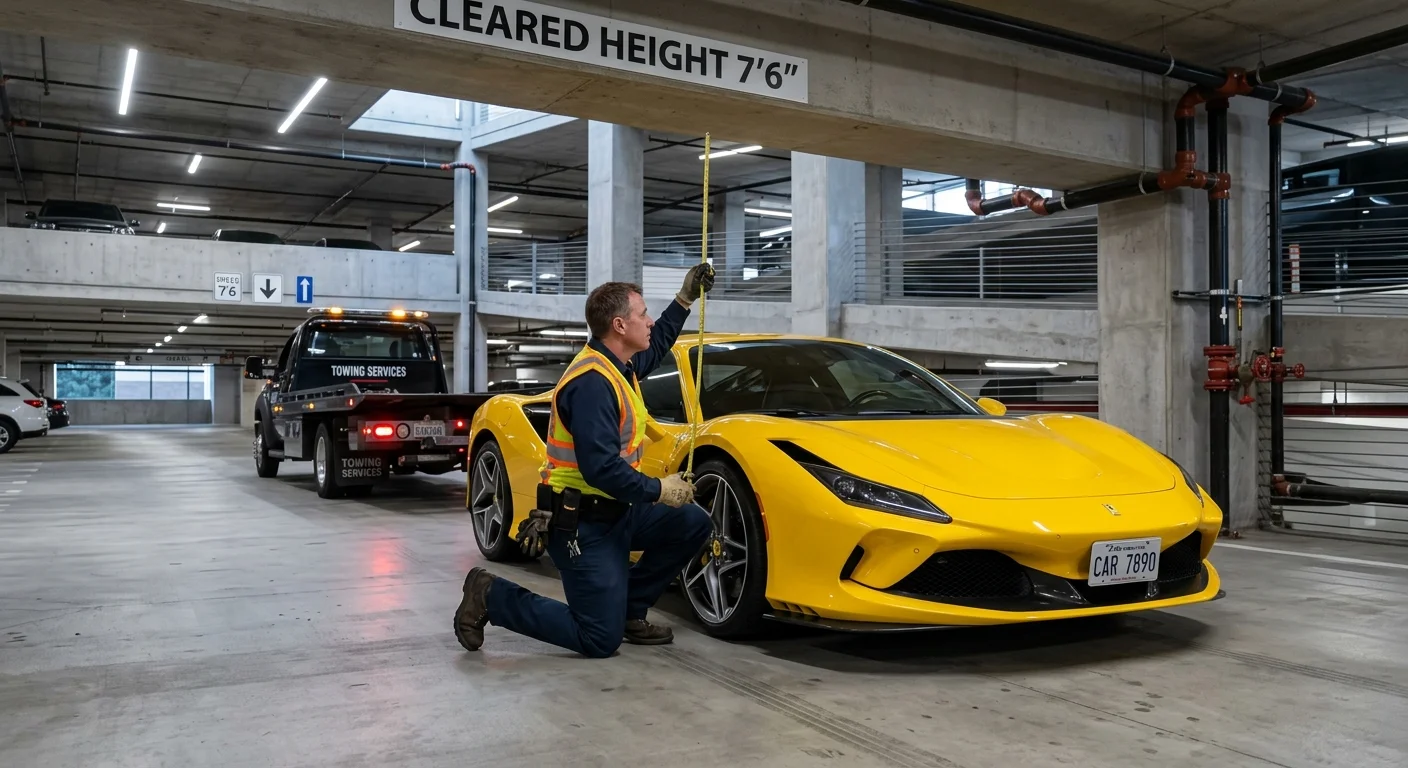
Yes, a car can be towed out of a parking garage. A full-size truck often cannot drive down to the stall. The work is matching the car and the building to an independent licensed operator, then letting that driver set the pickup plan and the price.
Describe the vehicle without guessing at the failure
Start with what you can see and what the dash actually says. Do not guess the failure on the call. “It won’t start” is not the same as a locked transaxle, a seized caliper, a bent splitter, or a car that still rolls in neutral. Those details change how the driver sent out stages the car inside a tight structure.
Give year, make, model, and drivetrain. Say if it is a manual, a dual-clutch, or an automatic that will not select neutral. Say if the battery is dead, if the steering is locked, and if a tire is flat or off the rim. Photos of the nose, the rocker, and the stall help more than a brand name.
San Diego’s mix of cars is not one job. A stock Cayman in a UTC mall garage is not the same as a track-lowered 911 on a spiral ramp in East Village. A plug-in exotic in a Little Italy mixed-use garage is not the same as a classic in a Point Loma hillside carport. Exotic and classic vehicle towing is the service lane for that mix. It is still the operator on scene who decides the method after they see the car.
Do not assume every exotic must ride a flatbed. Manufacturer recovery pages differ by model, and they are the source, not a blog rule. Tesla’s Model 3 transporter instructions call for all tires off the ground and unable to spin during transport. Tesla recommends a flatbed or comparable transport for that model. Wheel lifts plus dollies are allowed only under Tesla’s stated limits, including a 35-mile (55 km) maximum and the dolly maker’s speed rating. Those are Model 3 instructions, not a rule for every Tesla or every EV.
Ford’s Mustang Mach-E transport page recommends a wheel lift plus dollies or a flatbed, with all wheels off the ground, and it points readers to the towing manual for that vehicle. Ford also says the online page can differ from the book that shipped with a given car. That book is primary for that car. Other makes need their own recovery procedure. Tell dispatch the exact year, model, drivetrain, and damage so the referred pro can check the maker’s method instead of improvising.
If you do not have the owner’s manual in the glove box, say so. Do not try to force a transaxle into neutral if you do not know the override. Do not jack the car on garage concrete to “help.” The operator we connect you with is licensed and insured. They set the loading plan. Your job is a clear description, not a diagnosis you cannot prove.
Measure and report the garage clearance
The structure is half the job. Read the posted clearance at the entrance, then measure what the truck actually has to clear. Posted height is a starting number. Pipes, sprinklers, garage-door tracks, and a later retrofit can sit lower than the sign. Walk the path the truck or dollies would use, not only the stall.
San Diego does not have one garage type. Older downtown structures off Broadway, Kettner, and the East Village grid often have tight turns, low beams, and spiral ramps. Mission Valley and Fashion Valley decks are usually more open, but they still pinch at ticket gates and speed bumps. Coastal hotels in La Jolla, Pacific Beach, and Coronado stack cars under low lids and valet lanes. Inland north county offices along I-15 tend to have taller decks and longer ramps. South Bay malls and Chula Vista mixed-use buildings vary stall to stall. A page that treats Encinitas and El Cajon as the same garage is not useful here.
Report the posted height in feet and inches. Report the tightest point you can see on the way in. Note whether the entrance is a ticket arm, a roll-down gate, or a manned booth. Note whether the operator can stage on the street or must enter. Downtown curb space near Petco Park, the Convention Center, and Horton is often blocked by loading zones and bike lanes. A hillside garage in Bankers Hill or Point Loma may have a steep apron that a long bed cannot sit on.
This is the same access problem we cover in parking garage towing across San Diego, with one extra constraint: a low exotic often cannot be dragged over a speed bump or a ramp break. If the truck cannot enter, the plan may be to roll or winch the car to a legal staging spot, then load there. That is extra labor. It is not a reason to invent a countywide price.
If this is your car and you asked for the pickup, say that. A property-directed removal from a private garage is a different legal track under California Vehicle Code 22658. This page is for an owner-requested parking-structure vehicle pickup, not an HOA tow and not a repossession. Repossession follows other California rules. Quick Tow SD is a referral line for ordinary towing. We do not run repo jobs, and we do not stop them.
Ask building staff, before the truck is rolling, about after-hours access, elevator-only levels, and whether a second vehicle is blocking the stall. A gated podium garage in Little Italy at 11 p.m. is a different call than an open UTC deck at noon.
Share wheel, steering, and ground-clearance details
Ground clearance, wheel condition, and steering lock decide whether the car can be rolled, dollied, or loaded in place. A splitter that already kisses the concrete will not survive a steep bed angle. A locked steering column will not follow a wheel lift the way a free-rolling Civic will. A center-lock wheel or a very wide rear tire changes how straps sit.
Give the lowest point you can see: splitter, chin spoiler, side skirt, or aftermarket oil pan. You do not need a shop measurement. A photo next to a credit card or a known curb height is enough for dispatch to flag a low-clearance exotic car tow. Aftermarket lowering is common on weekend cars that park under Fashion Valley and along the coast. Factory aero on a modern supercar can sit just as low.
Say whether all four tires hold air, whether one corner is on a donut, and whether a wheel is folded under. A car that will not roll needs a different setup than a car that rolls but will not start. If the steering is locked, say so. If the car has air suspension stuck in a low mode, say so. If you already tried to raise it and it did not move, say that too.
Do not claim that wheel-lift towing is always wrong, or that a flatbed is always required. Some recovery manuals allow a wheel lift plus dollies when every tire is off the ground and the maker’s distance and speed limits are respected. Some cars and some damage states do not. The referred pro has to match the manual, the garage, and the car in front of them. Soft straps versus chains is a loading choice on scene. We do not publish a house method, because this brand does not own the truck.
If the car is an EV or hybrid, add that on the first call. High-voltage damage is a different conversation than a flat tire. Tesla’s submerged-vehicle guidance is for flooded cars and does not apply to a dry garage stall. Do not treat a parking-structure pickup as a battery emergency unless you have actual crash or water damage to report.
Keep people clear of the stall. NHTSA roadside guidance is written for shoulders, but the same idea holds in a dark garage: phone charged, lights on if you have them, and nobody standing behind a car that may roll. If the operator stages on a public street with amber lights, other drivers in California must move over or slow under Vehicle Code 21809.
Ask how the referred pro plans the pickup
Ask the driver sent out to walk the plan before anything hooks up. You want three things in plain words: where the truck will sit, how the car will move from the stall to the truck, and what contacts the car during loading.
A parking structure vehicle pickup often uses one of a few shapes. The truck enters and loads on a level deck. The truck stays at the entrance and the car is brought to it. The car is winched a short distance because it will not roll. Dollies or skates move a car that cannot steer. None of those is a promise that a given operator owns every tool. The question is what that operator will use on this job.
Ask whether they have read the maker’s transport notes for your year and model. Ask where straps will land. Ask whether the bed can sit low enough for the splitter at that ramp. Ask what happens if the ticket gate is too low. A good answer names the constraint. A bad answer is “we’ll figure it out when we get there” with no interest in the posted height.
How tow trucks get cars out of parking garages is usually this: the truck does not always go to the stall. The stall comes to a legal, tall-enough loading spot, or a lower-profile setup goes in. Extra positioning is extra time. The operator sets the price and is paid directly by you. Quick Tow SD does not publish a rate card, and there is no verified county figure for “tow a car out of a garage.” City of San Diego’s published impound schedule is a different system, used when AutoReturn handles a city tow. Do not treat those numbers as a quote for a private garage pickup.
If the car is in a fire lane or blocking a ramp, say so. If HOA security is already on scene, say so. If you need the car taken to a dealer in Kearny Mesa, a specialist in Mira Mesa, or a shop in Carlsbad, say the address before they load. The plan includes the exit path out of the structure, not only the hook.
Call any time, day or night, at (858) 923-5787. The line takes calls around the clock. The operator taking the job gives the arrival estimate for that address. We do not publish a countywide window.
Confirm unloading access at the destination
Pickup is only half of exotic car parking garage towing. A car that barely left a downtown podium garage still has to come off the truck at a dealer ramp, a home driveway, or another structure. Confirm that end before the bed goes up.
Give the drop-off address and the same clearance facts: gate height, slope, overhead wires, tight alley, pavers, and whether the shop wants the car in a specific bay. Many Kearny Mesa and Miramar service drives are open. Many La Jolla and Rancho Santa Fe driveways are steep, narrow, and lined with landscaping that a long bed cannot swing past. An Oceanside or Escondido industrial shop may have a tall roll-up and a flat apron. Do not assume the destination is easier than the garage you just left.
Ask where the operator will unload. Street unload on a collector near I-5, I-8, I-15, or I-805 may be legal in one block and blocked in the next. A shop that only takes cars during business hours needs a plan if you are leaving a garage after closing. If the destination is another parking structure, repeat the clearance check. Loading at UTC and unloading under an older East Village lid is two garage jobs, not one.
If the maker limits dolly transport to a short distance, as Tesla does for Model 3 wheel-lift-plus-dolly moves, say how far the shop is. A 35-mile cap is a Model 3 transporter limit, not a San Diego traffic estimate and not a rule we apply to every car. When the manual and the trip do not match, the referred pro should choose a method the manual actually allows.
Stay until the car is on the ground and you have walked around it. California storage-facility inspection rules in Vehicle Code 22651.07 apply to stored vehicles at a facility, not to every roadside drop. Still, looking at splitters, wheels, and rockers before the truck leaves is the practical check you have. Photograph the car in the stall and again at the drop-off. That is your record, not a warranty from this site.
We refer work in every city in San Diego County. The operator performs the work, sets the price, and is paid by you. Matching the garage, the car, and the unload is how a sports-car pickup stays a planned job instead of a scrape on P2.
When to call us
Call when the exotic will not leave the garage under its own power, or when the posted lid, ramp, or gate makes a casual hook a bad idea. Do not try to drag a low car over a speed bump with a strap from a pickup. Call (858) 923-5787 to reach dispatch.