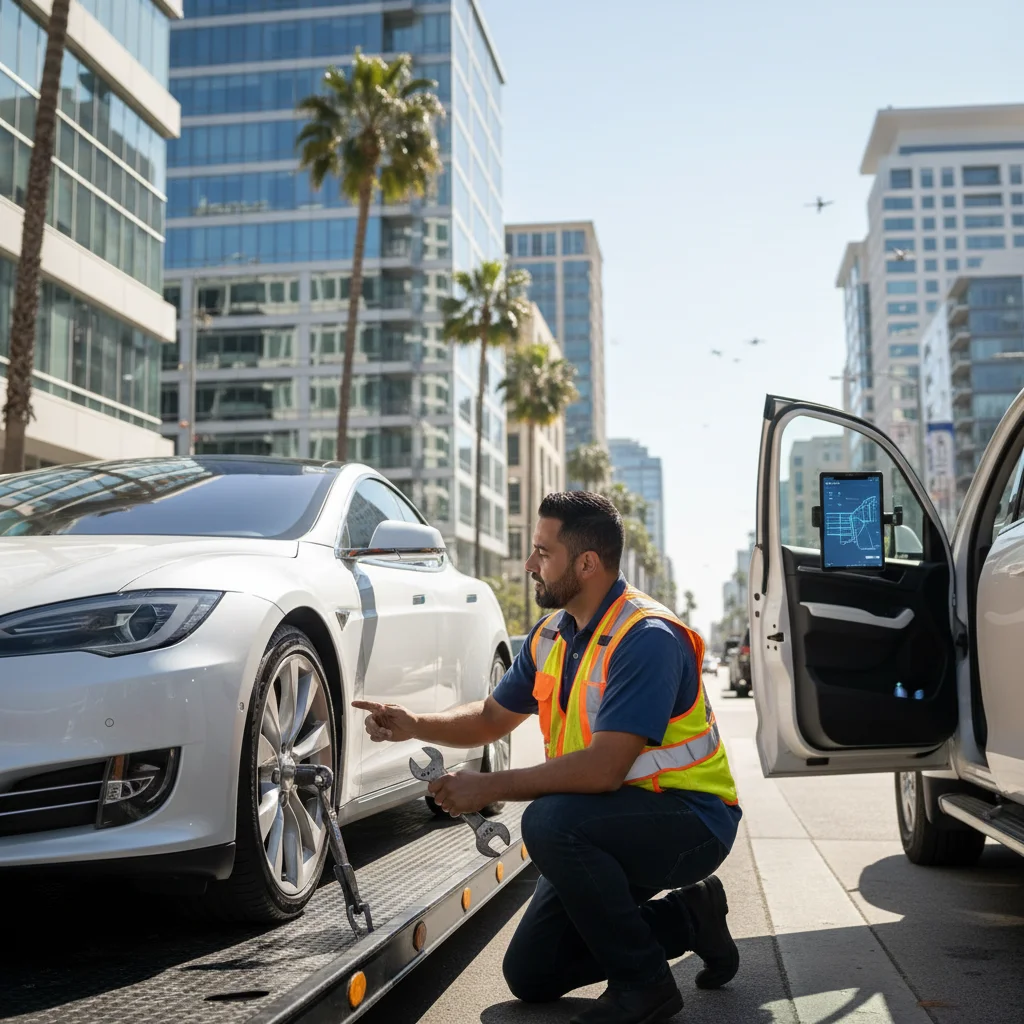
Your Tesla needs a tow, perhaps after a flat tire on I-5 near La Jolla or a battery issue in East County. Before any tow truck hooks up, you absolutely need to enable Tesla Transport Mode. Skipping this critical step can lead to thousands of dollars in damage to your electric vehicle’s motors and drivetrain. For San Diego Tesla owners, understanding how and why to use Transport Mode is as important as knowing how to charge your car.
At Quick Tow SD, we see firsthand the consequences when this isn’t done right. Modern electric vehicles, especially Teslas, are not like conventional gas cars when it comes to towing. They require specific preparation to ensure they reach their destination without further damage. This guide covers everything San Diego drivers need to know about enabling Transport Mode, why it matters, and what to expect when a tow truck arrives.
What is Tesla transport mode?
Tesla Transport Mode, also known as Tow Mode or Jack Mode on older models, is a software setting designed to prepare your vehicle for safe transport. When activated, it does several important things:
- Disengages the drive motors: This is the most important function. It prevents the motors from attempting to regenerate power or resist wheel rotation while the vehicle is being moved.
- Engages the parking brake lightly: On some models, it might release the parking brake completely, while on others, it might apply it minimally to allow for movement but prevent rolling on inclines. The goal is to allow the wheels to turn freely without damaging the motor.
- Disables automatic leveling (if equipped): For Teslas with air suspension, Transport Mode prevents the suspension from trying to self-level during loading or transport. This keeps the vehicle at a consistent height, reducing the risk of scraping.
- Deactivates Sentry Mode and other power-intensive features: This helps conserve the 12V battery, which is essential for maintaining vehicle functions during a tow, especially if the main high-voltage battery is low.
Think of it as putting your Tesla in a neutral state, but a special kind of neutral that protects its sophisticated electric powertrain. Without Transport Mode, dragging a Tesla with its wheels on the ground is like trying to drive a car with the parking brake fully engaged and the transmission in park – it’s a recipe for expensive repairs.
How to enable Tesla transport mode: a step-by-step guide
Enabling Transport Mode is a straightforward process, but it requires access to your Tesla’s touchscreen. Here’s how to do it, applicable to most Tesla models (Model S, Model 3, Model X, Model Y, Cybertruck) as of 2026:
Step 1: Park your Tesla and ensure safety
First, make sure your Tesla is safely parked. If you’re on the shoulder of I-8 near El Cajon or pulled over on SR-163, activate your hazard lights. Put the vehicle in Park (P).
Step 2: Access the service menu
On your Tesla’s large touchscreen display:
- Tap the Car icon (usually in the bottom left corner).
- Navigate to Service from the menu options.
Step 3: Locate and activate transport mode
Within the Service menu:
- Scroll down until you find Tow Mode or Transport Mode. The exact wording might vary slightly by model year and software version.
- Tap on Tow Mode or Transport Mode.
- You’ll typically see a prompt asking for confirmation. Tap Enable or Activate.
Step 4: Confirm activation
Once activated, your Tesla’s display will usually show a message confirming that Transport Mode is active. The parking brake might disengage with an audible click, and you might see a specific icon on the dashboard indicating its status.
Important notes:
- Low 12V battery: If your 12V battery is completely dead, you might not be able to access the touchscreen to enable Transport Mode. In such cases, a professional tow operator with experience in EVs will need to use specialized dollies or an immediate flatbed recovery to prevent damage.
- Software updates: Tesla frequently updates its software. While the general process remains consistent, minor menu changes can occur. If you’re unsure, refer to your Tesla owner’s manual or the official Tesla support website for the latest instructions.
- Security: Ensure your car is unlocked or the key card/phone key is present to access the touchscreen.
Remember, this preparation is your responsibility as the owner. A tow operator can guide you, but you’re in control of your vehicle’s settings.
Why transport mode and flatbed towing are non-negotiable for San Diego Teslas
This isn’t just a recommendation; it’s a requirement for safe and damage-free towing of any Tesla or electric vehicle. Ignoring Transport Mode and opting for a wheel-lift tow can lead to catastrophic damage.
The flatbed imperative: protecting your EV’s core components
Electric vehicles like Teslas rely on sophisticated electric motors and intricate drivetrain components. When a Tesla is towed with its drive wheels on the ground, even for a short distance:
- Motors stay engaged: Without Transport Mode, the electric motors remain engaged. As the wheels turn, the motors are forced to spin, attempting to generate electricity (regenerative braking) or resisting movement. This creates immense heat, friction, and electrical stress.
- Irreversible damage: This forced rotation can fry the motor windings, damage the inverter, and destroy other sensitive electronic components. The repair bill for a damaged Tesla motor and inverter can range from $8,000 to $18,000 or more, depending on the model and extent of the damage.
- AWD vehicles: Many Teslas are All-Wheel Drive (AWD). Like any AWD vehicle (Subaru, Audi, Rivian), they MUST be flatbed towed. Wheel-lift towing an AWD vehicle can severely damage the differentials and transfer case, leading to $2,500 to $5,000 in repairs. Combine this with EV motor damage, and you’re looking at a massive bill.
For these reasons, Quick Tow SD exclusively uses flatbed tow trucks for all Tesla, EV, and AWD vehicle towing services. The flatbed we send trucks (also called rollback trucks) lift your entire vehicle onto a flat deck, ensuring all four wheels are off the ground. This eliminates any risk of drivetrain or motor damage. It’s the only safe way to transport your valuable EV. You can learn more about why this method is essential on our /services/flatbed-towing/ page.
San Diego’s unique towing challenges and your Tesla
San Diego County presents specific scenarios where proper Tesla towing becomes even more critical:
- Major freeways: Breakdowns on high-speed corridors like I-5 (especially the Camp Pendleton corridor, a 20-mile stretch between Oceanside and San Clemente where military families often need assistance), I-15 (the busy North County commuter route through Escondido and Poway), or I-8 (particularly the grades heading east towards Alpine and the desert) are common. The shoulders are narrow and dangerous. You need a fast, professional response and the right equipment. See our guide on /blog/freeway-breakdown-san-diego/.
- Coastal cities: In areas like La Jolla, Del Mar, Encinitas, Carlsbad, Ocean Beach, Pacific Beach, or Coronado, tight parking lots and busy streets mean tow truck operators need precision. Beach-lot lockouts can spike in summer. PCH shoulders are often narrow and dangerous.
- North County Inland: San Marcos, Escondido, Vista, Poway see high commuter traffic on I-15. Hot summer days can stress any vehicle, leading to unexpected issues.
- East County: El Cajon, La Mesa, Santee, Lakeside, Alpine. The I-8 grade is notorious for eating engines, and EVs are not immune to all breakdown causes. Canyon roads like Crest or Sunrise Highway can be tricky.
- South Bay: Chula Vista, National City, Imperial Beach. The I-5/I-805 border corridor is constantly busy.
- Mountain areas: Julian, Pine Valley, Ramona, Mt Laguna, Borrego Springs. Response times here are naturally longer than in the urban core, and winter conditions on Sunrise Highway may require chains. Having the right tow truck is paramount.
- Arrival times: Quick Tow SD publishes no average arrival figure, because no source for one exists. You get an estimate for your exact location on the call. Knowing how to quickly enable Transport Mode helps us get your Tesla loaded and safely off the road faster.
- CHP-rotation freeway response: In San Diego, tow companies are on a rotation for freeway accident scenes and breakdowns. When Quick Tow SD is called for a Tesla, the operator sent out arrives with the correct flatbed equipment ready.
- Pricing transparency: Reputable San Diego operators, like Quick Tow SD, quote a flat rate before the truck rolls. Ask dispatch to confirm the hook fee before you agree to the tow.
For these reasons, always insist on a flatbed tow for your Tesla in San Diego. If a tow operator suggests a wheel-lift for your Tesla, politely decline and find a company that understands EV towing.
When to use transport mode (and when not to)
Understanding the correct situations for Transport Mode ensures you’re protecting your Tesla and using its features as intended.
Use transport mode when:
- Your Tesla needs towing: This is the primary reason. Whether it’s a breakdown, a flat tire, or an accident, if your Tesla needs to be moved by a tow truck, engage Transport Mode.
- Your Tesla is being shipped: If you’re moving your Tesla across the country or internationally, Transport Mode ensures its safety during loading, unloading, and transit on a carrier.
- Your Tesla is being serviced: Some service centers might request Transport Mode if they need to move the vehicle without it being driven under its own power.
- You need to move the vehicle short distances without driving: In rare cases, if you need to manually push or pull your Tesla a very short distance (e.g., out of a garage for service), Transport Mode can help, though it’s still best to consult your owner’s manual for specific pushing guidelines.
Do not use transport mode when:
- You are driving normally: Transport Mode is not meant for regular driving. It will limit speed and functionality.
- You are parking: This mode is for transport, not for parking. Use the standard Park (P) setting.
- You are washing the car: Use Car Wash Mode if available, not Transport Mode.
- You are charging: Transport Mode has no relevance to charging.
What happens if you don’t use transport mode?
As mentioned, the consequences of not engaging Transport Mode for a tow are severe and expensive.
- Motor and inverter damage: This is the most common and costly issue. The forced rotation of the motors without proper disengagement generates excessive heat and electrical stress, leading to burnt-out windings and damaged inverters. This can render your Tesla inoperable and require extensive repairs.
- Drivetrain damage: For AWD Teslas, towing with wheels on the ground can damage differentials and other drivetrain components, even if the motors aren’t directly impacted.
- Voided warranty: Tesla’s warranty explicitly states that damage resulting from improper towing is not covered. If you tow your Tesla incorrectly, you’ll be on the hook for the entire repair bill.
- Safety risks: An improperly towed EV can be unpredictable. Motors resisting movement can make it harder for the tow truck operator to safely load and secure the vehicle.
It’s a mistake you’ll want to avoid. Always take the extra minute to enable Transport Mode.
Other Tesla towing considerations for San Diego drivers
Beyond Transport Mode, there are a few other points to keep in mind when your Tesla needs assistance.
Low or dead 12V battery
If your Tesla’s main high-voltage battery is completely depleted, or if its 12V battery (which powers the infotainment, lights, and other low-voltage systems) is dead, you might not be able to access the touchscreen to enable Transport Mode.
- Professional assistance: In this scenario, it’s even more critical to call a tow company experienced with EVs. Quick Tow SD’s drivers are trained to handle these situations. We use specialized equipment like wheel dollies if a short maneuver is needed to get the car onto a flatbed, but the ultimate goal is always to get all four wheels off the ground immediately.
- Jump-starting the 12V: Sometimes, jump-starting the 12V battery can restore enough power to access the touchscreen. This is a delicate process with Teslas and should only be attempted by someone familiar with the specific jump points. Check our guide on /blog/how-to-jump-start-car/ for general tips, but for a Tesla, professional help is often best.
Accident recovery
If your Tesla is involved in an accident on I-805 or SR-94, the situation can be more complex.
- Damaged wheels/suspension: If a wheel or suspension component is damaged, the vehicle might not roll freely, making it even harder to load without specialized equipment.
- High-voltage safety: Accident-damaged EVs can pose unique safety risks due to compromised high-voltage systems. The drivers we send are trained in EV safety protocols for accident recovery. For more information, check our /services/accident-recovery/ page.
Tire issues
A simple flat tire near Otay Mesa or a blown tire on SR-78 in North County can still necessitate a tow.
- No spare: Most Teslas do not come with a spare tire. A flat often means a tow to a tire shop or service center.
- Tire repair kits: While Tesla provides a repair kit, it’s for minor punctures. A significant blow-out will require a tow.
Quick Tow SD understands the nuances of Tesla and EV towing. The drivers we send receive continuous training on the latest EV models and their specific requirements. We ensure your exotic or classic EV, like a Tesla, is handled with the care it deserves. Visit our /services/exotic-classic-towing/ page for details.
Choosing the right tow company in San Diego for your Tesla
When your Tesla needs a tow, choosing the right company is paramount. You need more than just a truck; you need expertise.
- EV experience: Ensure the company’s operators are trained in EV towing. Ask if they understand Tesla Transport Mode. Quick Tow SD specializes in EV towing, as highlighted in our /blog/ev-towing-tesla-flatbed/ post.
- Flatbed, confirmed on the call: This is non-negotiable for Teslas and all AWD vehicles. Confirm they will dispatch a flatbed tow truck for your Tesla.
- Round-the-clock availability: Breakdowns don’t stick to business hours. You need a company whose line actually takes calls at 3 a.m., not one that opens at eight.
- Local knowledge: A company familiar with San Diego’s specific geography – from the busy downtown streets to the winding roads of Julian – can provide faster, more efficient service. Quick Tow SD covers all 67 cities and communities in San Diego County.
- Transparent pricing: Avoid companies that quote low then add hidden fees. Ask for a flat-rate quote upfront. For long-distance towing, a written quote is standard.
- Safety first: The company should prioritize your safety and the safety of your vehicle. This includes following proper loading procedures and roadside safety guidelines from organizations like the NHTSA.
A knowledgeable tow truck driver understands that a Tesla is not just another car. It’s a precision machine requiring specialized handling.
Comparison of towing methods for Teslas
To make it clear, here’s a quick look at why flatbed towing is the only way for your Tesla.
| Feature | Flatbed Towing (Recommended for Tesla) | Wheel-Lift Towing (Not Recommended for Tesla) |
|---|---|---|
| Motor Engagement | Wheels free, motors disengaged (with Transport Mode) | Motors can remain engaged, potential for severe damage |
| Drivetrain Stress | None, as all wheels are off the ground | High, risk of damage to AWD/EV components (differentials, transfer case) |
| Vehicle Clearance | Excellent, no scraping, even for low-slung Teslas | Risk of scraping low-clearance vehicles, especially on ramps or uneven ground |
| Safety for EV | Highest protection against mechanical and electrical damage | Low, high risk of expensive, irreparable motor and drivetrain damage |
| Typical Cost | Standard towing rates, prevents costly repairs later | Potentially cheaper initially, but leads to massive repair bills for EV damage |
| Best Use Case | All Tesla/EV towing, long distances, accident recovery | Short distances, FWD/RWD vehicles only, and only if absolutely necessary |
Frequently asked questions
Can I tow my Tesla with a wheel-lift truck?
No, you should never tow a Tesla with a wheel-lift truck where any of its drive wheels remain on the ground. This can cause severe and irreversible damage to the electric motors, inverter, and drivetrain components, leading to thousands of dollars in repairs and potentially voiding your warranty. Always insist on a flatbed tow.
What if my Tesla’s battery is dead and I can’t enable Transport Mode?
If your Tesla’s 12V battery is dead, preventing access to the touchscreen, it complicates things. In this situation, you need a tow company highly experienced with EVs. They may attempt to jump-start the 12V battery to enable Transport Mode, or use specialized equipment like wheel dollies to carefully load the vehicle onto a flatbed without turning the drive wheels.
How long can a Tesla stay in Transport Mode?
Tesla Transport Mode is designed for the duration of a tow or transport. While there isn’t a strict time limit, it’s not meant for extended parking. Its primary function is to protect the vehicle during movement by a third party. Once the vehicle is at its destination, you should disable Transport Mode.
Does using Transport Mode affect my Tesla’s warranty?
No, using Transport Mode as intended for towing will not affect your Tesla’s warranty. In fact, failure to use Transport Mode when towing is likely to void your warranty for any resulting drivetrain or motor damage, as improper towing is typically excluded. It’s a necessary step to protect your warranty.
What should I tell the tow truck driver when they arrive?
Inform the tow truck driver immediately that you have a Tesla (or any EV/AWD) and that it requires a flatbed tow. Clearly state that you have enabled, or are about to enable, Transport Mode. This ensures the driver understands the specific requirements and uses the correct equipment and procedures from the start.
When your Tesla needs a tow in San Diego, call the experts
Dealing with a vehicle breakdown is never ideal, especially with a specialized vehicle like a Tesla. Whether you’re stranded on the I-15 in North County, facing a flat tire in downtown San Diego, or need accident recovery services in East County, knowing how to properly prepare your Tesla for a tow is your first line of defense against costly damage.
At Quick Tow SD, we understand the unique needs of electric vehicles. Our experienced operators are trained in Tesla-specific towing procedures, always dispatching a flatbed truck to ensure your EV is transported safely and without damage. We’re available 24/7, providing prompt, professional, flat-rate service across all of San Diego County.
Don’t risk your Tesla’s expensive components to improper towing. For reliable flatbed towing services in San Diego, contact Quick Tow SD.
Call us at (858) 923-5787 or visit our /services/flatbed-towing/ page to learn more.