TL;DR
- Correct clamp order: red to dead positive, red to donor positive, black to donor negative, black to bare metal on the dead car’s engine block (never the dead battery).
- The last clamp goes on bare metal to avoid sparking near explosive hydrogen gas vented by the battery.
- A portable lithium jump pack ($70 to $150) eliminates the need for a donor car entirely and fits in your glove box.
- If the car cranks weakly after 30 seconds of donor idle, dies again within 5 minutes, or makes a clicking sound with no crank, a jump won’t help. Call a tow.
Jumper cables look simple, but a wrong move fries a computer module or sparks near battery gas. Here’s how to do it right - and when to stop.
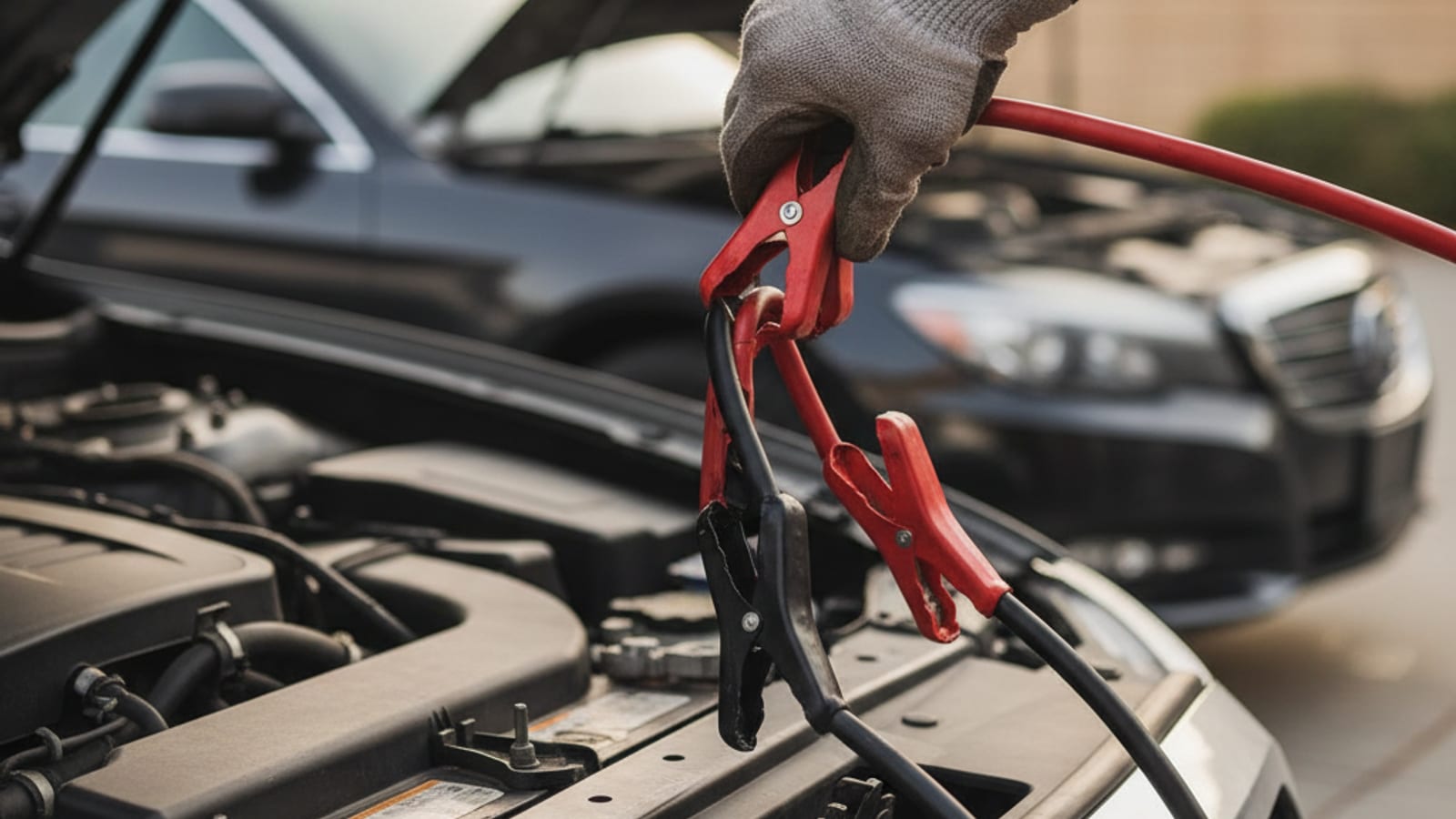
The correct clamp order (this is the whole thing)
- RED to POSITIVE (+) on the DEAD car’s battery. The positive terminal is usually marked with a plus sign or a red cover.
- RED to POSITIVE (+) on the DONOR car’s battery.
- BLACK to NEGATIVE (−) on the DONOR car’s battery.
- BLACK to BARE METAL on the DEAD car’s engine block - NOT the dead battery.
That last clamp placement is the one most people get wrong. Here’s why it matters.
Why doesn’t the last clamp go on the dead battery?
A discharged lead-acid battery vents small amounts of hydrogen gas. Hydrogen is explosive. When you connect the final clamp, there’s a small spark - that’s just physics.
If that spark happens right next to the battery, you can ignite the hydrogen cloud around the vent holes. Battery acid spray, cracked case, facial injuries - not theoretical, it happens a few times a year.
A bare metal bolt on the engine block (unpainted, clean) is an excellent ground point. Spark happens there, well away from the battery. Safe.
Good ground points on most cars:
- A large unpainted bolt on the engine block
- An exposed strut tower bolt (cleaner than the block)
- An unpainted part of the chassis frame under the hood
Do not ground to: the negative battery post (spark danger), a fuel line, or anything painted (won’t conduct).
What should you check before connecting cables?
- Both cars OFF. Keys out of the ignition, doors closed, interior lights off.
- Position the donor car so the cables reach. Usually nose-to-nose, parking brakes on, both in park (or 1st gear manual).
- Check the batteries visually. If the dead battery is bulging, cracked, or leaking - stop. A compromised battery can rupture. Call a tow.
- Check the cables. Frayed insulation or corroded clamps means the cables aren’t safe to use. Replace before using.
After connecting
- Start the donor car. Let it idle for 2-3 minutes. This pushes voltage into the dead battery.
- Try to start the dead car. Crank for 5 seconds max. If it doesn’t start, wait 60 seconds and try again.
- If it starts: let BOTH cars run for 2-3 minutes connected. This stabilizes the charge.
- Disconnect in REVERSE order:
- BLACK clamp off the bare metal ground point
- BLACK clamp off the donor negative
- RED clamp off the donor positive
- RED clamp off the formerly-dead positive
- Drive the formerly-dead car for 20+ minutes to let the alternator recharge the battery.
How do you know when a jump start won’t work?
If any of these happen, the battery or alternator is failing - a jump won’t get you home:
- Cranks weakly after 30 seconds of donor idle. Battery is too far gone to accept a surface charge.
- Dies again within 5 minutes of driving. Alternator isn’t charging. Battery drained while running.
- Engine runs, then dash lights flicker or shut off. Alternator is failing or the battery can’t hold any charge.
- Clicking sound, no crank. Could be the starter, not the battery. A jump won’t help.
- Smoke, smell, or visible sparks from the battery or cables. Stop immediately. Call for emergency towing.
In any of those cases, you need a tow to a shop for battery and alternator testing. Attempting more jumps can damage modules in newer cars.
Are portable jump packs worth it?
A modern lithium jump pack costs $70-$150 and lives in your glove box. It replaces the donor car entirely:
- Connect RED clamp to POSITIVE (+) on your battery.
- Connect BLACK clamp to BARE METAL ground (same rule as cable jumps).
- Turn the pack on. Try to start the car.
- Disconnect in reverse.
Advantages:
- No second car needed
- No alignment of two vehicles
- Safer for bystanders (no open battery-to-battery connection)
- Easier in tight parking lots
- Usable multiple times on one charge
Good brands: NOCO, Antigravity, Halo, Weego. Look for 1,000+ peak amps for a standard sedan; 2,000+ for a truck or diesel.
Can a jump start damage modern car electronics?
Cars made after ~2010 have sensitive computer modules. Protect them:
- Never disconnect jumper cables while either engine is revving. Voltage spike can fry modules.
- Don’t “touch and spark” to test the cables. Same reason.
- Don’t jump a hybrid or EV with a regular 12V system without checking the owner’s manual. Some hybrids have 12V aux batteries with specific jump procedures; EVs need specific wake-up steps and should always be transported on a flatbed. If your EV’s main drive battery is simply depleted, a 12V jump won’t help you drive anywhere - for that situation, Charge Pro SD provides mobile EV charging across San Diego County.
- Don’t leave a portable jump pack connected for minutes at idle. Connect, start, disconnect. That’s it.
What should you do if the jump fails?
Fair play: half the time, the battery isn’t the problem. A slow crank with dim headlights is the battery; a rapid click with normal-bright headlights is the starter; a dead-silent failure with dashboard warnings is a computer or key-fob issue.
If one jump doesn’t start the car, don’t try five more. Call for roadside assistance. We can often diagnose on-scene before deciding whether to tow - sometimes it’s a 5-minute fix, sometimes you need a shop.
Related reading: If the jump doesn’t work and you’re on the highway, our freeway breakdown guide covers how to stay safe on the shoulder while you wait for a tow. Wondering what the tow will cost? Our San Diego tow cost guide breaks down pricing by truck type and distance.
Frequently asked questions
Why does the last jumper cable clamp go on bare metal instead of the battery?
A discharged battery vents small amounts of hydrogen gas. The final clamp connection creates a small spark - if that spark happens right next to the battery, it can ignite the hydrogen and cause a battery explosion. Bare metal on the engine block puts the spark safely away from the gas.
How long should I drive after a jump start to recharge the battery?
Drive for at least 20 minutes continuously. The alternator needs sustained RPMs to push a meaningful charge back into the battery. Short trips or idling won’t fully recharge it. If the battery keeps dying after a full drive, it needs replacement.
Can I jump-start a hybrid or electric vehicle?
Most hybrids have a separate 12V auxiliary battery that can be jumped using the standard procedure - check your owner’s manual for terminal locations. Full EVs typically need a 12V jump to wake the electronics but won’t “start” the same way. Never connect a standard jump to an EV’s high-voltage system.
How do I know if I need a new battery or just a jump?
If the car starts fine after the jump and doesn’t die again, the battery probably drained from a dome light or accessory left on. If the car cranks weakly after 30 seconds of donor idle, dies again within 5 minutes, or shows flickering dash lights, the battery or alternator is failing and needs professional testing.
Quick Tow SD runs 24/7 roadside with jump packs on every truck. If you’re stuck in Downtown, La Mesa, National City, Chula Vista, or anywhere else in San Diego County, call (858) 923-5787 and we’ll tell you on the phone whether we should send a jump or a flatbed.