A stalled car in Coronado needs a location-specific response. Tell dispatch whether you’re on the Coronado Bridge, an island street, or near a restricted gate. That detail shapes the safest pickup plan.
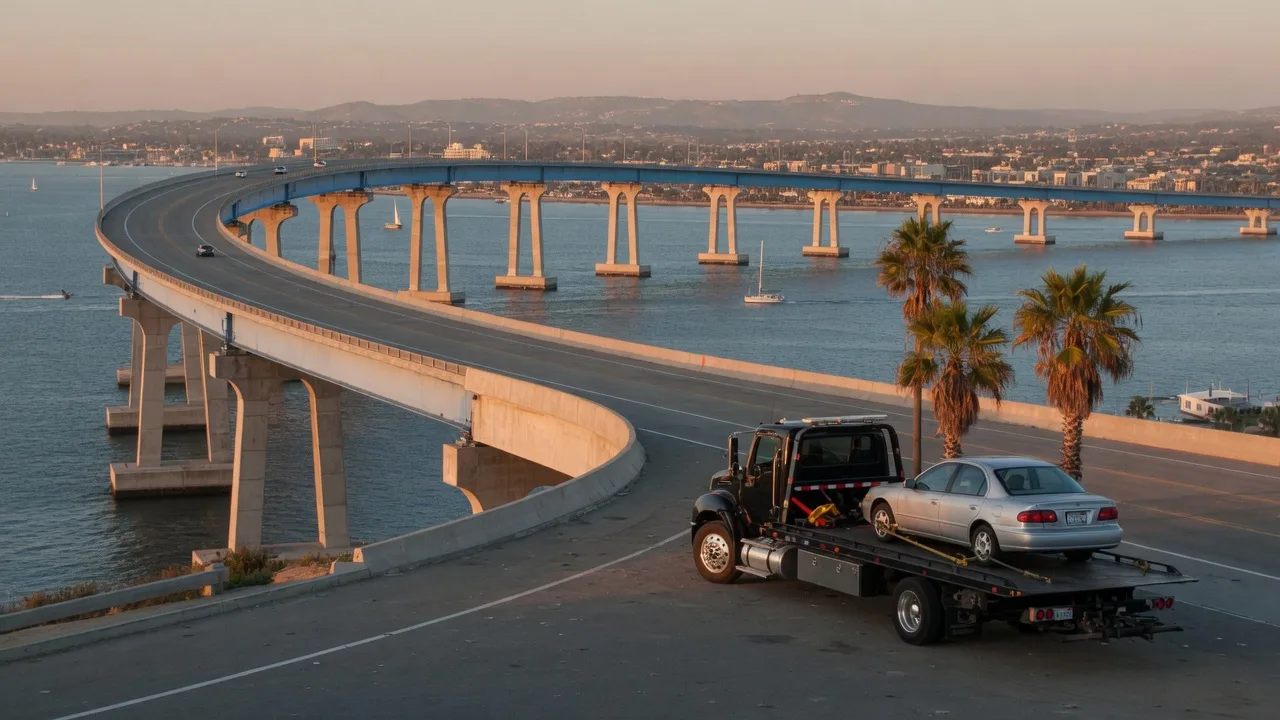
Share whether you are on the bridge, Orange Avenue, or a side street
Start with the exact place where the vehicle stopped. “Somewhere in Coronado” doesn’t give the operator enough information. A bridge shoulder, Orange Avenue, Third Street, and a residential side street present different access conditions.
If you’re on the Coronado Bridge, say which direction you were traveling. Share any visible sign, lane, shoulder, or nearby landmark. Follow instructions from on-scene authorities before moving yourself or the vehicle. Don’t arrange a meeting point that requires crossing active traffic.
For a stop on Orange Avenue or Third Street, provide the nearest cross street. Mention whether the car is in a traffic lane, curb space, driveway, or parking area. A storefront name can help, but a street address is better.
Side streets need another layer of detail. Tell dispatch about narrow access, parked cars, alleys, gates, low branches, or a tight driveway. If the vehicle is inside a garage, share the entrance clearance before an operator accepts the job.
Drivers approaching from the Strand should identify their direction and nearest visible marker. Don’t assume dispatch knows which side of Coronado you entered from.
Quick Tow SD connects stranded drivers with independent local operators. For an urgent passenger-car pickup, review our emergency towing service. Our phone line takes calls around the clock, but the operator handling the job provides the arrival estimate.
Motorcyclists face different loading and securing needs. Our guide to motorcycle towing near the Coronado Bridge covers that situation separately.
What changes near NAS North Island and port property
A request near NAS North Island needs a precise pickup point. “At the base” isn’t specific enough. State whether the vehicle is outside a gate, in an unrestricted public area, or beyond a controlled entrance.
Don’t assume a dispatched operator can enter Navy property. Base access couldn’t be confirmed as a universal rule for outside towing operators. Follow the instructions given by gate personnel or the agency controlling the location. If they direct you to move the pickup outside the gate, give dispatch the approved meeting point.
Share the gate name or posted entrance information exactly as shown. Also report whether the vehicle can roll, steer, and shift into neutral. Don’t attempt to push a disabled car through a controlled area unless authorized personnel direct the move.
Port property requires similar care. Harbor Police patrol Port District tidelands in Coronado and four other member cities. Still, not every waterfront parking area has the same control or release process. If an officer or property representative identifies the location as Port property, follow that agency’s instructions.
A privately requested tow also differs from an impound. Quick Tow SD can refer an ordinary towing request. It can’t release a police-held vehicle, waive a hold, or change an agency’s paperwork requirements.
If the vehicle was already removed from Port property, don’t order another tow before locating it. Our Port of San Diego impound guide explains the verified release process and required owner documents.
When access is uncertain, pause before dispatch. Confirm the exact boundary, approved pickup location, and person controlling entry.
When roadside help may be enough
Not every stalled car needs a tow truck. A simple battery, tire, lockout, or fuel problem may call for roadside assistance in Coronado. The deciding factor is whether the vehicle can safely return to normal operation at its current location.
A battery jump may fit when the car is parked in an accessible place. Tell dispatch if the vehicle is in a garage or tightly parked. Also mention whether it’s a gasoline, hybrid, or electric vehicle. Don’t guess about the cause if warning lights remain on after the engine starts.
A tire change may be possible when you have an usable spare and the car sits on stable ground. A bridge shoulder or active traffic lane changes that decision. Follow directions from law enforcement or roadway personnel rather than beginning a roadside repair yourself.
Fuel delivery may solve an empty-tank problem. It won’t address a fuel leak, overheating, smoke, collision damage, or repeated stalling. Those symptoms call for a different response.
The National Highway Traffic Safety Administration recommends keeping a phone, charger, first-aid kit, flashlight, water, food, and jumper cables in a roadside kit. Those items help you wait and communicate. They don’t replace trained help in an exposed location.
Give dispatch a plain description of what happened. Note any impact, leaking fluid, unusual smell, smoke, locked wheels, or dashboard warning. The operator can then decide whether roadside service is suitable or towing equipment is needed.
When arranging a tow makes more sense
Arrange a tow when the car can’t safely continue after basic roadside help. Common signs include collision damage, steering trouble, a failed wheel, severe overheating, fluid loss, or a vehicle that won’t remain running.
A tow also makes sense when the repair can’t be completed at the pickup point. Choose a destination before dispatch when possible. That might be a repair shop, tire shop, dealership, home, or another location willing to receive the vehicle.
Confirm that the destination is open or accepts after-hours drop-offs. Get permission before sending the car to private property. A closed gate can turn a straightforward Coronado towing request into a second destination decision.
Tell dispatch the exact year, make, model, and drivetrain if known. Electric vehicles and some other models have manufacturer-specific transport procedures. Don’t assume every vehicle needs the same truck or loading method. The operator should match the equipment to the manufacturer’s instructions and the vehicle’s condition.
Report locked wheels, missing keys, lowered suspension, collision damage, or parking-garage clearance. These details affect loading. Photos can also help the operator understand access and damage before accepting the job.
Don’t drive a car that has unsafe steering, braking, tire, or temperature symptoms merely to clear the area. Follow agency directions if you’re on the bridge, at a restricted entrance, or on property controlled by another authority.
Quick Tow SD refers the request to a vetted licensed operator. That operator performs the work, gives the arrival estimate, sets the price, and receives payment directly.
What to confirm before dispatch
A clear dispatch call prevents avoidable confusion. Have the vehicle location and destination ready. Then describe access, vehicle condition, and any instructions from police, Navy personnel, Harbor Police, or property staff.
Confirm these details with the operator:
- Exact address, cross street, direction of travel, and visible landmark
- Whether the car is on the bridge, an island street, or near a gate
- Whether an agency controls access or has directed a specific pickup point
- Vehicle year, make, model, drivetrain, and approximate size
- Whether the wheels roll and the steering works
- Whether the keys are available
- Any collision damage, leaks, smoke, overheating, or locked wheels
- Garage height, narrow driveway, alley, gate, or curb restrictions
- Destination address and after-hours acceptance
- The operator’s price and accepted payment method
Quick Tow SD doesn’t publish a Coronado rate card. The independent operator sets the price. Ask what the quoted amount includes before authorizing dispatch. If mileage, special loading, storage, or after-hours access could apply, ask the operator to explain those items.
Insurance and membership towing coverage varies. Check your policy or membership terms before assuming the tow is covered. Ask whether the provider requires prior authorization, a particular destination, or documents for reimbursement.
Keep the operator’s business name and contact details. If you want to check a California motor carrier, the DMV’s Motor Carrier Permit Operations lookup is the approved state resource. Confirming the operator matters most when an unknown caller or roadside solicitor approaches you without being requested.
When to call us
Call when the vehicle can’t safely continue, roadside help won’t solve the problem, or bridge and gate access requires a professional towing operator. Quick Tow SD will connect you with an independent local pro for the specific pickup.
Call (858) 923-5787 to reach dispatch.