A rig that stalls on a ranch driveway off Old River Road isn’t reachable the same way a car on a city street is. Bonsall’s roads run long, narrow, and often unpaved before they ever reach a house. That changes what a tow truck needs to do its job here.
Bonsall isn’t a town, it’s a valley
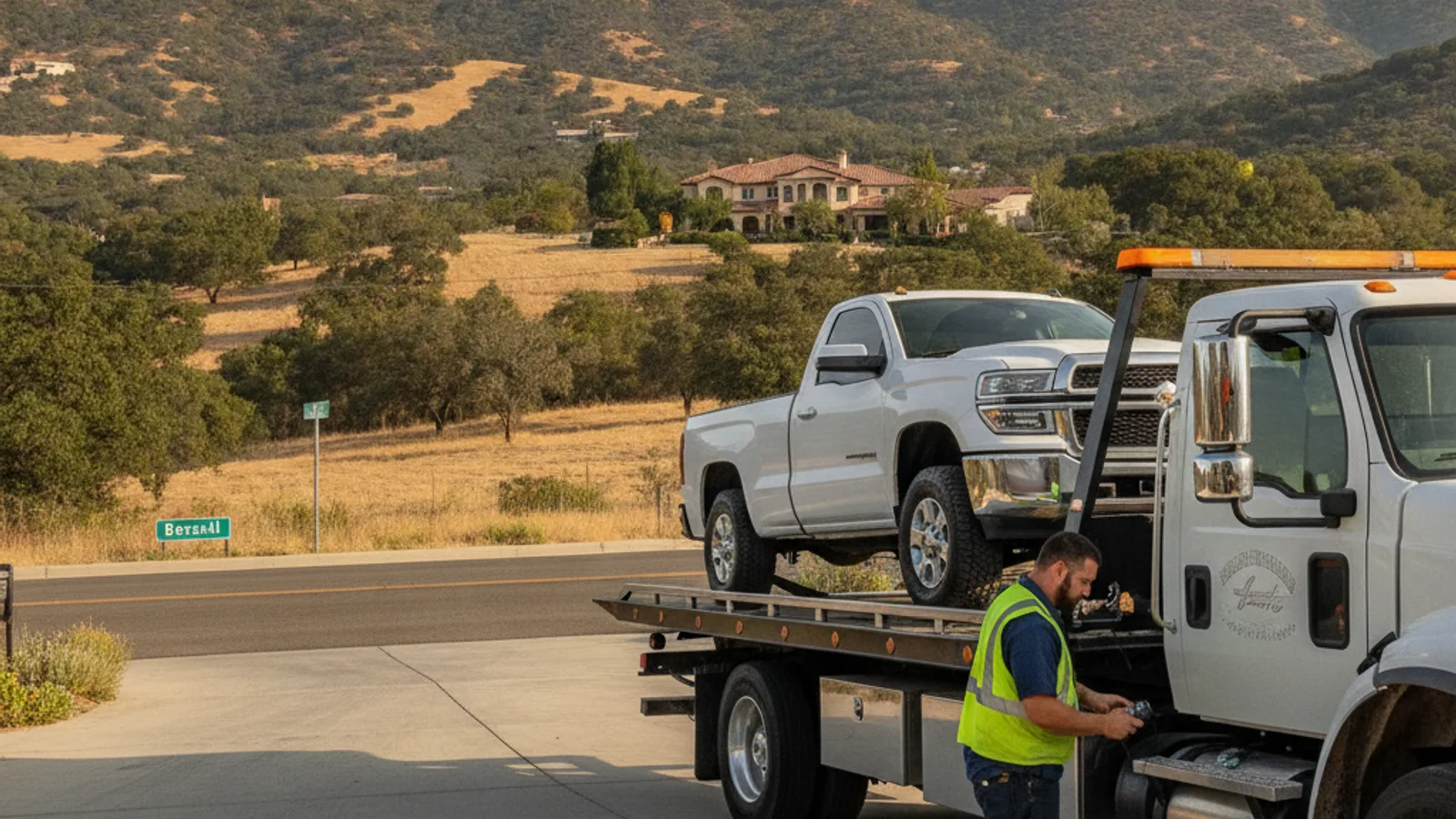
Bonsall is unincorporated North County. It’s strung along SR-76 between Fallbrook and I-15. It sits in the San Luis Rey River valley. There’s no downtown grid. Instead, there are horse ranches with long private driveways. Avocado and citrus groves back right up to the road. Homes are scattered well off the highway on Old River Road and Camino del Rey. The SR-76 and I-15 junction is the closest thing Bonsall has to a landmark. Most calls out here reference distance from that junction instead of a cross street. That’s because cross streets are thin on the ground.
The rural motorhome and RV population
Bonsall carries a real motorhome and RV population. It’s not just a handful of weekend units. Ranch properties often park a motorhome long-term. Search traffic for “truck services” and towing here consistently leans toward trucks, motorhomes, and trailers. It doesn’t lean toward passenger sedans. A stalled Class A might sit on a gravel ranch drive. A fifth-wheel might not back off a soft shoulder. Both need equipment and reach that a compact wheel-lift truck doesn’t carry. Dispatch needs to know up front whether the vehicle is an RV, trailer, or car. That detail changes which operator gets sent. It also changes what’s loaded on the truck before it leaves the yard. See RV towing in San Diego for how that recovery differs from a standard car tow.
A trailer that’s detached from its tow vehicle is its own category again. So is a fifth-wheel with its landing gear stuck in soft ground. Dispatch needs to know whether the unit is still hitched. It needs to know whether the tow vehicle is drivable. Dispatch must also know whether the trailer has working brakes. An unbraked trailer changes what the recovery vehicle can safely handle. That’s especially true on highway grades leading out of the valley.
The long ranch driveway problem
At a lot of Bonsall addresses, the driveway has a dirt or gravel surface. It’s sometimes gated. It sometimes crosses a private bridge over a dry wash. A tow truck built for city streets can struggle with the grade or ruts. It can also struggle with a gate that needs a code. The truck can’t even reach the vehicle until that code is entered. When you call, describe the driveway like you’d describe an off-road trail. Tell dispatch whether it’s paved, graded dirt, or loose gravel. Mention any gate. Explain whether a full-size flatbed can turn around at the end. Otherwise, the truck may need to back the whole way out. Those details decide whether the operator can complete the job on the first trip.
SR-76: a two-lane road with nowhere to pull off
SR-76 through Bonsall has two lanes in each direction in some stretches. Further east, it narrows to a rural two-lane highway. Shoulders are limited in many spots between the groves and the river valley. A car or truck that breaks down here often can’t fully leave the traveled lane. That makes it a higher-priority, higher-caution job than a parking lot breakdown. If you’re stopped along SR-76, get as far right as the shoulder allows. Turn on the hazards. Stay out of the vehicle if you can do so safely. Only do that when there’s room to stand well clear of traffic. CHP patrols this corridor. It’s the right call if the vehicle blocks a travel lane or visibility is poor.
Distance changes the job, not just the price
Bonsall sits further from the county’s urban core than most coastal North County cities. The terrain in between includes the river valley, grove roads, and ranch country. That means a tow here often covers more ground than a city-to-city job. The vehicle might need a short pull to a shop in Fallbrook. It might instead need a longer haul toward the I-15 corridor. Give dispatch the exact drop-off address, not just “the nearest shop.” That lets dispatch route the right truck the first time without guessing at distance. For destinations outside the immediate area, flatbed towing is usually the right equipment. That’s true for anything that can’t be safely wheel-lifted over that kind of distance.
Groves, ranches, and why access varies house to house
The properties along Camino del Rey and its branching roads aren’t laid out like a subdivision. One avocado ranch might have a wide gravel apron in front of the barn. A flatbed can turn around there without trouble. The next property might have a single-lane bridge crossing a dry creek bed. Its weight limit might prevent a heavy carrier from safely crossing. Citrus groves add their own wrinkle. Irrigation lines and low branches sometimes run close to a driveway. A tall RV or truck with a raised bed then needs a different approach angle. A sedan wouldn’t need that angle. None of this is dramatically unique to Bonsall’s terrain. Still, it adds up to more variables per call than a flat city block. That’s exactly why describing the property before the truck leaves matters more here. It matters more than almost anywhere else in the county.
What to have ready when you call
Before you call, know whether the vehicle is a car, truck, motorhome, or trailer. Know whether it’s on SR-76 itself or down a private driveway. If the driveway isn’t visible from the road, estimate roughly how far it runs. If there’s a gate or a code, mention it. Say whether the ground is soft from recent rain. A wet ranch driveway can bog down a truck as easily as a car. Fallbrook and Bonsall share many terrain and traffic patterns along SR-76. If your breakdown is closer to Fallbrook proper, our Fallbrook towing guide covers that side of the corridor in more detail.
When to call us
A stalled motorhome down a ranch driveway needs the right operator. So does a breakdown along the SR-76 shoulder. That operator should ask about the terrain before leaving the yard. They shouldn’t assume every call looks like a city street. Call (858) 923-5787 to reach dispatch.