Five miles is a neighborhood hop in San Diego County. North Park to Mission Valley, or National City to downtown Chula Vista, the loaded trip is short. That still does not produce one posted private-pay figure for the cost to tow a car 5 miles.
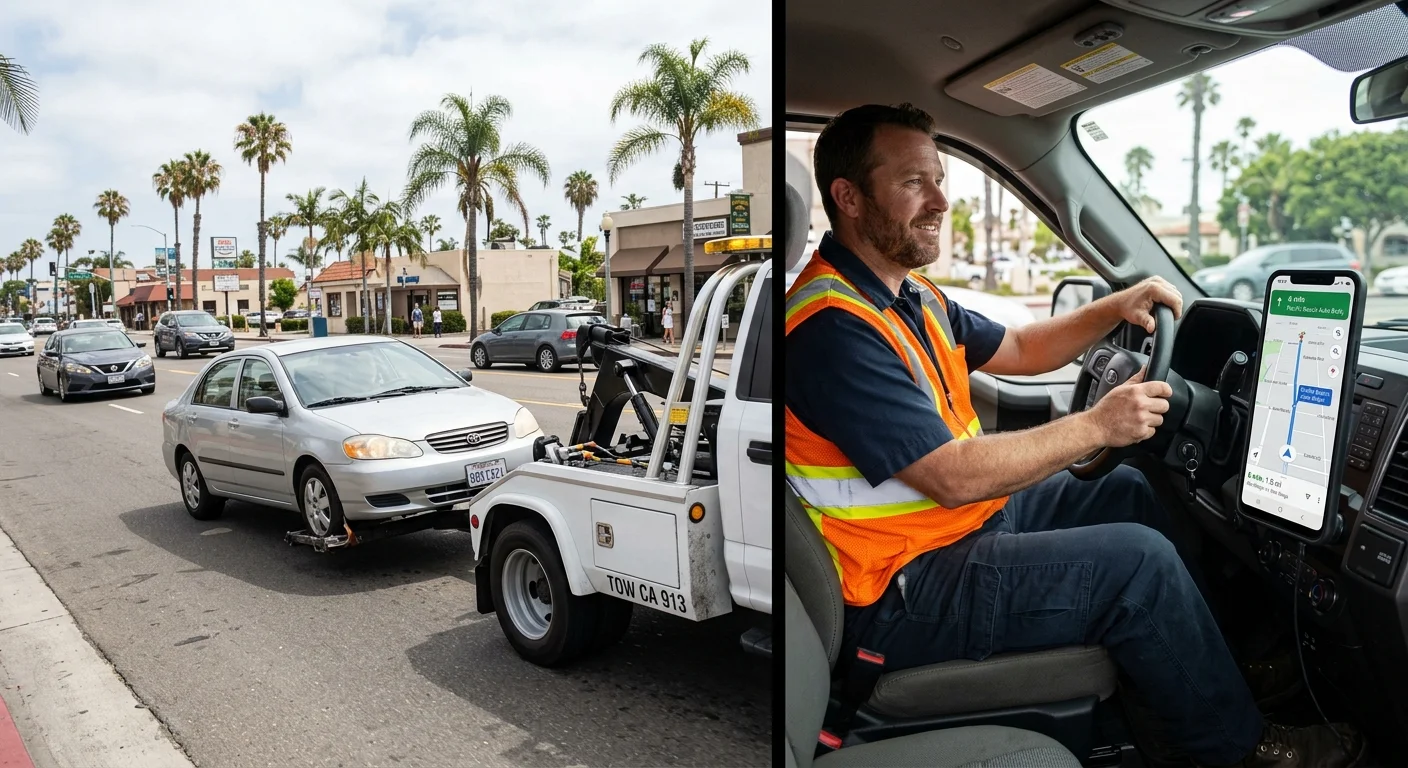
Why a 5-mile tow still has no single posted price
A tow you request is priced by the licensed operator who takes the job. California does not publish a statewide dollar cap for that work. Vehicle Code section 22651.07 says owner-requested rates are generally set by mutual agreement. Public-contract rates are set by agreement with a law-enforcement agency. Those are two different bills.
The only local dollar figures we can stand behind sit on the City of San Diego’s published fee schedule, verified as of August 2, 2026. That schedule covers city contract and impound work through AutoReturn, not a breakdown you call in from a surface street. On that schedule, a regular-duty tow (GVWR under 9,500 pounds) is $178. Extra mileage after 5 miles is $5.50 per mile for regular duty, $13.75 for medium duty, and $19.25 for heavy duty. Five miles is the city’s mileage breakpoint. It is not a private quote for a Honda on El Cajon Boulevard.
If the car is under a city hold, confirm the live schedule with AutoReturn and the locator at search.autoreturn.com. Do not treat those numbers as what an independent operator will charge to move your car to a shop in La Mesa.
Membership plans fail as a market rate too. AAA Auto Club of SoCal includes up to four roadside service calls per membership year at every tier. The Classic tier’s tow distance is about 5 to 7 miles. Plus goes up to 100. Premier includes one 200-mile tow, with remaining calls at 100. That is a membership benefit, not a cash 5 mile tow cost.
We cannot confirm a current private-pay hook-up fee, a per-mile cash rate, or a typical 5-mile total. If a figure is not on the city schedule or in a named membership contract, treat it as unconfirmed and get the job in writing.
For a county-wide picture, start with our San Diego tow cost guide. For a longer loaded trip, see how much a 10-mile tow runs and the 20-mile tow cost page.
Details that change a short-haul quote
Five loaded miles is only one input. The operator still has to reach you, get the car on the truck, and leave a legal drop.
Pickup access changes the work. A car on a Mission Valley surface lot is a different job from a lowered car in a downtown garage, a tight carport in City Heights, or a shoulder on I-8 in East County. Extra labor, dollies, or a winch are not mileage. They are separate line items if the operator charges for them.
Vehicle type matters. A passenger sedan is regular-duty work on the city’s weight classes. A pickup, van, or box truck can need a different truck. If you are asking how much it is to get a truck towed 5 miles, say the GVWR, whether it rolls, and whether it is stuck in park. The operator quotes that job. The city schedule’s medium-duty and heavy-duty contract lines ($190 and $250) are impound figures, not a cash-pay truck rate.
Towing method changes the quote. Wheel-lift is common on short, rolling cars. Flatbed is often the safer call for AWD, EVs, luxury cars, or cars that will not roll. Manufacturer recovery notes vary by year and model. Give the operator the year, make, drivetrain, and damage before they roll.
Condition is its own cost driver. No keys, locked steering, a transmission stuck in park, collision damage, or a car in sand or a ditch can turn a short haul into recovery work. A clean hook-up is not the same job as a winch-out.
Drop-off location matters even at 5 miles. A shop on the same boulevard is simpler than a dealer across a canyon or a home on a steep cul-de-sac in La Jolla. Storage is a different charge if the car sits at a yard. Ask before you approve a yard drop. City of San Diego daily storage on the published schedule is $41 regular, $70 medium, and $100 heavy, plus a $54 TICR fee on city releases. That package is for city impounds. A private yard sets its own storage.
Time of day can change what an operator will accept. We do not have a verified after-hours surcharge for owner-requested tows, so we will not invent one. The city’s after-hours release fee of $48 is an impound-release line, not a roadside add-on.
Put pickup, destination, mileage, access, method, and possible storage on the paper you approve. The checklist lives in details for an accurate tow quote.
How a local drop-off differs from a longer tow
On a 5-mile job, hook-up and access eat more of the bill than they do on a 50-mile run. The loaded miles are few. The labor is not. A 5-mile quote is not half of 10 miles. Do not scale the 10-mile or 20-mile guides with homemade per-mile math.
Empty miles still count for the operator when you only need 5. A truck coming from Barrio Logan to a stall in Carmel Valley, then dropping the car in Sorrento Valley, is a short loaded trip on a long clock. Coastal North County, inland North County, the central city, East County, and the South Bay are not the same dispatch problem. Five miles in North Park is dense streets and garages. Five miles on SR-67 toward Ramona is open road, fewer shops, and a longer deadhead if the truck started in the urban core.
A 6-mile tow is the same product. Searchers type how much to tow a car 6 miles, and the answer follows the same rules. One extra loaded mile does not flip the job into long-distance work. What flips it is a different destination class: a shop across town, a dealer in another city, or a yard with storage. Interstate towing is a different market. Do not use those quotes for a hop from Hillcrest to a Mission Valley shop.
Roadside memberships often treat 5 miles as the Classic-tier window. If your plan covers that distance, call the membership first and confirm the drop-off sits inside the covered miles. Extra miles, a second drop, or a non-covered vehicle type can leave you paying the operator directly.
Searchers also ask about the “80% rule” for towing. We could not confirm a California towing-fee rule by that name, and it is not on the City of San Diego’s published schedule. In other contexts people use 80% as a trailer-weight talking point. It is not a verified 5-mile rate in this county. Skip it when you compare quotes.
Questions to ask before you approve dispatch
Ask for the total in writing before the truck is loaded. A verbal number on a loud shoulder is easy to dispute later.
Cover these points with the operator. Pickup address or freeway marker, and the exact drop-off. Loaded miles between those two points. Whether any extra mileage, labor, or equipment sits outside that figure. Wheel-lift or flatbed. Whether the car must roll, shift to neutral, or have keys. After-hours or weekend terms, if any. Whether the drop is a shop, a home, or a storage yard. Storage rates if it might sit. Payment method the driver will take. Whether your insurer or club is billing, or you are.
California Vehicle Code 22651.07 requires storage facilities to accept cash, an insurer’s check, or a valid bank credit card, and to give an itemized invoice of actual charges. You may inspect the vehicle and retrieve personal property at no charge during normal business hours, without paying first. Those rights attach to stored vehicles. Confirm the same payment terms on an owner-requested roadside job before you hang up.
If this is an emergency breakdown, say so. Emergency towing is the service path for a disabled car that has to leave the scene. Stay out of traffic. NHTSA roadside safety guidance is the federal baseline: get to a safe spot if you can, make the car visible, and call from a place that is not the travel lane.
If the car was taken without your request, this is not a 5-mile quote problem. It is an impound or private-property tow. City of San Diego holds go through AutoReturn. Private-property rules sit in California Vehicle Code 22658. If you return after hookup but before the truck leaves the property, the statute’s half-fee drop cap can apply. That is a different bill from a tow you ordered, and it is the legal path that can cut what you pay. It does not cancel a tow you asked for.
Check roadside coverage before you approve a cash dispatch. AAA’s four calls per year and the Classic 5-to-7-mile window are the verified membership facts we can cite. Your insurer’s add-on, if any, is in your policy. We cannot confirm a standard insurance mileage cap for San Diego.
What to do when no current rate can be confirmed
No current private-pay figure for a 5-mile car tow in San Diego County is confirmed. That is the honest answer, and it is still useful.
Request a written quote that names pickup, destination, loaded mileage, access notes, towing method, labor or equipment extras, and possible storage. If the operator will not put that on paper, do not approve the load.
If the hold is a City of San Diego impound, use the City of San Diego’s published fee schedule as of August 2, 2026, and confirm the live numbers with AutoReturn before you pay. Schedules change. The $178 regular-duty tow fee and the $5.50-per-mile charge after 5 miles are city lines, not a referral rate from this site.
If you are on a patrolled freeway during Freeway Service Patrol hours, you can request free roadside help by calling 511 and saying “Roadside Assistance.” SANDAG publishes an average dispatch of about nine minutes for that program. It is not an arrival time for an operator we dispatch, and it is not a 5-mile transport to a shop. FSP covers a gallon of gas, a jump start, radiator water, and a flat tire change on the segments it patrols. Hours are weekdays 5:30-9:30 a.m., 9:30 a.m.-2:30 p.m., and 2:30-6:30 p.m., weekends 10 a.m.-6 p.m., and not on federal holidays. Midday and weekend service does not run on SR 905 or SR 11.
Quick Tow SD is a referral line. We match you with an independent licensed operator. The operators in our network are licensed and insured. That operator sets the price, does the work, and is paid by you. We do not hold a tow license, run a yard, or publish a rate card. The line takes calls any time, day or night, in every city in San Diego County.
When to call us
When the car cannot roll to a shop on its own, skip a DIY pull and have a licensed operator move it. Call (858) 923-5787 to reach dispatch.