A stall on I-5 near the Encinitas Boulevard exit and a dead battery on Coast Highway 101 above Swami’s are not the same call. One sits in fast freeway traffic with a real shoulder to work from. The other sits on a narrow coastal road with a rail line, a bluff edge, and nowhere wide to pull a truck off.
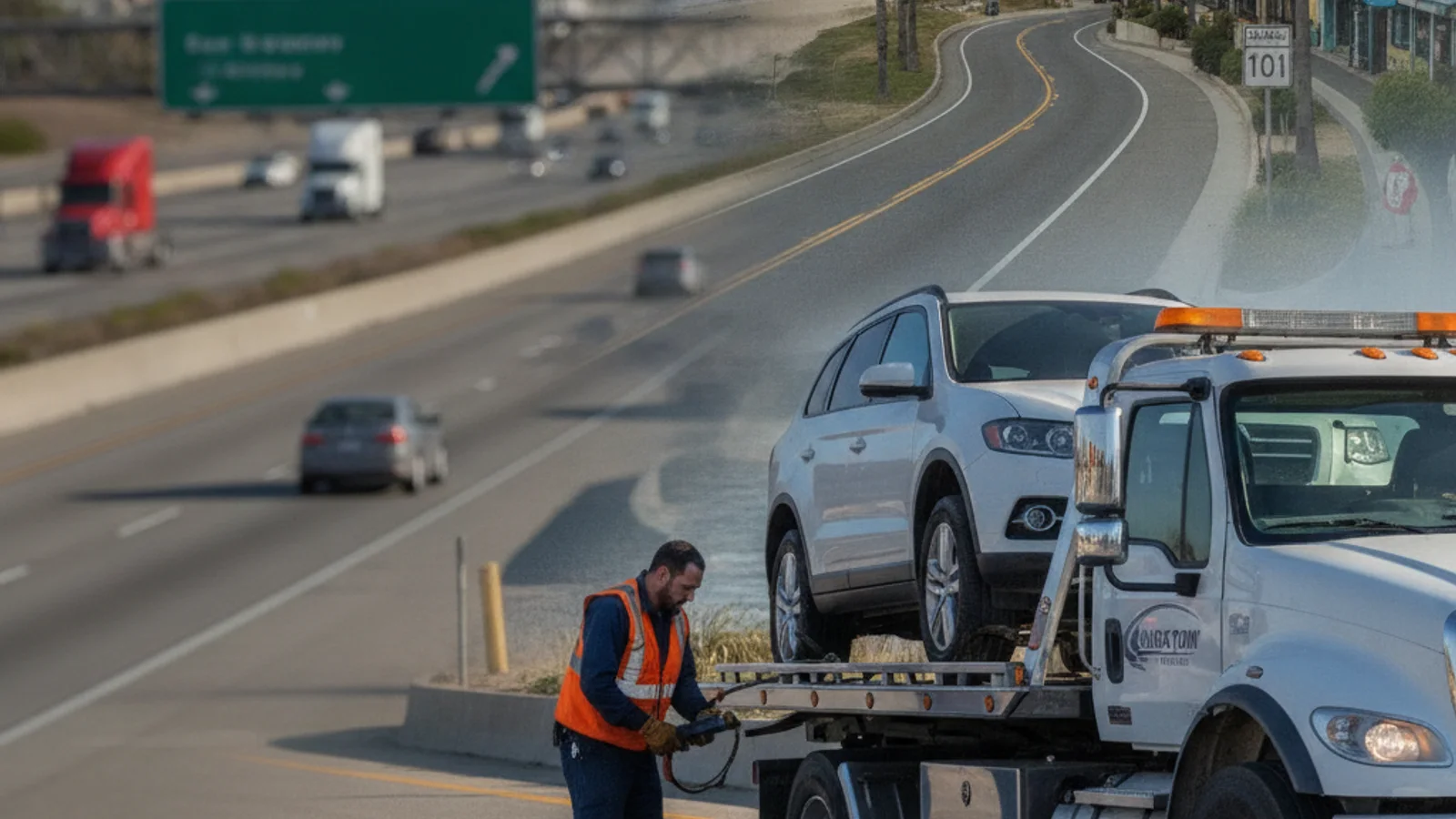
I-5 and 101 ask for different equipment and positioning
I-5 runs through Encinitas with three main exits: Encinitas Boulevard, Santa Fe Drive, and Leucadia Boulevard. It’s a standard freeway job in most respects. There’s a shoulder, there’s usually room to load safely, and the main hazard is fast-moving traffic behind you rather than the road itself. An operator dispatched to an I-5 breakdown here treats it like any other freeway pickup: get the vehicle clear of the lane, get lights up, load and go.
Coast Highway 101 through Encinitas is a different problem entirely. Through downtown Encinitas and Leucadia’s antique district, the road narrows to two lanes with parking on both sides, bike lanes squeezed in, and pedestrian traffic crossing constantly. A car that dies in the travel lane there can’t just get muscled onto a shoulder, because there often isn’t one. The bluff-top stretch near Swami’s is its own case: the highway runs close to the edge above the surf break, with limited pullout space and a steep drop on the ocean side. A flatbed working that stretch needs a driver who knows exactly where the safe load points are, not just the nearest gap in traffic.
The rail corridor limits how fast help can reach you
The coastal rail line that carries the Coaster and Amtrak runs parallel to 101 through Leucadia and Cardiff, and there are only a handful of crossings between the highway and inland streets like El Camino Real or Manchester Avenue. An operator responding from inland can’t just cut straight over to the coast at any point. They have to route to one of the actual crossings, which can mean backtracking depending on where the crossing gates happen to be down when a train passes. Near the San Elijo Lagoon in Cardiff, the lagoon itself adds another constraint, since Manchester Avenue and Santa Fe Drive are the practical ways across, and both funnel traffic through a narrow corridor. None of this changes whether help comes. It changes the route an operator we dispatch has to take to get there.
Beach lots come with their own kind of tow risk
Parking near Moonlight Beach, Swami’s, and the smaller lots along Stone Steps and D Street runs on posted time limits, and those lots are frequently on private property with signage that allows the owner to have a car removed under California Vehicle Code 22658. A car left past the posted limit, or parked in a spot marked for permit holders only, can be towed without much warning in these high-turnover beach lots. It’s worth reading the sign at the entrance before you leave your car for the day, especially in summer when enforcement tends to be tighter because the lots fill fast.
Downtown Encinitas, Leucadia, and Cardiff aren’t interchangeable
Even within Encinitas, the coastal stretch changes character block by block. Downtown Encinitas around E Street and the historic 101 storefronts sees heavy foot traffic and metered parking that fills fast on weekends, which means a disabled car there is also a car blocking a business’s foot traffic, not just the road. A few miles north, Leucadia’s antique row has a looser, slower feel, but the road narrows further in spots and the diagonal parking along parts of 101 leaves less room to maneuver a truck than downtown’s straighter curb. Cardiff, at the southern edge near the San Elijo Lagoon, is different again: surf-lot traffic backs up 101 on good swell days, and the lagoon itself means there’s genuinely less inland street grid to reroute through if the highway is tied up. An operator who’s worked this coastline knows these aren’t the same three miles of road just because they share a highway number.
Salt air adds wear you don’t see until it fails
A block from the ocean, salt air gets into places a car owner rarely checks. Battery terminals corrode faster near the coast, brake lines and undercarriage hardware pick up rust sooner than they would inland, and electrical connectors under the hood can develop the kind of intermittent contact that shows up as a car that won’t start on a humid morning. None of that is unique to Encinitas, but a coastal town like this one sees more of it than East County does, and it’s part of why a “sudden” breakdown on 101 often has months of quiet corrosion behind it. Regular rinsing of the undercarriage and a battery terminal check twice a year go a long way here. Cars that spend most of their life a block or two from the water tend to need this kind of maintenance sooner than the manual’s mileage schedule suggests, and that gap is easy to miss until the day the car simply doesn’t start. If you’re already stuck, that history doesn’t matter as much as getting a driver out to you who knows this stretch of coast.
Why the exit you name matters to dispatch
When you call in a breakdown on I-5 through Encinitas, naming the nearest exit, Encinitas Boulevard, Santa Fe Drive, or Leucadia Boulevard, gets an operator moving in the right direction faster than a general “somewhere in Encinitas” description. The same goes for 101: a cross street or a nearby landmark, the Self-Realization Fellowship grounds above Swami’s, the Leucadia roundabouts, or the Cardiff kook statue near the lagoon, tells dispatch which stretch of the highway they’re dealing with before the driver ever leaves. Given how different the recovery job is between the freeway and the coast road here, that detail isn’t a formality. It changes which truck gets sent and how the driver plans to approach the vehicle.
Know your rights before you assume the worst about a tow you didn’t expect. Our guide on what to know when your car gets towed in San Diego covers the private-lot and street-parking rules that come up most in beach towns like this one.
When to call us
A dead battery on a flat stretch of 101 might be a five-minute jump. A car stuck against the bluff-side guardrail near Swami’s, or one that won’t move at all on a narrow Leucadia block, needs a professional operator with the right equipment and a plan for the road you’re actually on. Call (858) 923-5787 to reach dispatch.