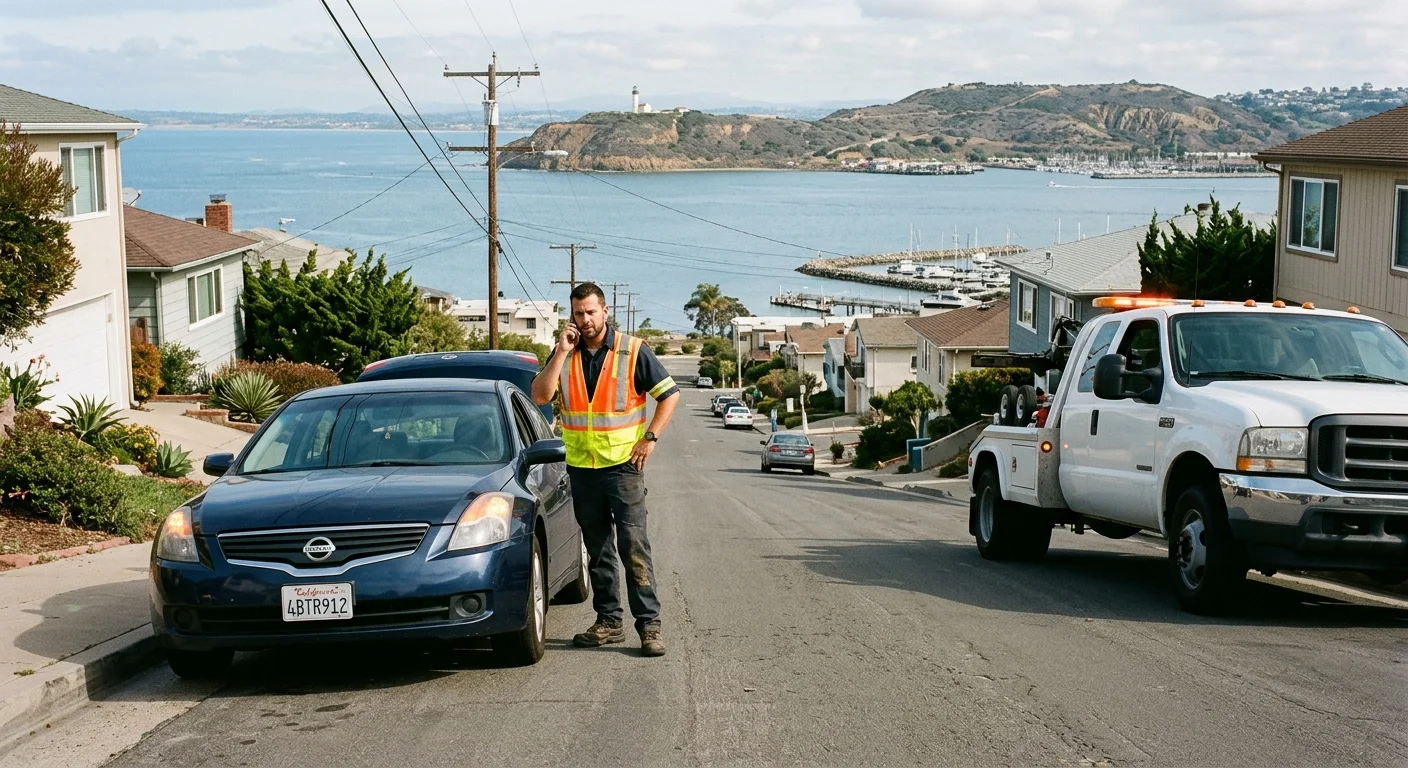
The ignition turns and the car stays dead on a Point Loma street. You are on a peninsula with steep grades, tight marina lots, and Navy gates that run on their own rules. The useful split is roadside assistance that might get you rolling, or a tow to a shop you name.
Describe what happens when you try to start
When you call, skip the guess about the battery or the starter. Say what the car did on this try.
If the key or button does nothing, say that. If you hear a rapid click, say that. If the engine cranks and never catches, say that. If it fires, then dies, say that. Note whether the dash lights came on. Note any fuel smell, hot plastic smell, or a warning lamp that was already lit before you parked.
That report is for the operator we dispatch. It is not a diagnosis. A quiet click in a Liberty Station lot is not the same job as a car that stalled halfway up a grade and will not restart. The driver sent out still has to see the car. Your job is to keep people safe and describe the scene.
If you are in a live lane, turn on the hazards. Stay in the car if stepping out puts you in traffic. NHTSA roadside safety guidance is simple: be visible, and do not stand in a travel lane. Point Loma’s hills make a quick push to a better spot a bad idea. A disabled car can roll. Set the parking brake. Keep your foot on the brake until the car is in park. Do not try to nurse a dying car down Catalina Boulevard toward Cabrillo National Monument, or down to Rosecrans Street.
If you are in a garage, a shopping lot, or a hotel driveway, say so. A car that won’t start in a parking lot has different access and different traffic. Sometimes a property manager wants the stall cleared. Share the lot name, the nearest entrance, and whether the car is boxed in.
If anyone is hurt, or the car is smoking like a fire, call 911 first. Roadside help is not a substitute for emergency services.
Share whether you are on Rosecrans, Catalina, or a steep side street
Point Loma is a long peninsula, not a flat beach grid. The operator needs the street, not just “Point Loma.”
Rosecrans Street is the main run from the Midway District and Liberty Station south through the commercial strip. It carries through traffic, buses, and people cutting toward Shelter Island. A dead car here can block a lane fast. Give the cross street. Voltaire Street, Lytton Street, and the Liberty Station gates are useful landmarks. A business name helps if you are in a lot off Rosecrans.
Catalina Boulevard is the ridgeline road toward Cabrillo National Monument. It climbs. South of the neighborhoods, it does not give you a second way off the tip. If you are on Catalina, or on a side street that feeds it, say you are on a grade. Tell the driver which way the nose of the car points. A car that will not start on a hill is a different load than a car sitting flat.
Canon Street drops you toward the bay side and the Shelter Island approach. Harbor Drive and North Harbor Drive sit along the water and the airport edge. Those streets mix city traffic with port-area rules. If you are on Shelter Island Drive, in a marina lot, or near a launch ramp, say whether a trailer is attached. Do not assume a light-duty pickup can treat a truck-and-trailer like a sedan.
Steep residential streets off the ridge are the calls people underestimate. The lanes above Rosecrans and the short connectors that pitch down toward the water often have no shoulder. Share the house number, the nearest cross street, and whether the car is against a curb, in a driveway, or blocking a neighbor.
If you are on Naval Base Point Loma, at a gate, or on other restricted Navy property, follow that agency’s instructions. The same is true on Port of San Diego tidelands if Harbor Police or port staff are already involved. Quick Tow SD connects you with local licensed operators. We cannot promise a truck will be waved through a gate. The operator taking the job will tell you what they can do from the public side of the fence.
If you have used towing in Pacific Beach before, do not expect the same scene. Pacific Beach is a flat grid. Point Loma is a ridge with one long commercial street and a lot of gravity.
When roadside assistance may fit
Roadside assistance Point Loma jobs are the ones that can be finished where the car sits, without dragging it over a hill.
A jump may fit when the car is on a level, legal spot, the lights behave like a weak battery, and you are not on a steep grade that makes a rolling start a hazard. A spare-tire swap may fit when you have a usable spare, the car is stable, and there is room to work off the travel lane. A lockout or a small fuel drop may fit when the car itself is fine. Those are on-scene jobs. A tire swap is usually a 15-minute job once the operator is at the car. That is work time, not a promise about when someone arrives.
Roadside help is a poor fit when the car already failed on a climb, when it will not stay running, or when you still have to descend Catalina or drop down to Rosecrans. Getting a restart on the ridge and then driving a sick car down the grade is how people lose brakes and transmissions. If the car needs a shop, skip the one more try.
If you are on a San Diego freeway, not a Point Loma surface street, there is a public option. SANDAG’s Freeway Service Patrol, with Caltrans and the California Highway Patrol, provides free roadside help on patrolled freeway segments. SANDAG’s published figure is an average dispatch of about nine minutes. You request it by calling 511 and saying “Roadside Assistance.” Hours are weekdays 5:30-9:30 a.m., 9:30 a.m.-2:30 p.m., and 2:30-6:30 p.m., and weekends 10 a.m.-6 p.m. It is not available on federal holidays. Free help can include a gallon of gas, a jump start, radiator water, and a flat tire change. That program does not cover a dead car on Rosecrans, Canon, or a residential hill.
Club membership is a different wallet. Auto Club of Southern California AAA plans include up to four roadside service calls per membership year. If you are not a member, do not expect club dispatch to treat this as a free call. Pay-per-use roadside help through a local operator is the usual path. We do not publish a rate card. The operator who takes the job sets the price and tells you before the work starts.
The cheapest honest option is the one that matches the road you are on. On a patrolled freeway during Freeway Service Patrol hours, start with 511. On Point Loma city streets, you are paying an operator or using a membership you already have.
When arranging a tow may make more sense
Arrange a tow when the car is not going to leave under its own power, or when making it start still leaves you on the wrong side of a hill.
That includes a no-crank car that already had a jump and died. It includes a car that overheated on Catalina, a transmission that will not stay in gear, a steering or brake warning, collision damage, or a vehicle sitting where it blocks a driveway or a travel lane. California Vehicle Code 22500(e) makes stopping in front of a driveway illegal. If you are already there, do not argue with gravity or with a neighbor. Get emergency towing lined up and move the car with a professional hook-up.
A tow also makes more sense for many all-wheel-drive and electric vehicles, and for anything that cannot roll. Do not treat manufacturer recovery rules as a DIY project. Give the year, make, model, and whether the car can roll or steer. The operator we dispatch chooses the truck. We do not promise a flatbed or a wheel-lift in advance.
If you are in a tight Liberty Station garage, a Shelter Island lot, or a driveway that pitches toward the street, say so. Loading on a grade takes planning. Do not release the parking brake to make it easier before the driver is in control of the car.
Name the destination. A shop on Rosecrans, a dealer in the Midway District, a house on the ridge, or a lot in another neighborhood changes the job. The operator sets the price for that trip. Ask for that figure before the car is hooked. There is no published arrival window for Point Loma, and we will not invent one. The driver sent out gives you an estimate for your exact pin.
If Harbor Police or base security already has the vehicle, this is not a normal roadside call. Follow that agency. Quick Tow SD does not release police-held or agency-held cars.
Confirm access, clearance, and the destination
Before anyone rolls, confirm three things: can a truck reach the car, can it work there, and where the car is going.
Access is the pin plus the obstacle. “Point Loma” is not an address. Give a street number on Rosecrans, a slip or lot name on Shelter Island, a garage level at Liberty Station, or a gate name if you are at the Navy. If a guard has to badge a truck in, you need that answer from the agency, not from us. If the car is on port tidelands and Harbor Police is involved, their process controls the next step.
Clearance is height, width, and slope. Read a garage height sign if you are under one. Say if both sides of a hill street are parked out. Lowered cars and full-size trucks need different room. Speed bumps, tight turns, and a trailer still hooked all change the truck the operator sends.
Destination is the last piece. A shop name and city if you have one. If you do not, say you need the car off the street first. Do not send a sick car over the ridge because it is closer to home if a Rosecrans shop is the safer drop.
Keys, wheel lock, and park position matter. Say whether the steering is locked and whether the car is in park on a grade. The operator needs that before they pick a truck.
Quick Tow SD is a referral service. We take the call and match you with a licensed and insured operator in our network. The operator performs the work, sets the price, and is paid directly by you. Call any time, day or night. The line takes calls around the clock. The driver who accepts the job is the person who can speak to access at your pin.
When to call us
If the car will not start on a Point Loma grade, in a live lane, or in a lot you cannot leave it in, skip a DIY jump on a hill and get a licensed operator on the scene. Call (858) 923-5787 to reach dispatch. Tell them the street, the grade, the access, and whether you need roadside help or a tow.