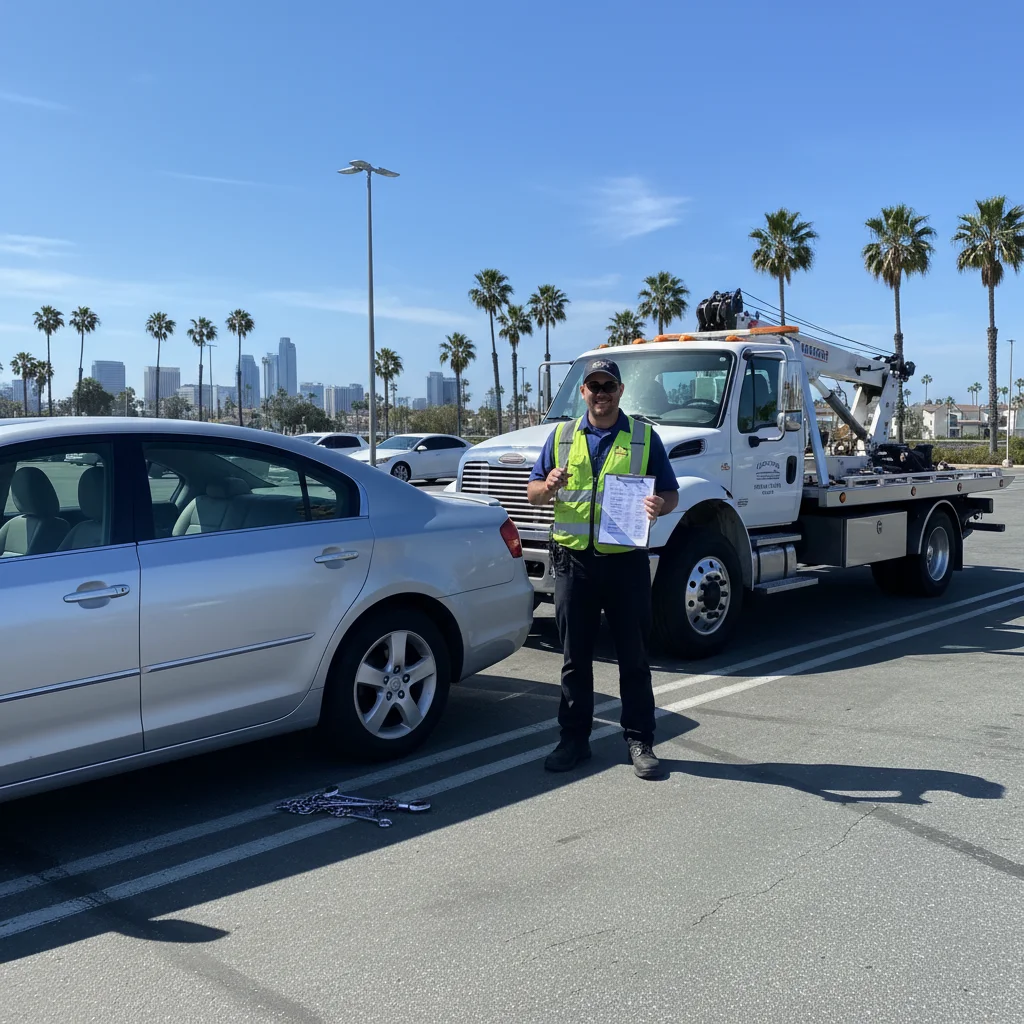
Some towing fees in California are regulated, and some aren’t. If the police or a property owner has your car towed against your will, the rate is capped by the local authority under California Vehicle Code 22658. But when you call a tow yourself because you broke down, that’s a free-market consensual rate, not a regulated one. Here’s what reasonable looks like in San Diego, and how to spot a fee that isn’t.
The two kinds of tows, and only one is rate-capped
This is the part most people miss, and it’s the whole answer.
A consensual tow is one you ask for. Your car won’t start, you got a flat with no spare, you slid into a ditch, or you just need your vehicle moved across town. You pick up the phone and choose who comes. Because you’re the customer hiring the service, the price is set by the open market. There’s no statewide maximum the company has to honor. Competition keeps honest companies in a normal range, but the law doesn’t put a ceiling on it.
A nonconsensual tow is one done without your say-so. The two common versions are a police-directed tow (your car gets impounded, towed off a freeway after a crash, or removed during a street-sweeping enforcement) and a private-property tow (your car gets hooked from a no-parking lot or an apartment complex). These are the tows California actually regulates.
Under California Vehicle Code 22658, local authorities, usually the city council or county, set the maximum rates and charges for nonconsensual and police-directed tows by resolution. A tow company working those jobs can’t charge more than the published cap. So when people ask about a “maximum towing charge” in California, that maximum exists only for the tows you didn’t choose.
What a reasonable consensual tow runs in San Diego
For a standard light-duty vehicle, a car, small SUV, or pickup, going a short distance, a fair San Diego rate is a flat fee, not a meter that surprises you at the end.
At Quick Tow SD, a local light-duty tow under 10 miles is quoted as a flat rate before we dispatch, based on distance and vehicle type. You hear the number first, then decide, not after the truck shows up.
That tracks with the broader California market. Industry pricing guides put a typical local tow at roughly a $95 hook fee plus about $5 per mile, which lands a 5- to 10-mile tow within the everyday range for a legitimate local company. Where you start seeing $250, $300, and up is heavy-duty work, long-distance hauls, or companies adding after-hours and “difficult access” charges on top of the base.
For the full breakdown by distance and vehicle type, see our tow cost san diego guide and our deeper auto towing rates san diego post. Want a quick number for your exact trip? Run the tow cost calculator.
The minimum cost for a tow, and the “hook fee”
There’s no legal minimum tow fee in California. But there is a practical one, and it has a name.
The hook fee (sometimes called the base or hookup fee) is the flat charge a company applies just to send a truck and connect to your vehicle, before any mileage. It covers the dispatch, the driver’s time, and the truck. In most of California that base fee starts around $95, which is effectively the floor for a real, insured local tow.
If a company quotes you well below that, treat it as a flag, not a deal. A “$45 tow” usually means the mileage, fuel surcharge, or labor gets stacked on after the truck shows up, and the final bill lands higher than an honest flat quote would have. The minimum you should expect for a legitimate light-duty San Diego tow is roughly the hook fee, with a clear flat rate quoted up front.
Storage fees and your rights on a police or impound tow
If your car gets impounded or towed off private property, the storage clock starts and the fee schedule is set by the local authority, not invented by the lot.
The City of San Diego publishes its tow and impound fee schedule, and the numbers give you a real benchmark. A regular-duty tow runs $178, daily storage is $41, additional mileage over 5 miles is $5.50, a flatbed or dolly fee is $47, an after-hours release (after 5 PM and weekends) is $48, and there’s a tow and impound cost recovery fee of $54. Those are the regulated figures for that class of tow, which means the operator can’t freelance above them.
Your rights on these tows are real. You’re entitled to retrieve personal property from the vehicle, to a written, itemized statement of charges, and to release of the car once you’ve paid the authorized fees and shown proof of ownership and a valid license. A storage lot can’t hold your car hostage over a charge that exceeds the published cap. For the full walkthrough, read know your rights towing san diego and our step-by-step on how to get my car back from impound.
Red flags of an unreasonable fee
A fee is a problem when:
- No quote up front. A legitimate consensual tow comes with a number before the truck rolls. “We’ll total it when we’re done” invites surprises.
- A teaser base with stacked add-ons. A $40 to $50 base that quietly becomes $200 once mileage, fuel, hookup, and labor pile on.
- Cash-only, no receipt. You’re owed an itemized statement. A company that won’t put it in writing is a company you can’t dispute later.
- Charging above the cap on a police or property tow. If it’s a nonconsensual tow, compare the bill to the local published rates. Anything over the cap is contestable.
- Storage charges that don’t match the schedule. Daily storage on a San Diego impound has a set figure. A lot inventing its own daily rate is overcharging.
Tow type, who sets the price, and your rights
| Tow type | Who sets the price | Typical SD range | Your rights |
|---|---|---|---|
| Consensual (you call it) | Open market, the company you hire | Flat rate, quoted before dispatch | Get a quote before dispatch; choose any company |
| Police-directed / impound | Local authority (city/county) under CVC 22658 | $178 tow + $41/day storage (City of San Diego) | Itemized bill, retrieve belongings, release on proof + payment |
| Private-property (no-parking) | Local authority rate cap under CVC 22658 | Capped at the published local rate | Itemized statement; can’t be charged above the cap |
Frequently asked questions
What is the minimum cost for a tow in San Diego? There’s no legal minimum, but the practical floor for a legitimate light-duty tow is roughly the hook fee, around $95. A real consensual tow under 10 miles is typically quoted as a flat rate before the truck is dispatched. Quotes far below that usually hide add-ons that show up on the final bill.
Are towing prices regulated in California? Partly. Nonconsensual tows, the police-directed, impound, and private-property kind, have maximum rates set by the local authority under California Vehicle Code 22658. Consensual tows that you call yourself are not rate-capped; they’re set by the open market.
What is a reasonable towing fee? For a light-duty consensual tow in San Diego, a reasonable fee is a flat rate for a trip under 10 miles, quoted before the truck is dispatched. Heavy-duty, long-distance, or specialty recovery jobs cost more, but they should still be quoted up front.
Can a tow company overcharge me? On a nonconsensual tow, no, the company is bound by the local rate cap, and anything above it is contestable. On a consensual tow you arranged, there’s no legal ceiling, so the protection is getting a written flat quote before you agree and an itemized receipt after.
What is the maximum towing charge in California? A statewide maximum exists only for nonconsensual tows, and it’s set locally, not by one statewide number. For consensual tows you choose, there’s no maximum; the market and your up-front quote set the price.
Get a flat-rate quote first
The simplest protection against an unreasonable fee is a number before the truck shows up. Call Quick Tow SD at (858) 923-5787 for a flat-rate San Diego tow quote before you agree to anything.