Granite Hills isn’t the El Cajon most people picture. Skip the strip malls on Main Street and head east into the foothills, and the streets stretch out, the lots get bigger, and the driveways stop being a short straight shot from curb to garage.
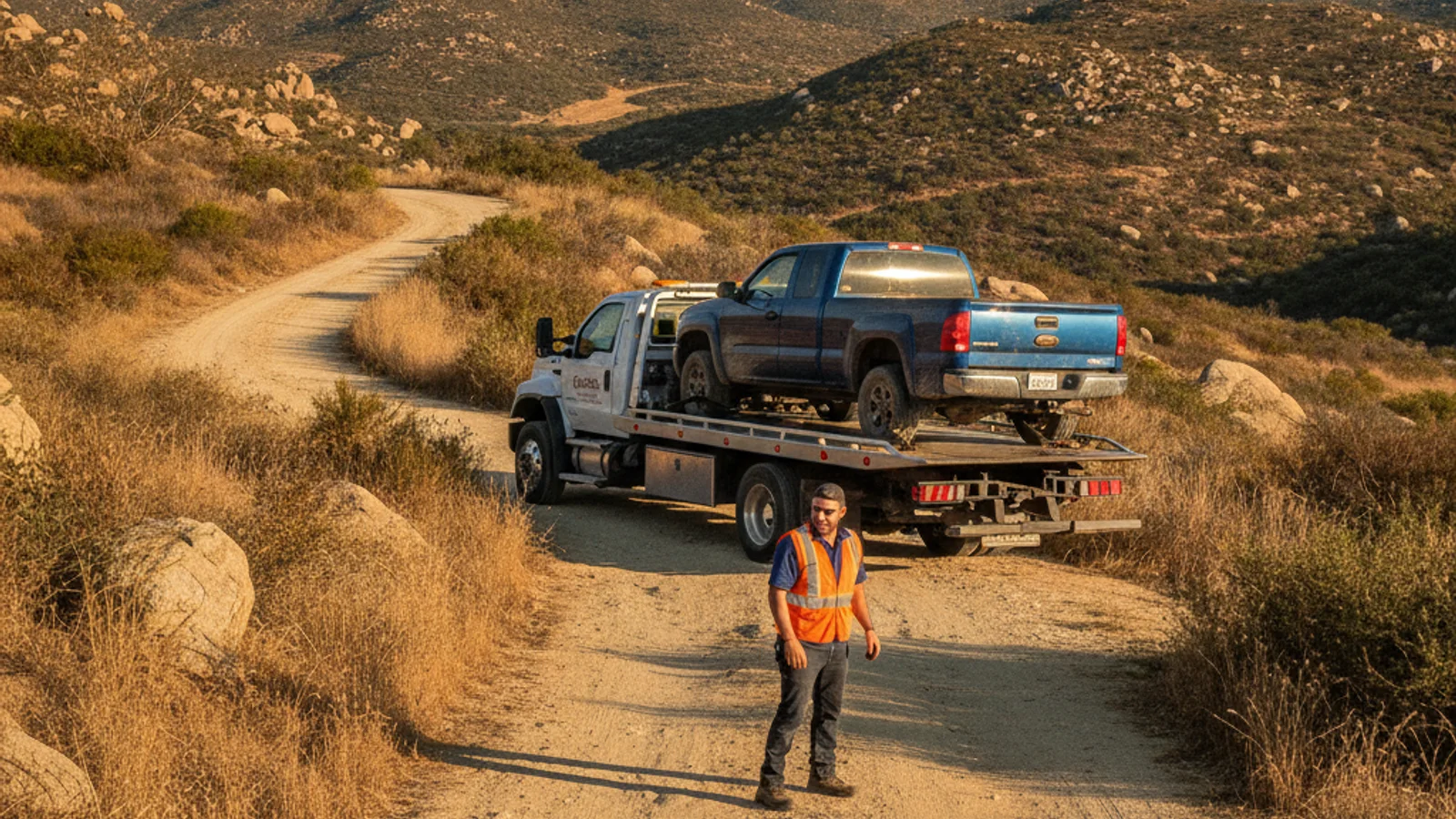
An unincorporated foothill pocket east of the city
Granite Hills sits in the hills east of central El Cajon, reached off Granite Hills Drive and connecting toward Dehesa Road as it runs into the Dehesa valley. SR-94 and I-8 are both within a few minutes, but the streets between the freeway and a given property here look nothing like the tight residential grid closer to downtown El Cajon. That difference matters for towing, because our city-focused guide to towing in El Cajon is really describing the I-8 corridor and the commercial core. Granite Hills and the Dehesa valley are a separate problem, one built around horse property, acreage, and roads that were never meant for tight turning radiuses.
Long private driveways with no room to turn around
A lot of the parcels along Granite Hills Drive and out toward Dehesa are horse properties or large-lot residential, and that means driveways that run hundreds of feet from the street to the house, often with no widened turnaround at the end. A standard tow truck can back down a normal suburban driveway and pull back out in a three-point turn. A driveway built for one truck and trailer at a time, with fencing or a barn on either side, doesn’t offer that option. An operator we dispatch working a call out here often has to plan the approach before ever hooking up a vehicle, because getting stuck trying to leave defeats the entire purpose of the call.
Decomposed granite soil is a real weight problem
The soil that gives Granite Hills its name isn’t paved-lot dirt. Decomposed granite breaks down into a loose, sandy material that looks solid on the surface but compresses and shifts under real weight, especially after it’s been dry for months, which is most of the year here. A heavy carrier or a loaded flatbed can sink into a dirt driveway surfaced this way, particularly near a gate or a spot where vehicles regularly turn and grind the surface down further. This isn’t a hypothetical for heavy-duty calls specifically. Any truck with real weight behind it needs to consider ground conditions before committing to a dirt approach, the same way a driver would think twice about driving a loaded truck onto wet sand.
Gates, horse trailers, and equipment that isn’t a passenger car
A lot of the vehicles that need help out here aren’t ordinary sedans. Horse trailers, flatbed utility trailers, and larger trucks used for hauling feed or equipment are common on these properties, and a breakdown involving a loaded trailer is a different job than a stalled commuter car. Gates add their own delay before an operator even reaches the vehicle: many Granite Hills and Dehesa valley properties are gated at the street, with a code or a call box that needs to be worked out before a truck can get down the driveway at all. If you’re calling in a breakdown from a gated property, having the gate code ready, or having someone available to let the driver in, saves real back-and-forth once the truck arrives.
Inland heat adds its own breakdown pattern
El Cajon’s valley holds heat that the coast never sees, and Granite Hills sits far enough inland and up in elevation that summer afternoons run hotter than most of San Diego County realizes. That heat shows up in the calls: batteries that fail without warning after sitting in a hot garage or driveway all day, cooling systems that finally give out on the climb up Dehesa Road, tires that lose pressure fast enough in extreme heat to go from low to flat within a drive. None of that is unique to this one neighborhood, but the combination of real elevation, real distance from the coast, and long exposed driveways with no shade means breakdowns here tend to happen at the property itself rather than on the road, which changes the kind of access an operator needs to plan for.
If you’re dealing with a vehicle stuck in soft ground rather than a straightforward flat driveway, our guide on recovering a car stuck in sand covers similar loose-surface recovery techniques that apply to decomposed granite as well.
How this differs from the El Cajon most people know
Central El Cajon, along Main Street and the I-8 corridor, is a dense commercial and residential grid where a tow truck can reach nearly any address within a few turns off the freeway. Granite Hills and the Dehesa valley are close by in miles but far apart in practice: fewer through streets, longer distances between neighbors, and properties set well back from the road. A driver dispatched to this part of El Cajon needs a different mental map than one working the commercial strip closer to downtown, even though both fall under the same city name on an envelope.
The Dehesa valley itself carries a mix of large residential parcels, small agricultural operations, and event venues that draw traffic in bursts, which means the roads out here see very different volumes at different times of day. A quiet stretch of Dehesa Road on a weekday morning can be backed up with event traffic on a weekend evening, and a breakdown timed with one of those bursts changes how much room an operator has to work with when they arrive.
What to mention when you call from this area
Given how spread out Granite Hills and the Dehesa valley are, a few extra details help before a truck ever leaves the yard. Mention if your driveway is dirt, paved, or gravel, since that changes which equipment makes sense. Say whether there’s a locked gate and whether someone will be there to open it. And if you’re on Dehesa Road itself rather than a side street, give a direction of travel and a nearby cross street or landmark, a winery entrance, a ranch sign, anything visible from the road, since house numbers alone can be hard to spot from a moving vehicle on a road with long gaps between properties.
When to call us
A car that won’t start at the end of a long dirt driveway, or one that’s settled into soft granite soil near a gate, needs an operator who’s ready for the ground before the truck ever leaves the yard. Call (858) 923-5787 to reach dispatch.