La Presa doesn’t show up on most people’s mental map of San Diego County until they break down there. It’s unincorporated South Bay, tucked between Spring Valley and Lemon Grove, and the roads that thread through it were laid out around a reservoir, not a grid.
A community named for a dam
“La presa” is Spanish for “the dam,” and the name comes straight from the Sweetwater Reservoir and the dam that holds it back on the community’s western edge. That geography still shapes how the area is laid out. Streets curve around the reservoir’s shoreline instead of running straight, and a lot of La Presa’s residential blocks sit on the hillsides that rise up from the water. Jamacha Boulevard and Sweetwater Road are the two main arteries that actually connect the neighborhood to the rest of the South Bay, with SR-54 and SR-125 the nearest freeway access a few minutes off in either direction.
The reservoir roads make for a real recovery problem
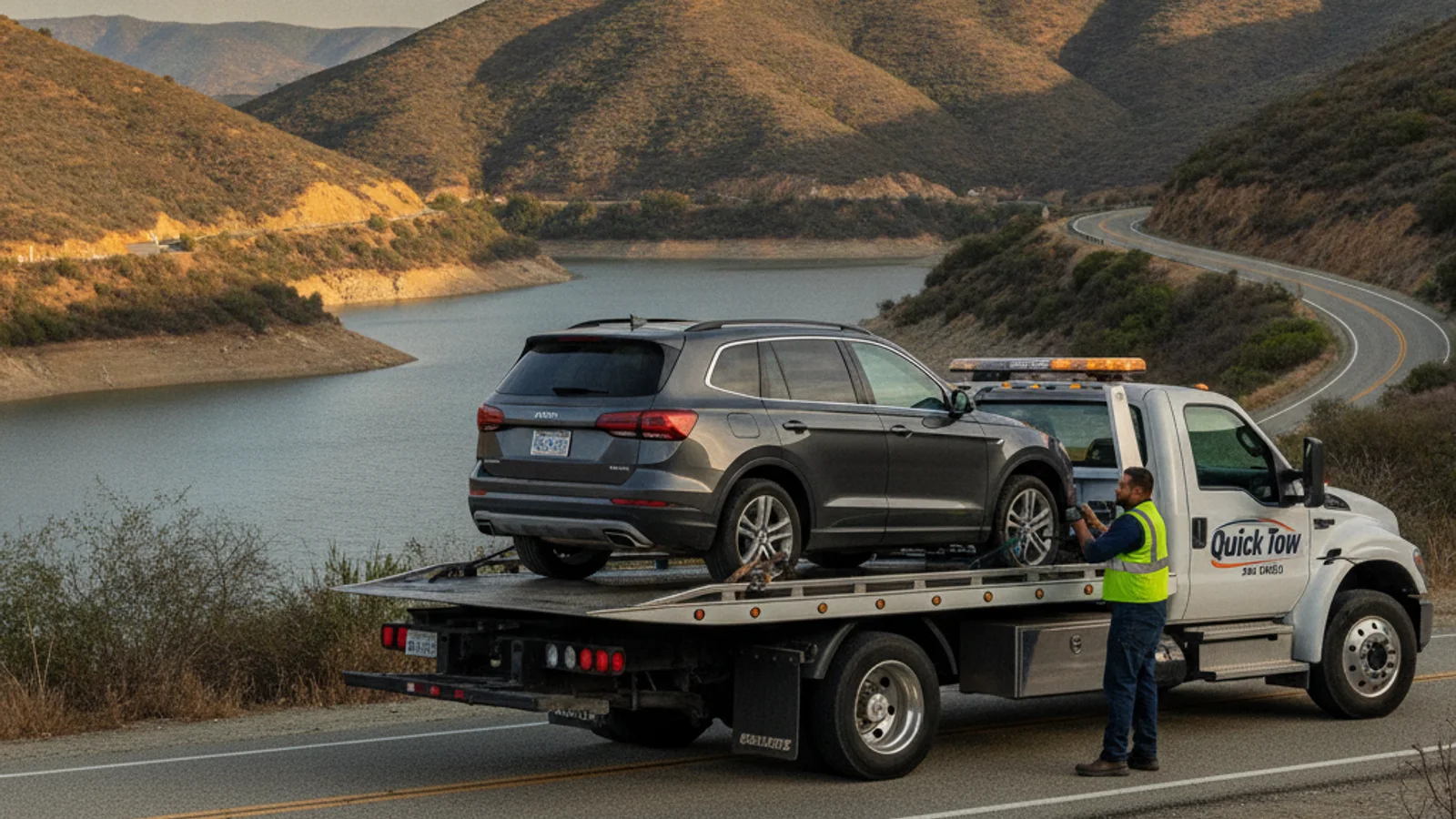
A breakdown near the reservoir itself isn’t like a breakdown on a straight residential block. The roads that wrap the shoreline are narrow in places, with limited shoulder and a drop toward the water on one side. There’s not always a wide spot to pull a disabled car fully out of the travel lane, and a tow operator working that stretch needs to find a safe load point rather than just stopping wherever the car happened to die. It’s a smaller-scale version of the same problem coastal roads present: geography that limits where a truck can safely position itself, not just how far it has to drive to get there.
Landmarks that help dispatch find you faster
La Presa doesn’t have a single obvious downtown strip the way an incorporated city does, so pinpointing a location by street address alone can be harder here than in Spring Valley or Lemon Grove next door. Sweetwater Reservoir itself is the biggest landmark, along with Sweetwater Summit Regional Park on its northern shore. Jamacha Boulevard runs the length of the community and connects to most of the side streets, so naming your position relative to Jamacha, or to a cross street like Bancroft Drive or Willow Glen Drive, gives an operator a much faster starting point than “somewhere near the reservoir.” The same goes for a breakdown near SR-54 or SR-125: naming the nearest on-ramp or the exit you were heading toward matters more here than it would on a street with clear block numbers.
Grade and hillside streets change what a tow needs
Beyond the reservoir roads, a lot of La Presa sits on genuine grade. Hillside streets climbing away from Jamacha Boulevard can be steep enough that a car with a failing transmission or a parking brake issue needs more than a flat tow. An operator we dispatch has to account for the slope itself: a vehicle that’s rolled partway down a hillside street, or one parked at an angle that makes hooking up from the usual position impractical, needs a driver who can read the grade before deciding how to load. That’s a different job than the same breakdown would be on a flat street in, say, central Chula Vista.
Who actually responds on unincorporated county land
La Presa isn’t inside the city limits of Chula Vista, Lemon Grove, or Spring Valley. It’s unincorporated San Diego County, which means law enforcement coverage comes from the San Diego County Sheriff’s Department rather than a city police department. That matters if you’re trying to figure out who to call about a car that’s been abandoned on a public street near you, or who responds if a vehicle needs to be flagged and removed from a county road. We don’t have a verified source for a specific county tow ordinance or a Sheriff’s dispatch procedure for these calls, so if you need that level of detail, the Sheriff’s non-emergency line is the right place to confirm it rather than assuming it works the same way a city police tow would.
How La Presa differs from its incorporated neighbors
Spring Valley and Lemon Grove border La Presa on either side, and Spring Valley is itself unincorporated too, so the jurisdiction lines aren’t obvious just from driving through. Lemon Grove is an incorporated city with its own police department, which means a breakdown or a parking dispute a few blocks apart can fall under two entirely different agencies depending on which side of an invisible line you’re on. That distinction rarely matters for getting a tow truck to you, since dispatch covers every part of the county the same way. It matters more if a vehicle needs to be reported abandoned, or if you’re trying to figure out who enforces a parking violation on the street where your car broke down. When in doubt about which agency covers a specific block in this area, the Sheriff’s non-emergency line can confirm jurisdiction faster than guessing based on which city’s name shows up on the nearest street sign.
For general context on how private-property and street towing rules work across the county, our guide to knowing your rights during a San Diego tow covers the framework that applies whether you’re in an incorporated city or unincorporated county land like La Presa. Neighboring La Mesa runs its own version of this same reservoir-and-grade geography a few miles north; our roadside assistance guide for La Mesa covers that stretch if your route runs through both.
What to have ready when you call
Because La Presa’s geography doesn’t sort itself into neat blocks the way a planned subdivision does, a little preparation before you call in helps more here than it would in a denser neighborhood. Have your nearest cross street or a landmark in mind, know roughly which side of the reservoir you’re on if you’re near the water, and mention if you’re on a hillside street with a noticeable grade. If your car is disabled somewhere along Jamacha Boulevard or Sweetwater Road, note which direction of travel you were headed, since both roads run for miles and a direction narrows things down fast. None of this replaces giving your exact address when you have one, but in the stretches where a formal address is hard to pin down quickly, these details get an operator oriented before they’re even on the way.
When to call us
A hillside street above the reservoir, a car that’s stalled on grade, or a breakdown on the narrow shoreline roads all need an operator who knows this part of the South Bay isn’t flat, gridded, or covered by a city patrol car. Call (858) 923-5787 to reach dispatch.