Pacific Beach doesn’t tow like most of the county. The blocks are tighter, the alleys are the real streets, and half the cars in trouble here are stuck behind a building, not in front of one.
Mission and Garnet run the show, the alleys run everything else
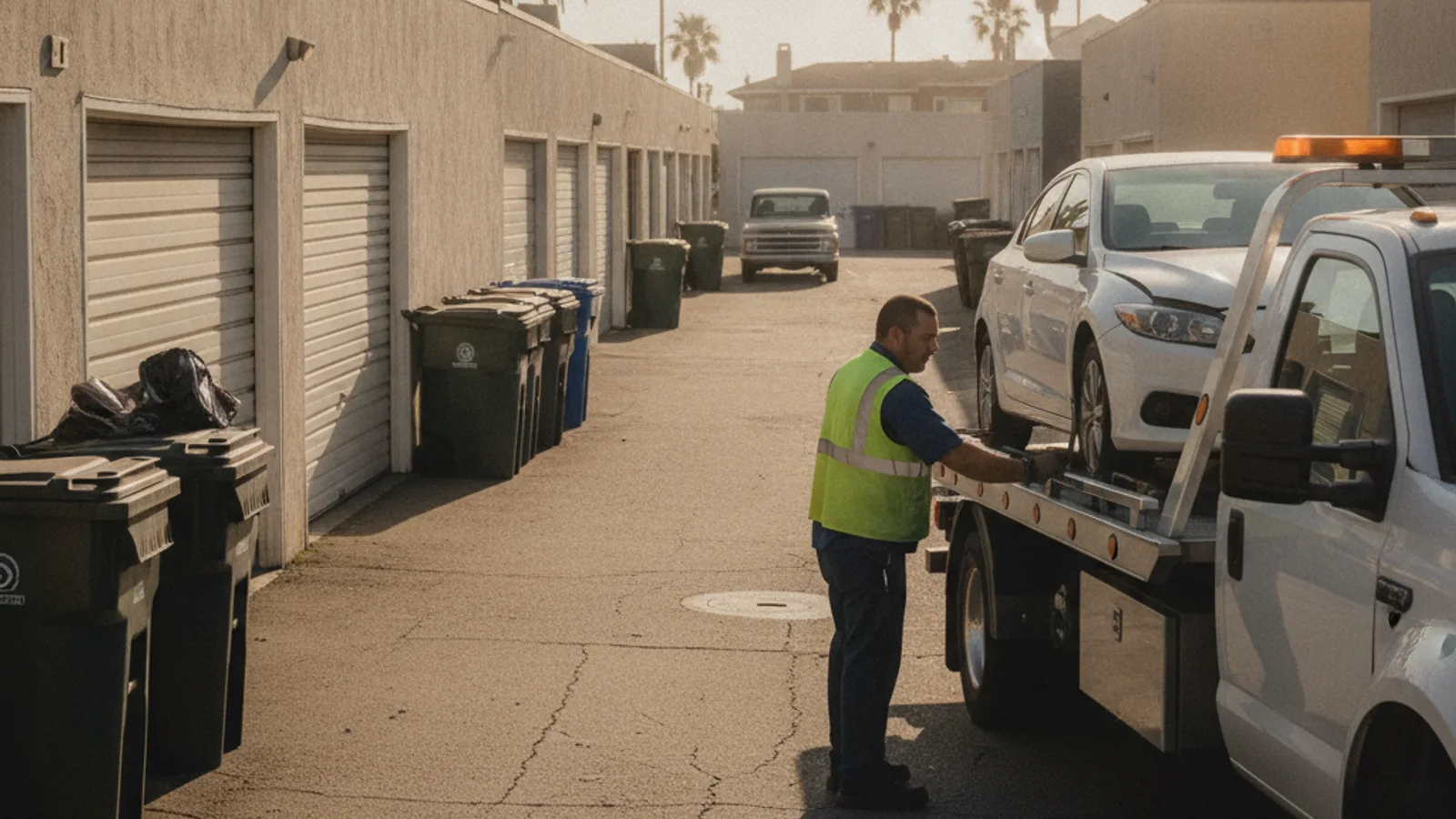
Mission Boulevard and Garnet Avenue are PB’s two main arteries, and most visible traffic problems happen along them, especially where Garnet feeds toward the pier and the boardwalk. But a lot of actual parking and access in Pacific Beach happens behind the beach blocks, in the alley network that runs parallel to the main streets. Those alleys are narrow, often one-lane with cars parked tight against both sides, and they were built for foot traffic and small deliveries, not a full-size flatbed. That’s one of the clearest cases where a wheel-lift truck genuinely beats a flatbed: it’s shorter, tighter-turning, and can back into an alley a flatbed simply can’t fit down.
Permit and time-limited parking make PB its own category
Pacific Beach runs permit parking zones and time-limited street parking in several residential pockets, layered on top of standard meters near the beach itself. That combination means a car can be legally parked one hour and towable the next, especially for a visitor who doesn’t know which blocks require a resident permit. If your car is towed from a permit zone you don’t hold a permit for, that’s a straightforward private-property or municipal enforcement situation, not a mystery, but it’s worth checking the actual posted sign on your specific block since the rules aren’t uniform across all of PB.
Summer turns this into a different job entirely
From Memorial Day through Labor Day, Pacific Beach traffic and parking pressure both spike hard, particularly on weekends. Garnet Avenue and the blocks closest to the boardwalk see gridlock that can turn a normally quick tow into a genuinely slower job, simply because there’s nowhere for a truck to pull over and work. A breakdown on Mission Boulevard on a July Saturday afternoon is a different call than the same breakdown on a Tuesday morning in February, and dispatch factoring that in isn’t an excuse, it’s just an accurate read of the street.
Salt, sand, and older vehicles don’t mix well
Cars that live near the beach in PB take a beating from salt air and blowing sand that inland San Diego vehicles never see. Corroded battery terminals, rusted brake lines, and sand working into undercarriage components all show up more often on PB service calls than they do a few miles inland. If your car has sat near the water for years, a random no-start is worth taking seriously rather than assuming it’s an isolated fluke. Our dead battery guide covers how corrosion and age combine to cause exactly this kind of failure, and a jump start is often the first thing worth trying before assuming the car needs a full tow.
Low-clearance garages in the newer buildings are a real constraint
Pacific Beach has added a wave of newer condo and apartment buildings along and near Garnet, many with underground or ground-level parking garages built to tighter clearance specs than older surface lots allow. A standard tow truck, especially a flatbed with its bed raised for loading, may not physically clear some of these garage entrances or interior ramps. If your car is stuck in one of these structures, tell dispatch about the garage specifically, including whether there’s a marked clearance height posted at the entrance, so the right equipment gets sent the first time instead of a truck that has to turn around.
What to check before you park for the night in PB
If you’re leaving a car overnight anywhere near the beach blocks, read the actual posted sign on that specific street rather than assuming it matches the block you parked on last time. Permit zones in Pacific Beach aren’t uniform: one street can require a resident permit while the next one over allows unrestricted parking, and the signage sits on individual poles rather than at a single entrance the way a private lot works. A rental or vacation-stay guest is especially exposed here, since visitors often don’t know which few blocks are permit-only until a citation or a tow already happened.
If your car won’t start the next morning in one of these zones, that adds urgency beyond the usual inconvenience: a disabled car sitting in a permit zone past its allowed window is a tow risk on top of the mechanical problem. Getting it moved before the day’s enforcement pass, rather than waiting to see if it clears on its own, is the safer call.
Crown Point and the Mission Bay side are quieter, but not simple
The Crown Point side of Pacific Beach, facing Mission Bay rather than the ocean, has calmer traffic than the beach-facing blocks but its own layout quirks: cul-de-sacs, bay-access parking areas, and streets that dead-end at the water in ways that aren’t obvious from a map. I-5 access from this side generally runs through Grand Avenue or Balboa Avenue rather than through the denser beach core, which matters if a tow needs to move a car out toward the freeway rather than to a shop within PB itself.
Getting a truck through PB’s traffic in the first place
Even before a truck reaches your car, it has to get through Pacific Beach’s own traffic to arrive at all. Garnet Avenue backs up hard on summer weekends between the I-5 off-ramp and the beach, and Mission Boulevard slows to a crawl anywhere near the boardwalk from late morning through evening in peak season. An operator working a PB call may take a longer approach route deliberately, cutting through Grand Avenue or one of the quieter residential streets rather than fighting straight down Garnet, simply because it’s the faster way to actually reach the vehicle.
This is also why giving dispatch your exact block, not just “Pacific Beach,” matters more here than almost anywhere else in the county. PB is a small neighborhood by square mileage but a dense one, and the difference between the beach-facing blocks and the Crown Point side can mean a completely different approach route for the truck.
Private lots carry real risk on a summer Saturday
Private commercial lots near the beach, restaurants, small strip centers, and hotel parking, enforce their signage aggressively during peak season because the parking pressure is real and the businesses depend on turnover. A car left in a private lot “just for a minute” on a packed Saturday is a meaningfully higher tow risk here than the same move on a quiet weekday. Our CVC 22658 breakdown covers what makes a private-property tow valid in the first place, including the signage the lot owner has to post.
When to call us
Whether your car is stuck in a PB alley, blocked in by summer traffic, or stalled inside a low-clearance garage, tell dispatch the specific access problem so the right truck gets sent. Mention the block, the nearest cross street, and whether you’re on the beach side or the Crown Point side, since that alone can change the route an operator takes to reach you.
Call (858) 923-5787 to reach dispatch.