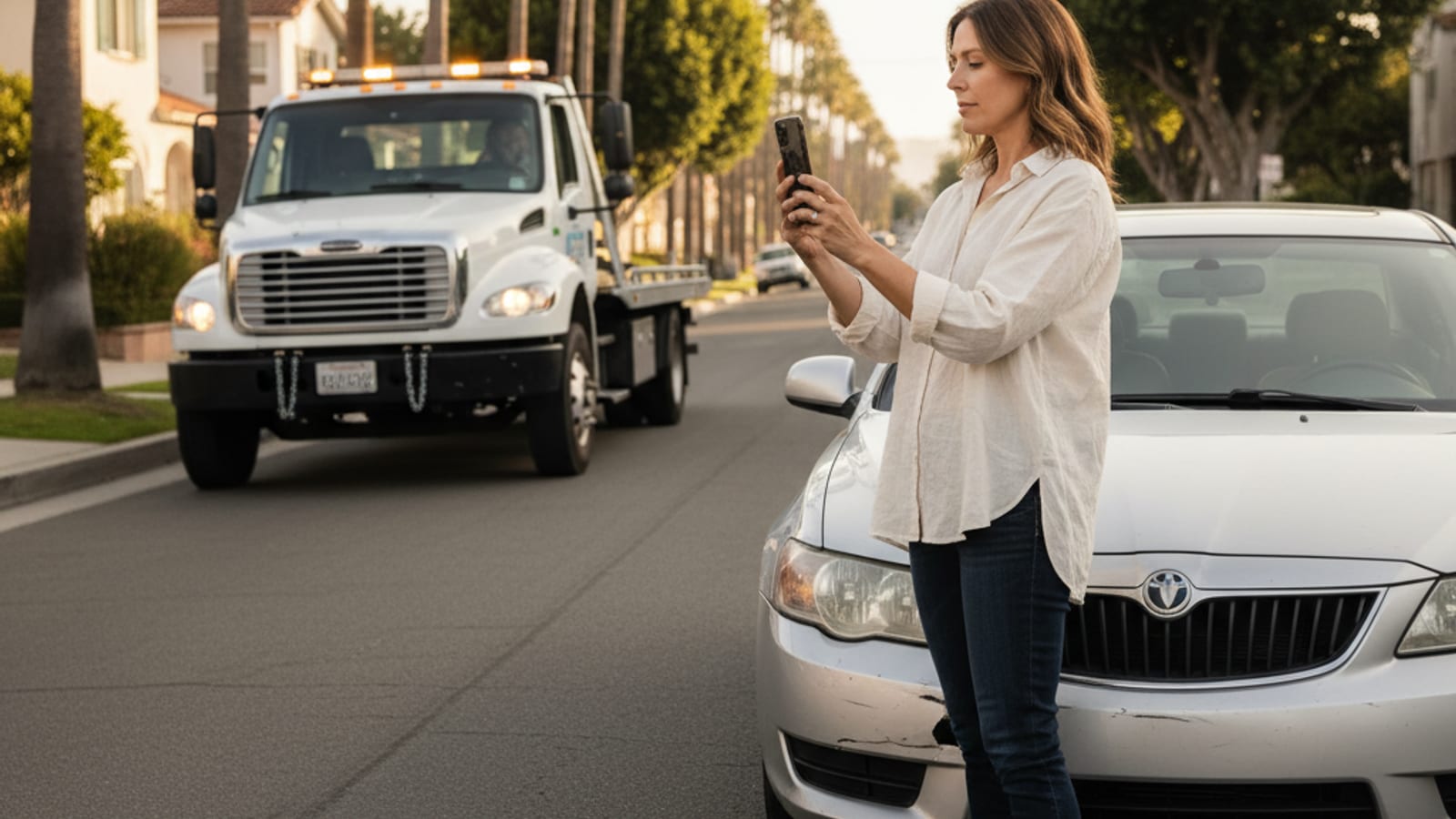
TL;DR
- Follow a strict 30-minute sequence after any collision: check injuries, move to safety, call police, document the scene, then coordinate the tow.
- In California, you must call police if anyone is injured or damage exceeds $1,000.
- Photograph every angle of every vehicle, exchange driver info, and get witness contacts before anyone leaves.
- Never admit fault, accept off-the-record settlements, or post on social media until the claim closes.
A minor fender-bender can still ruin a week if you don’t handle the first 30 minutes right. Here’s what to do at the scene.
First 5 minutes: safety and check-in
- Check for injuries. You first, then your passengers, then the other driver. If anyone’s hurt, call 911 immediately - everything else can wait.
- Move to safety. If the vehicles are drivable and there’s no fire, move them to the shoulder, a side street, or a parking lot. Blocking a lane causes secondary accidents.
- Hazard lights on for all involved vehicles.
- Take a breath. Adrenaline makes you do dumb things. A minute of collecting yourself makes the next 25 go smoother.
Minutes 5-10: Call police (even if minor)
In California, you must call the police if:
- Anyone is injured, even slightly
- Any vehicle has more than $1,000 in damage (most tow-worthy collisions)
- The collision involves property damage to public infrastructure (guardrail, signs, etc.)
Even for minor incidents, an official police report protects you. The other driver’s story can change in 48 hours. A report lock in facts while memory is fresh.
- 911 for any injury or active danger
- #399 from a cell phone for non-emergency CHP on freeways
- Local non-emergency line for surface-street incidents (SDPD, Chula Vista PD, etc.)
Give dispatch: location (with mile marker or cross-street), number of vehicles, any injuries, and whether traffic is blocked.
Minutes 10-15: Document the scene
Take photos. Lots of photos. Your phone has unlimited storage.
Every angle of every vehicle:
- Front, back, both sides of your car and the other driver’s car
- Wide shots showing position of both cars on the road
- Close-ups of every damage point
Wider context:
- Skid marks, debris on the pavement
- Stop signs, traffic signals, lane markings
- The view each driver had approaching the intersection
- Weather conditions (sun angle, rain, fog)
- Time-stamped photos of the dashboard (clock) and odometer
Exchange info with the other driver:
- Full name and phone
- Driver’s license (photo it)
- Insurance card (photo it)
- License plate (photo it)
- Vehicle VIN from the dashboard (photo it)
Witnesses, if any:
- Name and phone of anyone who saw the crash
- Quick statement of what they saw
- Don’t let them leave without getting contact info
What NOT to say:
- “I’m sorry.” Even reflexively. Sounds like admitting fault.
- “I didn’t see you.” Admits distraction.
- “I was going about ___.” Admits a specific speed that could be over the limit.
Stick to what happened from your perspective. Save judgments for your insurance adjuster.
Minutes 15-20: Coordinate the tow
If either vehicle can’t be driven safely:
- Call your insurance (not your roadside plan - your claims line). Many policies will dispatch a tow directly and handle billing.
- If CHP is on scene, they may dispatch the next tow in rotation. You can request a specific company by name if you prefer - ask for accident recovery specialists who carry the right equipment.
- If you have a tow company preference, tell the responding officer. They’ll note it; you can direct your car to a shop of your choice.
When the tow driver arrives:
- Tell them where you want the vehicle taken. Options: specific body shop, dealer, your home, or an insurance-preferred shop.
- Don’t let the driver just take it to an impound yard unless law enforcement directs it. Impound storage fees pile up fast.
- If your vehicle is damaged, make sure the driver is using a flatbed tow truck - wheel-lift on a wrecked suspension can cause additional damage.
- If you’re in an EV and it’s drivable but low on charge after the accident, Charge Pro SD can bring mobile charging to the scene so you can drive to the body shop instead of paying for a flatbed.
- Get a copy of the tow receipt with scene address, destination, and total cost.
- Take off any valuables: registration, insurance card, personal items, baby seat.
Minutes 20-30: Post-scene paperwork
- Write a one-paragraph statement of what happened while it’s fresh. Date and time it. Save in your phone notes.
- Call your insurance claims line (not the agent, the claims number). Open a claim immediately. You’ll get a claim number and an adjuster assigned.
- Request a copy of the police report when it’s filed (usually 5-10 business days). Some are available at crashreports.chp.ca.gov if it was a CHP response.
- Photograph your injuries even if minor. Soft-tissue injuries sometimes show up 24-48 hours later.
- Schedule a medical check-in for yourself and anyone else in the car, even if you feel fine. Whiplash and concussion symptoms can delay.
What mistakes should you avoid in the first 30 minutes?
- Do not argue with the other driver. Exchange info, take photos, let police handle disputes.
- Do not accept fault or “settle it off the record.” Even if you think you’re at fault, let the claim process run. Side deals often go sideways.
- Do not leave the scene until police release you. In CA, leaving can be misdemeanor hit-and-run even if you were just trying to get out of the way.
- Do not post on social media. Photos, complaints about the other driver, even “what a day” updates - all of it gets discovered by insurance adjusters and lawyers later. Private channels only until the claim closes.
What happens if the tow driver arrives before police?
Sometimes a tow truck arrives before police. That’s fine. The driver can:
- Help move vehicles off travel lanes if necessary (and safe)
- Photograph the scene for their records
- Provide flares or triangles for visibility
- Offer roadside assistance like hazard setup and scene stabilization
- Tell you what they’re seeing from their experienced eye
They cannot:
- Determine fault
- Give you legal advice
- Tell you what to say to police
A reputable tow driver will defer those to CHP or your insurance adjuster. Ours are trained to.
What are the red flags to watch for at a crash scene?
Watch for:
- A tow truck that showed up before you called one. “Chasers” monitor police radio for accidents and rush to scenes. In California, this is illegal - a tow company cannot solicit at an accident scene. Don’t hire them; call your insurance or ask the responding officer for rotation dispatch.
- The other driver pressuring you to skip police and “handle it.” That’s a red flag for no insurance, expired registration, or bigger legal issues.
- A witness who wants to “mediate” between you. Witnesses give statements; they don’t negotiate.
What should you do in the 24-48 hours after an accident?
Within 24-48 hours:
- Confirm your insurance claim is open and has a claim number
- Send your photos and scene statement to the adjuster
- Get an estimate from the body shop the tow took your car to
- Follow up on the police report once filed
- If you have any pain or stiffness, see a doctor - and document the visit
Bottom line
Thirty minutes of discipline at the scene saves weeks of headache during the claim. Stay calm, document everything, and don’t make statements that feel good in the moment but cost you later.
Serving San Diego County: We respond to accidents across Downtown, Chula Vista, El Cajon, Oceanside, and Escondido - plus every other city in the county.
Related reading: Once the scene is handled, you’ll need a tow — our San Diego tow cost guide covers what to expect on pricing so you’re not blindsided at a vulnerable moment. Vetting a company from the shoulder? Here are the red flags to watch for before you say yes. And if the accident happened on the highway, our freeway breakdown guide walks through exactly what to do while you wait for help.
Frequently asked questions
Do I have to call the police after a minor car accident in California?
Technically, you’re required to report any accident with injury or damage over $1,000 to law enforcement. In practice, most tow-worthy collisions exceed that threshold. Even for fender-benders, a police report protects you if the other driver’s story changes later.
How long do I have to file an insurance claim after a car accident in San Diego?
Most California auto policies require you to report a claim “promptly” or within 24-72 hours. Filing at the scene or within a few hours is best. Waiting days gives the other party time to file first and frame the narrative.
Can I choose which tow company takes my car after an accident?
Yes. In California, you can request a specific tow company even when CHP is on scene. Tell the responding officer your preference. If you don’t specify, they’ll dispatch the next company in the rotation.
What if the other driver doesn’t have insurance?
Exchange info the same way and file a police report. Then file a claim under your own uninsured/underinsured motorist coverage. About 15% of California drivers are uninsured, so this scenario happens regularly.
Should I go to the doctor after a minor accident even if I feel fine?
Yes. Whiplash, soft-tissue injuries, and mild concussions often don’t show symptoms for 24-48 hours. A documented medical visit within a day or two strengthens any future claim and catches problems early.
If you need post-accident towing in San Diego County, we’re on the CHP rotation and respond with a proper flatbed for damaged vehicles. Call (858) 923-5787.