A dead battery or flat tire after dark doesn’t always require towing. If you’re searching for 24 hour emergency roadside assistance in San Diego, first decide whether one safe roadside service could return the vehicle to normal use. Smoke, fire, a collision, or another immediate hazard calls for emergency authorities before roadside dispatch.
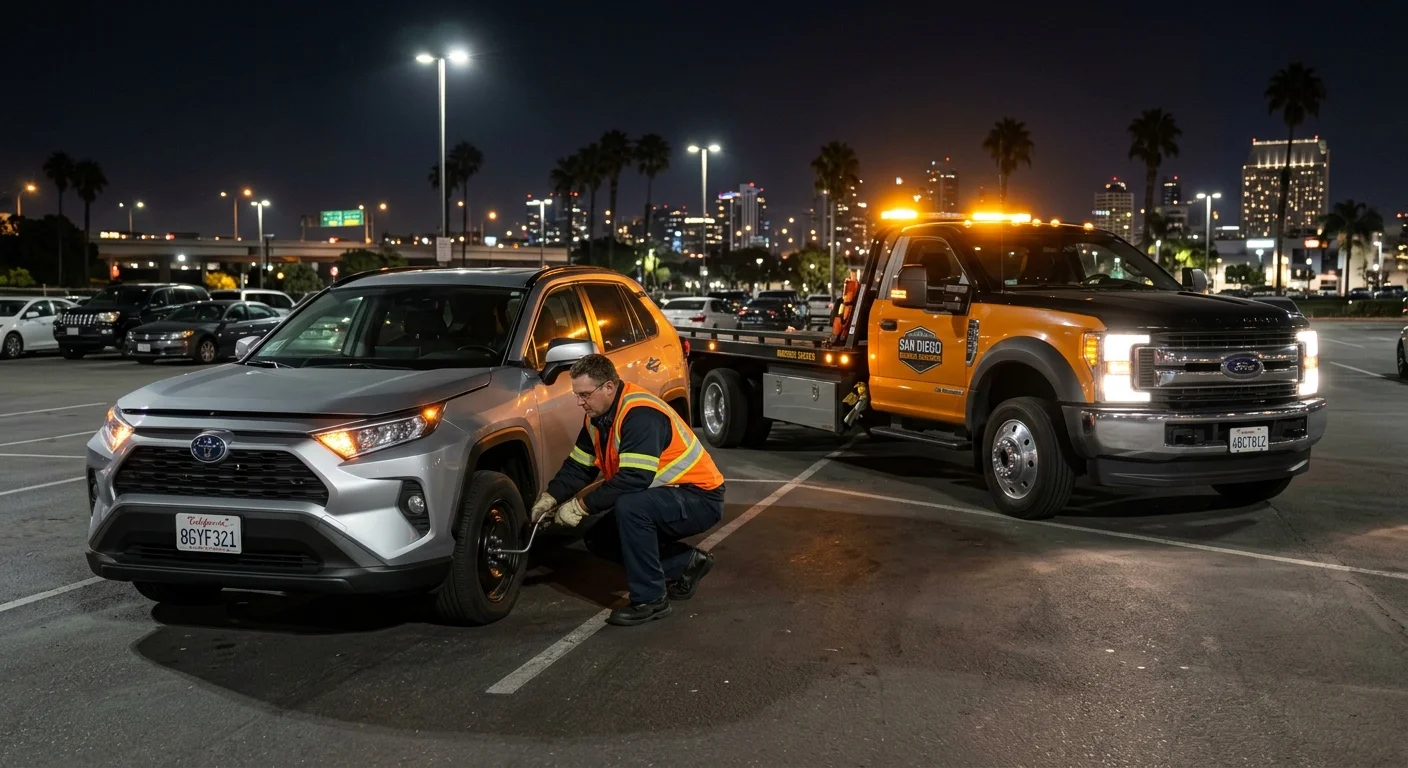
Move away from traffic before arranging help
Your location matters more than the mechanical problem at first. A dead battery inside a lit parking lot is different from the same failure beside I-805. Before arranging help, move away from moving traffic if you can do so safely.
Don’t cross active lanes on foot to reach a better calling spot. Don’t stand between your vehicle and approaching traffic. Your safest position depends on the shoulder, nearby barriers, traffic, and the vehicle’s condition. If the location feels immediately dangerous, contact emergency authorities and follow their instructions.
Once you’re away from traffic, note where the car stopped. San Diego freeway interchanges can make a vague location difficult to identify. “Near I-8” isn’t enough around Mission Valley. The direction of travel, nearest exit, and side of the freeway are much more useful.
On surface streets, look for a cross street, business name, parking level, or visible address. In areas such as North Park or City Heights, two nearby blocks can have very different access. A parking lot entrance may also be on another street from its posted address.
Drivers stopped on a freeway can review our San Diego freeway breakdown guide for location-specific steps. For future trips, NHTSA roadside guidance recommends carrying a phone charger, flashlight, first aid kit, water, and jumper cables.
When a jump, tire change, or fuel delivery may fit
Roadside help may fit when the problem is isolated and the vehicle should be usable afterward. The goal isn’t merely to make the warning disappear. The service needs to leave the car ready for ordinary driving.
A jump start may fit when the engine won’t crank and the vehicle has no other known problem. Tell dispatch what happens when you turn the key or press the start button. Clicking, dim interior lights, complete silence, and normal cranking are different symptoms. Don’t promise yourself that every no-start condition is a dead battery.
A tire change may fit when the vehicle has a usable spare and sits on a stable, accessible surface. Tell dispatch if the tire came apart, the wheel looks damaged, or the vehicle rests unusually low. Those details can change the recommended service. A narrow freeway shoulder may also make a routine tire change unsuitable at that location.
Fuel delivery may fit when the vehicle simply ran out of fuel. Share whether the engine stopped while driving or failed after being parked. If fuel wasn’t the clear cause, describe the symptoms without guessing.
Lockout help is another roadside service, but mention whether a child, animal, or medical item is inside. Immediate danger belongs with emergency authorities.
Our roadside assistance service covers the types of help dispatch can arrange. The independent operator taking the job can confirm whether a roadside fix fits the reported symptoms and pickup point.
When the vehicle should be towed
Towing is the better choice when a single roadside service won’t return the vehicle to normal driving condition. It also makes sense when the roadside location doesn’t provide a workable place for the proposed service.
Collision damage is one clear reason to avoid treating the problem as a simple restart. The same applies when steering, braking, a wheel, or another driving control doesn’t seem normal. Smoke, fire, or leaking fluid should be reported immediately. Don’t touch damaged components or approach an active hazard.
A tow may also be needed when:
- The tire is damaged and there isn’t a usable spare.
- The wheel or suspension appears damaged.
- The engine stopped while the vehicle was moving.
- The vehicle overheated or produced smoke.
- A jump start didn’t restore normal operation.
- Warning messages indicate a problem beyond the original symptom.
- The car sits in a garage or location where the expected service vehicle can’t reach it.
Electric vehicles need model-specific handling. Tell dispatch the exact make, model, and condition. Manufacturer transport guidance varies, especially after collision damage or water exposure. Don’t assume one EV’s towing procedure applies to another.
Our emergency towing service explains how dispatch connects drivers with independent operators. The operator may ask where the vehicle should go, such as a repair shop, dealership, home, or another lawful destination. If you haven’t chosen one, say so before the operator accepts the job.
How to describe a dark or difficult pickup point
A precise pickup description reduces confusion after dark. Start with a dropped map pin, then add details a driver can see from the road. Map pins can land on the wrong side of a freeway, behind a building, or at an inaccessible entrance.
For a freeway stop, provide the route, direction, nearest exit, and shoulder. “Southbound I-5 before the Washington Street exit” is more useful than “near downtown.” Around the I-5 and I-805 split, confirm which freeway you’re actually on. Along I-8, include whether you’re eastbound or westbound and name the nearest signed exit.
For a surface street or parking lot, share:
- The street address and nearest cross street
- The business or building name
- The entrance you’re closest to
- Your parking row, stall, floor, or garage level
- The vehicle’s color, make, model, and plate
- Whether the warning lights and exterior lights work
- Any gate, height limit, steep ramp, or access restriction
- Whether the vehicle can roll, steer, or shift into neutral
San Diego’s pickup conditions change quickly by area. A curbside stop in Chula Vista isn’t described like a garage pickup downtown. East County roads may have fewer visible landmarks. Coastal freeway stops can look similar after dark, so exit signs and travel direction matter.
Mention nearby traffic, debris, collision damage, smoke, or fluid without inspecting anything closely. Dispatch needs an honest description, not a mechanical diagnosis. Photos may help if they can be taken without entering traffic or approaching a hazard.
What to confirm before dispatch
Before accepting service, confirm what the operator believes the job requires. Describe the symptoms first, then ask whether the call is being handled as roadside assistance or towing. That distinction affects the equipment, destination planning, and questions you’ll need answered.
Confirm these details with the independent operator:
- The exact pickup location and vehicle description
- The requested service
- The destination if towing is expected
- The price and what the quoted amount includes
- Accepted payment methods
- The arrival estimate for your exact location
- Any garage clearance, gate, or access problem
- What happens if the roadside fix doesn’t restore normal operation
Quick Tow SD doesn’t publish a standard arrival window or rate card. The operator taking the job sets the price and provides an estimate based on the actual location. Mountain, backcountry, and Camp Pendleton corridor pickups can take considerably longer to reach than central San Diego, so location accuracy matters.
The phone line takes calls 24/7, but that doesn’t make every call identical. Vehicle type, road position, access, and operator availability all shape the dispatch. Our guide to 24-hour towing service in San Diego explains what information helps during an urgent call.
If you have roadside coverage through a membership or insurer, check its current terms directly. Don’t assume every service, towing distance, or provider is included. Confirm whether you must contact the plan before accepting outside service.
When to call us
Call when a safe jump, tire change, fuel delivery, or lockout service may solve the problem. If the vehicle is damaged, unsafe to drive, or still disabled after a roadside attempt, dispatch can connect you with a professional towing operator. Call (858) 923-5787 to reach dispatch.