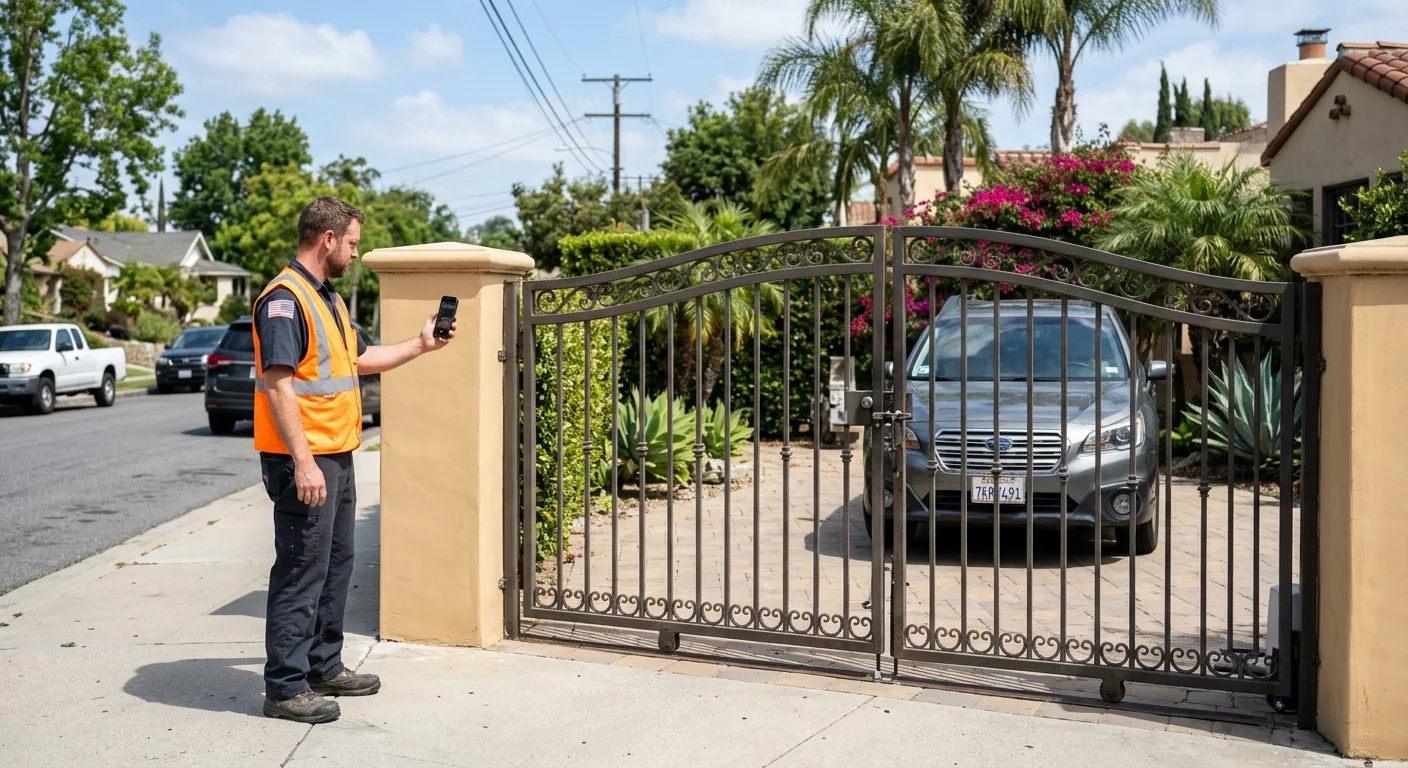
The usual scene in San Diego County is a closed driveway gate, a car on the pad, and a recovery truck at the curb. After a default, California Commercial Code 9609 lets a secured party take the collateral without a court order only when the taking happens without a breach of the peace. Business and Professions Code 7508.2 also bars unlawful entry into a private building or a secured area without consent of the owner or the person in legal possession. A repo agent who breaks your gate, forces a lock, or enters a fenced and locked driveway without that consent is outside those rules.
What this question usually means at a locked driveway
When someone in Chula Vista, Poway, or Carlsbad asks whether a repo agent can open a gate, they mean a physical barrier. A keypad on an HOA arm. A chain across a Lakeside driveway. A fob gate under a Mission Valley podium. A locked side gate that is the only way onto the pad.
They want to know if the agent can punch codes, wait for a neighbor, follow a car through, cut a padlock, lift the arm, or ask night security to buzz them in. That is a different question from whether a recovery truck may stand on private property at all. Open-lot entry is covered in can a repo man come on private property in California. This page stays on the barrier.
The search “can a repo man open your gate” is about force and access. Missed payments start self-help repossession. They do not rewrite the entry rules. A recovery truck used for a repossession still has to take the car without a breach of the peace. A locked gate adds the secured-area rule on top of that.
San Diego housing makes the distinction local. Coastal north county tracts in Encinitas and Carlsbad often sit behind HOA arms and private driveway gates. Inland streets in Rancho Bernardo and 4S Ranch mix open cul-de-sacs with locked community entries. East County lots in El Cajon, Santee, and Lakeside more often have a chain, a ranch gate, or no gate at all. South Bay apartments in National City and Chula Vista use key-fob garages. The same loan default looks different at each of those addresses.
If the car sits on an open driveway with no fence and no lock, the gate question is not in play. If the only way in is a closed, locked gate, it is.
How a gated home differs from an open private lot
California Business and Professions Code 7500.1 defines a private building as a dwelling, an outbuilding, or another enclosed structure. It defines a secured area as a fenced and locked area. Both matter at a house with a gated driveway.
An uncovered parking stall or a driveway with no closed lock is the setting Commercial Code 9609 usually describes when it allows a taking without a judge. That taking still has to happen without a breach of the peace. Force, threats, and a scene that turns into a fight remain problems. The CFPB notes that force, threats, taking a car from a closed garage without permission, and continuing after a refusal can raise breach-of-peace issues under some state laws. Stay out of the truck’s path. Don’t treat a blog as a script for a confrontation.
A fenced and locked driveway meets the statute’s secured-area definition. Unlawful entry into that area without consent of the owner or the person in legal possession is prohibited during repossession. A garage that is a private building sits in the same statute. The Bureau of Security and Investigative Services tells consumers that agency employees may take a vehicle only while respecting those limits, and that they may not enter a private building or a secured area. BSIS also states that breaking gates, moving other vehicles, and damaging landscaping are not permitted.
A fence with the gate standing open is a fact pattern the statute does not automatically label as secured. The definition is fenced and locked. An open garage door is also not documented as blanket permission to walk in and take the car. Don’t treat every fence, every HOA arm, or every cracked garage door as the same case.
Apartment and condo garages add a third person. The statute looks at consent of the owner or the person in legal possession at the time of the repossession. Whether a night guard, a property manager, or an HOA clicker had that authority is a fact question. This page can’t settle it. Ask the lender in writing what access they claim, and ask a California lawyer if a guard walked an agent through a key-only garage.
A private property tow under Vehicle Code 22658 is a separate track. That statute is about a property owner removing a vehicle that does not belong on the lot. It is not the repossession statute. Mixing the two is how people get the gate rule wrong.
What to document if a gate, lock, or fence is involved
Stay out of the way. Don’t block the truck with your body. Don’t chase the driver. If it is safe, record from inside the house or from the street.
Photograph the gate, the lock, the keypad, and any damage before anyone argues about it. Get the time, the street, and the city. Capture the truck’s markings, the license plate, and any company name on the door. If a second car was moved, photograph where it sat. If the arm, the lock, or the landscaping is broken, photograph that too. Doorbell cameras are common on coastal north county houses and newer South Bay condos. Save the clip before it overwrites.
Write down who spoke, and what they said about consent. If an HOA board member, a guard, or a roommate waved them through, name that person. Consent is the statutory hinge. A vague “security let them in” is weaker than a name, a time, and a camera clip.
Call the local police non-emergency line to report property damage if a lock, gate, or fence was forced. Ask for a report number. That report is evidence. It is not a ruling on the loan. Inside the City of San Diego, that agency is San Diego Police. On Port tidelands it is Harbor Police.
Keep the loan paperwork, default notices, and any texts from the lender. Then complain to the California Bureau of Security and Investigative Services if the actor was a licensed repossession agency or a registered employee. BSIS takes consumer complaints online at bsis.ca.gov/consumers/complaints.shtml, including reports of unlicensed activity.
That record is not legal advice, and it does not stop a lawful taking on an open lot. It is what a lawyer or a regulator can actually use.
Where to confirm the current California rule
Read the statutes, not a forum post. California Commercial Code 9609 is the self-help rule after default. Business and Professions Code 7508.2 is the unlawful-entry and assault bar. Section 7500.1 in the same code is where “private building” and “secured area” are defined. The BSIS consumer FAQ is the agency’s plain-language version of those limits.
Those pages change when the Legislature amends them. Confirm the text on the date you need it. If a clause in the loan talks about driveway access, that clause still has to live next to the breach-of-peace rule and the entry statute. This site can’t interpret your contract.
Vehicle Code 22658 is the private-property towing statute. It governs posted lots, notice, storage distance, and the half-fee drop if you return before the truck leaves. We walk through that statute in CVC 22658 private property towing and in know your rights when your car is towed in San Diego. It does not answer whether a repo agent may open a locked residential gate.
For the loan itself, call the lender or servicer and ask where the vehicle was taken. For a damaged gate, use the police agency that covers the address. For the legal effect on your loan, your credit, or a lawsuit, talk to qualified California counsel. Quick Tow SD is a towing referral brand. We’re not your lender, not a repossession agency, and not a law office.
What to do if the vehicle is already gone
Start with the lender or servicer. Ask for the agency name, the storage location, and the itemized charges. Business and Professions Code 7507.9 requires a personal-effects inventory from a repossession agency, with the agency’s contacts and hours and any itemized removal and storage charges. The usual inventory timing is 48 hours, with weekend, holiday, and other exceptions in the statute. Ask the agency for the inventory in writing. Don’t assume every demanded fee is lawful. Disputed charges are a lawyer’s question.
Personal belongings on a repossessed vehicle don’t follow the same retrieval rule as an ordinary police or private-property tow. Vehicle Code 22651.07 gives pre-payment inspection and personal-property rights during business hours on many stored vehicles, with scope exceptions that include repossessed vehicles. Treat the repo agency’s inventory process as the path for belongings, and get legal help if they refuse.
Don’t assume the car is at a City of San Diego impound. Police tows inside the city run through AutoReturn’s locator at search.autoreturn.com. A repossession is a lender taking, so it often never appears there. If you can’t find it on AutoReturn, that does not mean it wasn’t taken. It means you’re likely in the lender’s process.
If a second household car is still in the driveway, or the gate is jammed and a vehicle is stuck, that is a towing problem. It is not a request to hide a car from the lender. We don’t reverse a repossession, and we don’t send operators to stop one.
When to call us
If a remaining vehicle is disabled, blocking the gate, or needs a lawful private-property removal, call any time, day or night. We match you with an independent licensed operator. That operator does the work, sets the price, and gives you an arrival estimate for the exact address. Call (858) 923-5787 to reach dispatch.