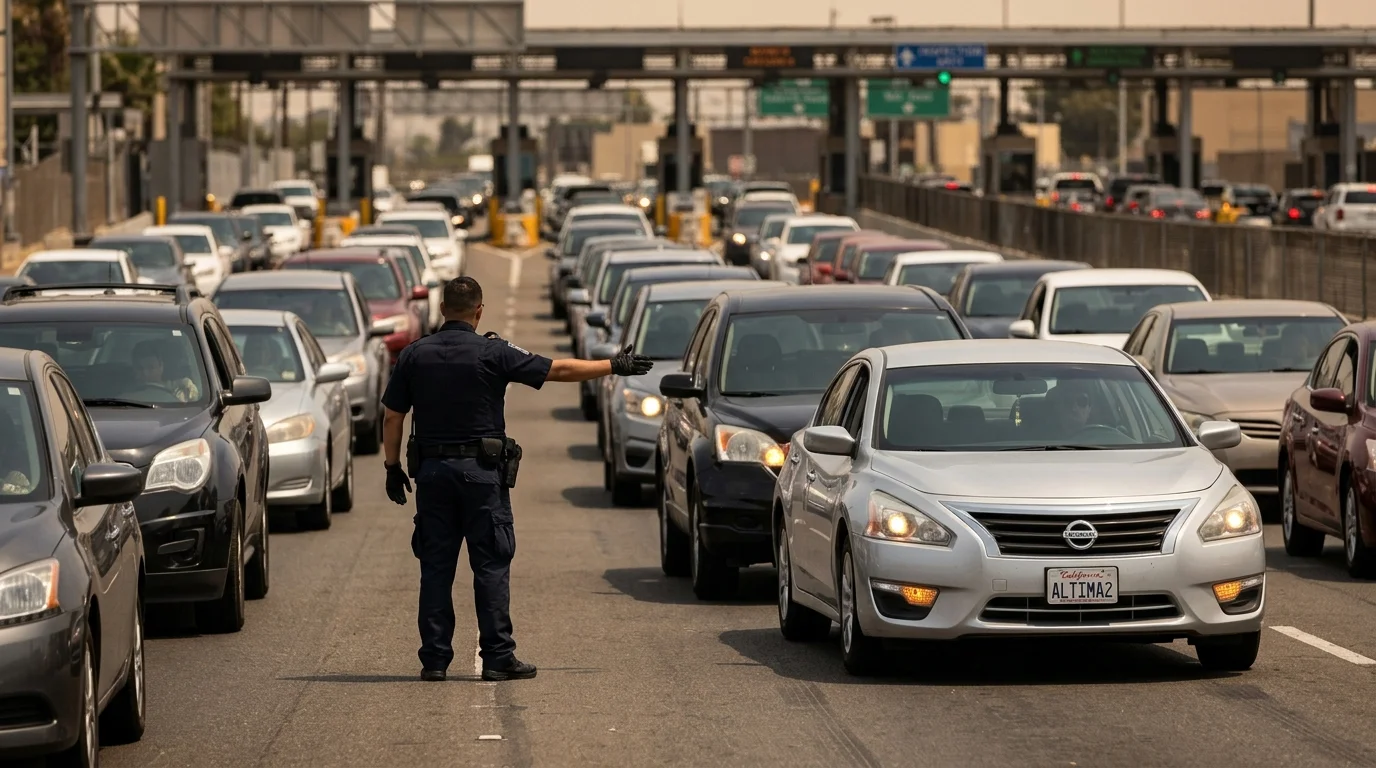
If your car dies inside the San Ysidro border crossing lanes, put your hazards on, keep your foot off the brake so you don’t blind the driver stacked behind you, and stay inside unless smoke or cross-traffic makes that unsafe. Wave down the nearest Customs and Border Protection officer or Mexican customs agent working the lanes. They manage stalled vehicles at this crossing constantly and can route traffic around you fast. Then call a tow company that actually runs the South Bay corridor, not whatever number shows up first in a search. Quick Tow SD dispatches to San Ysidro, Otay Mesa, and the rest of the border area 24/7 at (858) 923-5787.
That’s the short version. San Ysidro is the busiest land border crossing in the Western Hemisphere, and a stall here plays out differently than a stall on a quiet residential street. Here’s the full plan.
Why do so many cars stall out at the border?
The San Ysidro Port of Entry backs vehicles up for blocks, sometimes for well over an hour during peak crossing windows. That kind of stop-and-go idling is harder on a car than normal driving.
Air conditioning runs nonstop in stacked traffic, especially in summer, and that pulls a steady electrical load off a battery that never gets a real charge because the engine barely turns above idle speed. Add a cooling system that’s a quart low or a battery that’s a year past its prime, and the crossing lanes are where it finally gives out.
Vehicles crossing north from Tijuana also skew older on average, and older vehicles carry more of the wear that turns a long idle into a dead battery or an overheated engine. None of that means your car is doomed at the border. It means the border is a rough environment for a car that was already close to a problem.
What do you do the second your car stops moving?
Turn on your hazard lights immediately, even before you’re sure the car actually died. Shift into park and set the brake if you can. Don’t try to push the car yourself into the next lane. One person pushing a car in a packed crossing lane is a good way to get hurt.
| Do | Don’t |
|---|---|
| Turn on hazard lights the moment you stop | Try to push the car alone into moving traffic |
| Stay buckled in unless it’s unsafe | Get out on the side facing oncoming lanes |
| Flag the nearest officer directing traffic | Assume someone will notice you on their own |
| Keep ID, registration, and insurance ready | Leave the car unlocked and unattended |
| Call a South Bay tow company directly | Wait to see if the engine “cools down and starts” |
Look for the nearest officer, either CBP on the US-bound side or Mexican customs on the Tijuana-bound side, and get their attention. Dealing with a stalled vehicle is routine work for them, not an emergency escalation. Stay buckled in until someone tells you it’s safer to get out, especially if you’re boxed in on both sides.
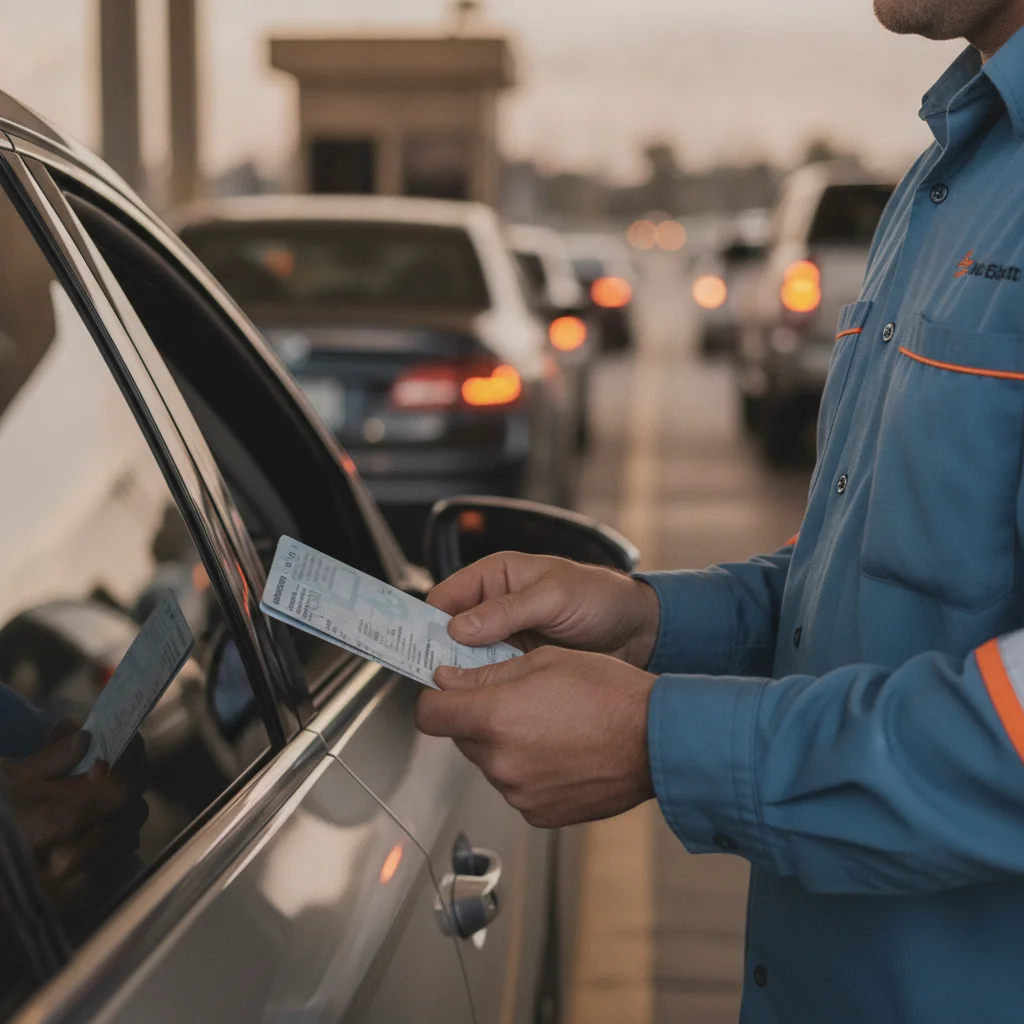
Once you’ve flagged someone down and you’re not creating a bigger jam, make your call. Have your license, registration, and insurance card within reach. An officer may ask for them, and you’ll want them ready for the tow driver too.
Can a tow truck actually get you out of the crossing lanes?
Yes. This is one of the more specialized calls we take in the South Bay, since the truck has to reach you inside an active federal port of entry, not a normal street or shoulder. The drivers we send coordinate with whoever is directing traffic in the moment, whether that’s a CBP officer, a Mexican customs agent, or crossing personnel, to get your car pushed or towed clear of the lanes and into a safe pull-off area nearby.
From there we either get you running again on the spot, if it’s something simple like a dead battery, or load the car onto a flatbed or wheel-lift and take it to your home or a shop anywhere in San Diego County. See our emergency towing service for what a same-day dispatch looks like outside the border context, since most of the truck and process is identical. Only the pickup spot changes.
Do you need special paperwork to get towed at the border?
Nothing beyond what you’d carry on any drive: a valid photo ID or passport card, your vehicle registration, and proof of insurance. If your car is registered in Mexico but stalls on the US side of the crossing, we can still tow it. We just can’t drive across the international line ourselves. Our coverage runs the San Ysidro side and the rest of San Diego County, not into Tijuana.
If the officer directing traffic asks you a question before the tow truck arrives, answer it directly. Getting a stalled vehicle out of an active crossing lane is a shared job between you, the officer, and the driver, and moving fast matters more here than almost anywhere else we serve.
What if someone rear-ends you while you’re stopped in line?
It happens. Stop-and-go crossing traffic, with drivers checking phones or distracted by the wait, is a real setup for a low-speed rear-end hit. If that happens, stay in the car, check for injuries first, and get the vehicle moved out of the traffic lane the same way you would for any stall: hazards on, flag an officer, call for a tow. Our accident recovery crews handle exactly this kind of aftermath, from documenting where the vehicles ended up to getting both cars clear safely.
Does a tow near the border cost more than a regular San Diego tow?
No built-in border surcharge exists. A tow from San Ysidro prices the same way any South Bay tow does: a flat local rate in the $95 to $175 range for most passenger vehicles under 10 miles, more if you need a long haul home or the vehicle needs a flatbed. See our full tow cost guide for the breakdown by vehicle type and distance. Tell the dispatcher exactly where you are, the lane or nearby landmark, your vehicle, and where you need it taken, and you’ll get a real number before the truck rolls, not after.
How fast can a tow truck reach San Ysidro?
Coverage in the South Bay includes the San Ysidro crossing, the Las Americas outlets, and the I-5/I-805 merge into the border, and the operator taking the job gives you the arrival estimate for your exact spot. Commercial trucks feeding the Otay Mesa freight crossing are a separate, heavier class of call. See our heavy-duty towing in Otay Mesa guide if you’re hauling freight and stall out on the approach.
Frequently asked questions
What should I do if my car breaks down at the San Ysidro border?
Turn on your hazard lights right away, stay in the car unless it’s unsafe, and flag the nearest CBP or Mexican customs officer so they can route traffic around you. Then call a tow company that covers the South Bay, like Quick Tow SD at (858) 923-5787, and give your exact lane or landmark.
Can a tow truck reach me inside the border crossing lanes?
Yes. Tow drivers coordinate with the officers directing traffic at the crossing to reach a stalled vehicle inside the lanes and move it to a safe pull-off area. It’s a specialized call but a routine one for a South Bay tow company.
Do I need my passport to get towed at the border?
You don’t need a passport specifically for the tow, but carry your photo ID, vehicle registration, and proof of insurance. An officer may ask for them, and your tow driver will want the registration too.
Can you tow a Mexican-plated car that breaks down on the US side?
Yes, as long as the vehicle is on the US side of the crossing. We can tow any vehicle stalled within San Diego County, including Mexican-registered cars, but we can’t drive across the international border ourselves.
Does towing near the border cost more than a regular tow?
No. There’s no border surcharge. Pricing follows the same local South Bay rate as any tow, typically $95 to $175 for a standard passenger vehicle under 10 miles, quoted before the truck leaves.
How long does it take a tow truck to reach San Ysidro?
Most calls to the San Ysidro crossing and the surrounding area get a truck on scene in about 25 to 35 minutes from South Bay dispatch, depending on time of day and how backed up the crossing is.
If your car stalls out anywhere near the San Ysidro or Otay Mesa crossings, get your hazards on, flag an officer, and call Quick Tow SD at (858) 923-5787. We run the South Bay corridor 24/7 and know exactly how to reach a car stuck inside an active port of entry.