For classic car towing in Carlsbad, good planning starts before dispatch. Describe the car, its condition, the pickup space, and the destination. Those details help match the job with an operator who can discuss a suitable loading plan.
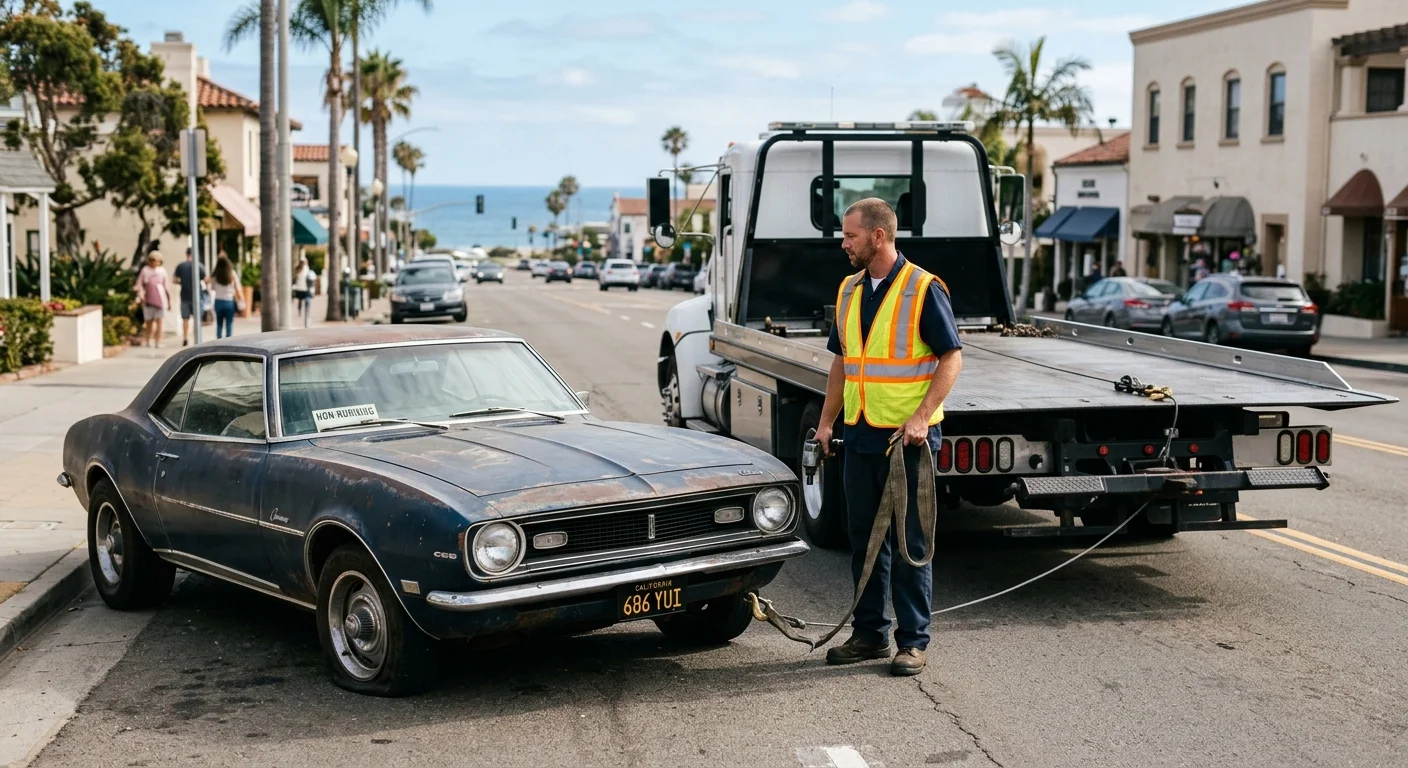
Describe the car without guessing at the failure
Start with the year, make, model, and body style. Give the operator the facts you can observe. You don’t need to diagnose why the classic won’t start.
Explain what happens when you turn the key. The engine may crank, click, or remain silent. Report any visible fluid, smoke, damaged wiring, or unusual smell. If you haven’t tried starting it again, say that too.
Mention every modification you know about. Relevant details include lowered suspension, wider wheels, side pipes, spoilers, or body panels close to the ground. Don’t assume the original factory specifications still describe the car. A clear side photo can show the car’s current stance better than a model name.
Tell dispatch whether the vehicle was running when parked. Share how long it has been sitting, if you know. Also mention any recent work, disconnected parts, or loose items inside the vehicle. Stick to what you can confirm.
Our exotic and classic vehicle towing service connects owners with independent, licensed and insured operators. The operator performs the work and chooses the loading approach after reviewing the vehicle and access.
Accurate details matter more than a confident mechanical theory. Saying “it won’t start and the cause is unknown” is useful. It prevents a guess from shaping the wrong transport plan.
Share clearance, wheel, and steering details
Next, describe how the car can move without its engine. Tell dispatch whether each tire is inflated and attached. Note any visibly damaged wheel, dragging tire, or missing component. Don’t try to force the car forward just to test it.
Check whether you have the keys. Explain whether the steering unlocks and the transmission can shift. If the parking brake won’t release, say so. A car that doesn’t roll, steer, or shift needs a different conversation than one that simply has a dead engine.
Ground clearance deserves special attention. Photograph the front valance, rocker panels, exhaust, and lowest visible suspension area. Take the pictures from wheel height when possible, without crawling beneath the vehicle. Include any loose panel or part that could contact the loading surface.
If the car sits inside a garage, share the door height and available space ahead. Mention shelves, parked vehicles, gates, posts, or sharp turns. The operator also needs to know whether the vehicle faces toward or away from the exit.
You can request flatbed towing, but don’t treat one method as mandatory for every classic. Ask the referred operator how the proposed equipment fits this car’s clearance, wheel condition, and steering status. A flatbed tow for a classic car is still a job-specific decision.
These details don’t create a damage-free guarantee. They give the operator a clearer picture before equipment reaches the car.
Explain the Carlsbad pickup location
A Carlsbad address alone doesn’t explain the pickup. A home garage near Carlsbad Village differs from a business lot off Palomar Airport Road. A gated property in Rancho Carrillo also requires different access details than a driveway in La Costa.
Give the exact address and the car’s position on the property. Say whether it’s inside a garage, beside a house, underground, or parked at the curb. Identify the surface beneath it, such as pavement, gravel, dirt, or decorative pavers.
Describe the route from the street to the vehicle. Include gate codes, garage clearance, driveway slope, tight corners, and parked cars. If landscaping or a wall limits access, photograph the narrowest point. The operator needs enough room to approach, load, and leave.
For a public parking lot, provide the business name and closest entrance. A dropped map pin can help when the lot has several driveways. If the car is near I-5, Coast Highway, or another major road, name the direction of travel and the nearest exit or cross street.
A freeway shoulder is a different situation from a scheduled garage pickup. Tell dispatch immediately if the car is exposed to moving traffic. Follow current NHTSA roadside safety guidance while arranging help.
Our broader Carlsbad tow truck guide covers common location details around the city. For this job, photos and precise access notes are more useful than saying the car is “easy to reach.”
Ask how the referred pro plans the tow
Quick Tow SD is a referral and dispatch service. We take the call and match customers with independent operators in our network. The operator performs the tow, sets the price, and receives payment directly.
Before agreeing, ask the operator to explain the loading plan. The answer should address the car you described, not classic cars in general. Ask what equipment will be used and how the vehicle will be moved if it can’t roll or steer.
Confirm which end of the car will face forward. Ask whether any wheels will remain on the road during transport. If dollies or other equipment are proposed, ask why they fit the vehicle’s condition. You can also ask where the operator expects to connect loading equipment.
Point out fragile or unusual areas before loading begins. These may include a low air dam, exposed exhaust, custom wheels, or nonstandard bodywork. Don’t assume a feature is obvious in dim light or from the driver’s approach angle.
Our countywide guide to towing luxury and classic cars in San Diego offers more questions for special vehicles. Still, the referred operator’s plan should reflect this car and this Carlsbad pickup.
Ask for the price before authorizing the job. Confirm what the stated price covers and what conditions could change it. Quick Tow SD doesn’t publish its own rate card because each independent operator sets the price for the work.
Confirm unloading access at the destination
The tow isn’t fully planned until the destination is ready. Give the operator the complete address and a contact name. Confirm whether the car is going to a repair shop, storage space, residence, or another approved location.
Call the destination before dispatch when possible. Make sure someone can accept the vehicle at the planned time. Ask where the car should be placed and whether the property requires a gate code, appointment, or special entry instructions.
Describe unloading access with the same care as the pickup. Report narrow driveways, low entrances, underground parking, steep approaches, gravel, and limited turning space. Send photos when the destination is unfamiliar.
A repair shop’s street address may lead to its customer entrance. The operator may need a different driveway or service gate. Get those instructions directly from the destination instead of guessing after arrival.
Decide who will hold the keys. If you won’t travel with the car, provide the receiving contact’s name. Tell both parties about paperwork, removable parts, or personal items that must accompany the vehicle. Keep valuables with you.
Confirm the final placement before unloading begins. The car may need room for later inspection or repair work. A clear destination plan also prevents the vehicle from being left where it blocks a door, driveway, or work area.
Non-running collector car towing depends on both ends of the trip. A detailed pickup plan can still fail if the destination can’t receive the car.
When to call us
Call when the classic won’t roll, steer, or leave its space without specialized towing equipment. We’ll collect the vehicle and access details, then refer the job to an independent licensed and insured operator.
Call (858) 923-5787 to reach dispatch.