A cargo van dead in a Mira Mesa alley is not the same job as a loaded box truck on an Otay Mesa dock. Guessing the tow category from the silhouette is how the wrong wrecker shows up. Delivery truck towing in San Diego County starts with the door sticker, the load still inside, and the space the operator has to work.
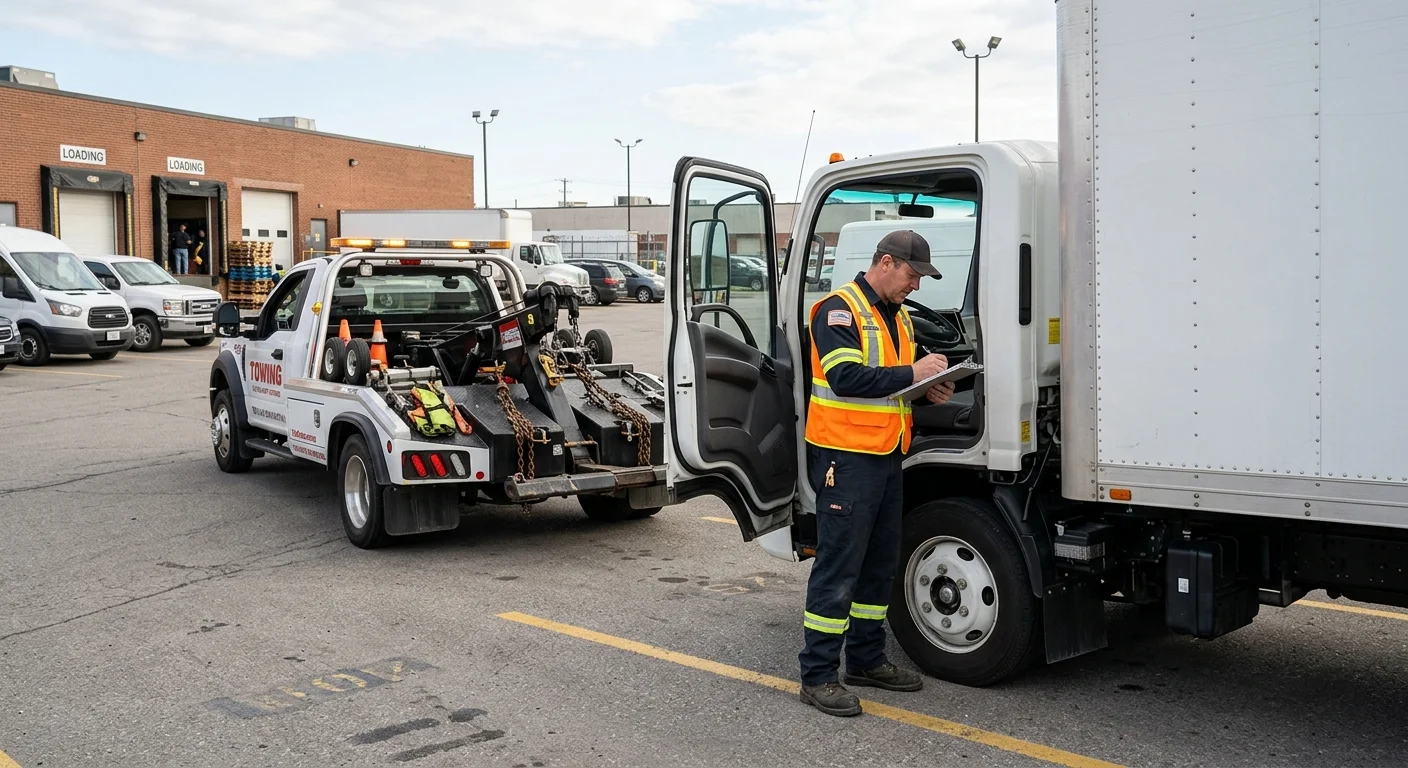
Identify the truck before requesting service
Start with year, make, model, and body style. A high-roof cargo van, a walk-in step van, and a straight box truck can wear the same courier wrap. They do not take the same hook. If you can reach the door-jamb sticker safely, read it. Note GVWR, VIN, and whether it has dual rear wheels. Those facts belong to the vehicle. They are not a category you assign on the phone. The operator we dispatch confirms class from that paperwork plus what they see on scene.
Do not treat dualies as automatic heavy equipment. Do not treat a short box as a passenger-car job. Last-mile vans on University Avenue in City Heights look like oversized cars until the wheelbase, roof, and payload show up. Warehouse boxes rolling out of Otay Mesa and Miramar often sit closer to work-truck recovery than to a sedan pickup. A Sprinter-style van in Sorrento Valley and a long straight truck in National City are not interchangeable, even when both say delivery on the side.
If it is a rental or a fleet unit, say so. The cab rating can differ from the box you are staring at. Keys, a spare, and whether the transmission still selects Neutral all change the pickup. For a similar cargo body, see moving truck breakdown towing. Photos of the door sticker, the wheels, and the full length of the truck help. A photo of the logo does not.
Share its load and current condition
Tell dispatch what is in the box and whether it can stay there. An empty van and a van stacked with parcels are not the same recovery. If the cargo is perishable, say that. If you do not know what is inside, say that too. Do not open sealed freight to guess. The driver sent out needs to know whether the truck will sit heavier on one axle, whether a liftgate is down, and whether freight will shift when the truck is winched.
Condition matters as much as size. Wheels that roll, a locked steering column, a broken axle, and a truck that will not come out of Park are four different setups. If this started as a crash, say where the damage is and whether fluids are on the pavement. That is an accident recovery scene, not a quiet lot pickup. If the unit is electric or hybrid, name the model and that it is electric so the operator can follow the manufacturer’s recovery procedure. Do not try to load it yourself.
Stay out of traffic while you talk. NHTSA roadside guidance is to get everyone to a safe place, use hazards, and wait for help rather than work under a live lane. On a San Diego freeway shoulder, that usually means behind a barrier if one exists, not standing at the rear doors. Leave the keys with someone who can stay with the truck if the load still has to be signed for.
Describe access, clearance, and traffic exposure
The truck is only half the job. The other half is the hole it is stuck in. A Kearny Mesa business park with wide drive aisles is not a Barrio Logan alley. A loading dock in Otay Mesa may have a lip, a canopy, and no room to square a wrecker. A Mission Valley or downtown garage may have a ceiling the recovery truck cannot enter. From a safe spot, note height to the lowest pipe, banner, or door. Say whether the truck is nose-in, blocking a drive aisle, or already on the street.
Strip-center stalls in Chula Vista and Oceanside often pack cars tight around a stopped van. Port-adjacent streets in National City mix truck traffic with low wires and tight turns. Name which of those you are in.
Traffic exposure changes the work. A disabled delivery vehicle on I-5, I-805, or SR-94 is a live hazard before it is a tow. California’s move-over rule in Vehicle Code 21809 covers stationary tow trucks with amber lights. Other drivers must change lanes when it is safe, or slow to a prudent speed if they cannot. Call 911 if the truck is in a travel lane or leaking fuel. For CHP freeway context, see chp.ca.gov. East County shoulders near Alpine and Jamul are narrower and darker than the urban core. Backcountry addresses take considerably longer to reach than Kearny Mesa or Chula Vista industrial parks. That is geography, not a clock. The operator taking the job gives the arrival estimate for that exact pin.
Ask the referred pro to confirm the tow category
You can describe the truck. You should not assign the class. Appearance lies. A compact step van can outweigh a long empty box. A dual-rear-wheel cargo van can still be a medium job, or it might not. Medium-duty towing in San Diego and heavy-duty towing are different recoveries. The referred professional confirms which one fits after they have the GVWR, the load, the wheel condition, and the access notes. If they need a different unit than the first match, that is the point of the check. Sending the wrong wrecker wastes the only thing a courier still has: time on the clock.
Quick Tow SD is a referral line. We take the call and match you with an independent licensed operator. That operator performs the work, sets the price, and is paid directly by you. We do not hold a tow license, and we do not run a yard. Licensed and insured describes the operators in our network, not a fleet we own. Ask the driver sent out to walk you through the category they are using and the equipment they are bringing. If the answer is vague, pause. A clean hook-up on a disabled truck is often 30 to 45 minutes of work on scene once they are set up. That is job time, not travel time.
If you want to check an operator’s motor carrier status yourself, use the California DMV Motor Carrier Permit lookup and the CHP Commercial Vehicle Section. Those agencies publish the official channels. A cab-door logo is not proof.
Confirm the repair destination and unloading plan
Name the drop-off before the truck is hooked. A dealer in Kearny Mesa, an independent shop in El Cajon, a fleet yard in National City, and a rental return in Mission Valley are four different routes. Height at the shop door, after-hours access, and whether the lot can take a loaded box all belong on the call. If the cargo has to come off first, say who is unloading it and where those parcels go. The operator we dispatch is there to move the vehicle. They are not your warehouse crew unless that is separately arranged with them.
Do not assume the destination can accept a loaded straight truck in the middle of the night. Call the shop. Confirm they have a bay, a key drop, or a lot that stays open. If the truck is a rental, the contract may require a specific yard. If it is a fleet unit, your dispatcher should give a written address, not a cross-street. Long, low approaches off I-15 in Rancho Bernardo are not the same as a flat lot off Main Street in Chula Vista. Share both ends of the trip so the referred pro can plan the path, not just the pickup.
Owner-requested tows are priced by the operator for that job. Distance, load, equipment, and shop access all change it. This site does not publish a brand rate. Ask for an itemized figure from the operator before they hook, and keep the destination honest. A second stop to dump cargo is a second piece of work.
When to call us
A delivery van, step van, or box truck that will not roll is not a DIY push. Call when the vehicle is disabled, the load is still on board, or the scene is a live lane, a dock, or a tight lot. Call (858) 923-5787 to reach dispatch. The line takes calls any time, day or night, and we serve every city in San Diego County.