A breakdown in Clairemont can happen on a freeway, commercial corridor, or quiet side street. The right response depends on your exact location, the vehicle’s condition, and whether you’re safely out of traffic.
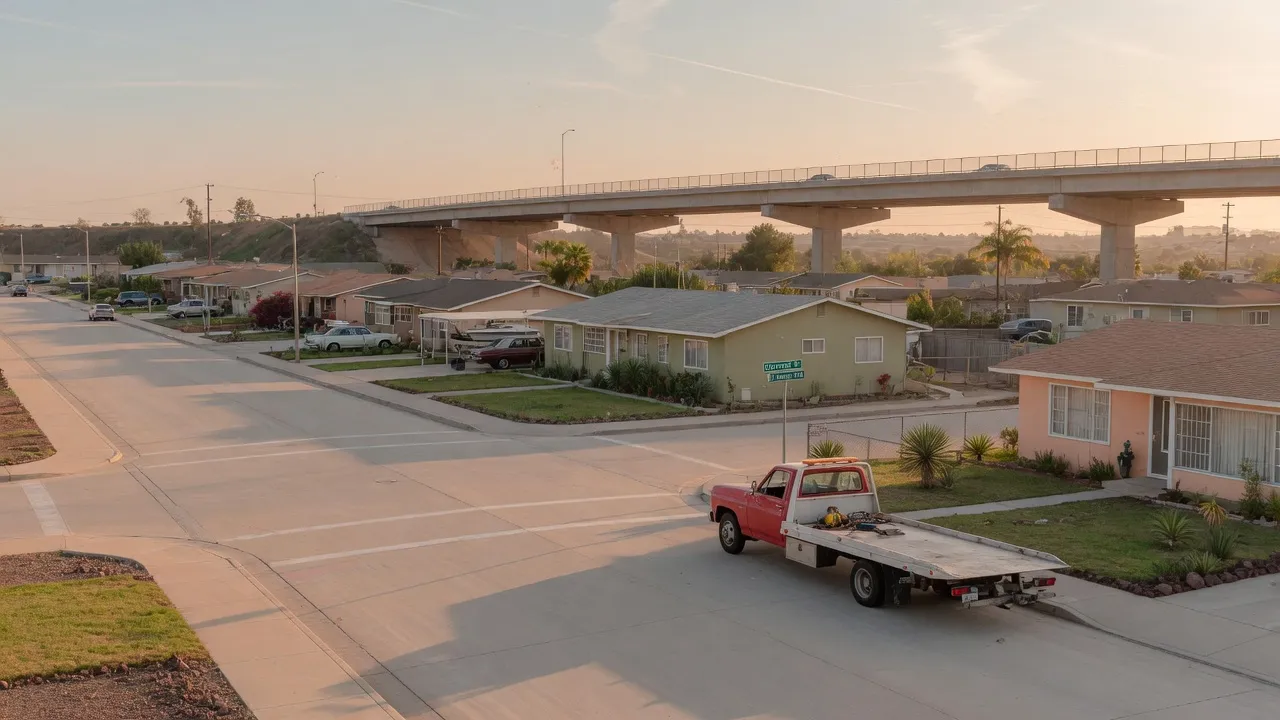
Share whether you are on I-805, SR 52, or Clairemont Mesa Boulevard
Start with the road name and your direction of travel. “Clairemont” alone covers too much ground for an accurate pickup location. A driver on I-805 needs a different approach than someone parked beside Clairemont Mesa Boulevard.
On I-805 or SR 52, share your direction and nearest exit. Mention whether you’re before or after the exit. If you can see a readable sign, use its wording instead of guessing. Your phone’s map pin can also help confirm your position.
Tell dispatch whether the vehicle is on a shoulder, in a traffic lane, or near a barrier. Also mention any law enforcement already at the scene.
On Clairemont Mesa Boulevard, identify the nearest cross street or business entrance. Explain whether you’re in a traffic lane, a marked parking space, or a driveway. A precise location helps the operator understand how the vehicle can be reached.
Side streets need similar detail. Give the full address, nearest intersection, and any visible building number. Mention a dead end, steep driveway, narrow curb area, or blocked approach.
Quick Tow connects stranded drivers with independent local operators. For urgent transport, review our emergency towing service. The operator taking the job will provide an arrival estimate for your exact location.
What changes in canyons, apartments, and shopping lots
Clairemont’s canyon edges create access questions that don’t arise on wide commercial streets. A vehicle near Tecolote Canyon may be on a public street, inside a residential property, or beside an access point that isn’t suitable for a tow vehicle. Share the marked street entrance rather than describing only a nearby trail or canyon.
Don’t direct a driver through an unmarked path or locked access point. If your car left the pavement, say how far it moved and whether any wheels are below the road edge. Describe the position and available access so the operator can assess the recovery.
Apartment lots need gate and clearance details. Tell dispatch whether the entrance has a keypad, call box, security arm, or locked gate. Provide the building number and assigned space if they’re visible. Mention covered parking, tight turns, low branches, or ramps before the operator accepts the job.
Shopping lots along Clairemont Mesa Boulevard present another issue. The storefront address may not identify your section of a large lot. Name the business you’re closest to and describe the nearest driveway. Say whether the car is beside a curb, loading area, parking island, or garage entrance.
If the vehicle was removed without your request, don’t order another tow. First determine whether it was impounded or removed from private property. Quick Tow doesn’t operate an impound lot and can’t release a vehicle held elsewhere.
When roadside help may fit
A tow isn’t necessary for every disabled car. Roadside assistance in Clairemont Mesa may fit when the vehicle remains safely accessible and the problem can be addressed where it sits.
Common examples include a dead battery, an empty fuel tank, a lockout, or a flat tire with a usable spare. Describe the symptoms without diagnosing the cause. “The engine clicks but won’t start” is more useful than saying the starter has failed.
For a flat tire, mention whether you have a spare and whether the damaged wheel appears bent. Tell dispatch if the car sits on a slope or soft shoulder. Those details may change whether roadside work is practical.
A jump start may fit when the battery lacks power. It may not solve a charging problem or another mechanical failure. If the car starts but warning lights remain, avoid assuming it’s ready for normal driving.
Keep safety ahead of convenience. NHTSA roadside guidance recommends preparing for breakdowns and treating traffic exposure seriously. Tell dispatch where the vehicle sits and how close it is to moving traffic.
Roadside service can also become a tow after the vehicle is assessed. Give dispatch a possible destination early, even if you’re hoping for a simple fix. That avoids another decision while you’re already dealing with a disabled car.
When arranging a tow makes more sense
Arrange a tow when the vehicle can’t be driven safely or roadside work won’t address the problem. Examples include steering trouble, brake concerns, collision damage, overheating, transmission symptoms, or a wheel that can’t roll normally.
Describe whether the vehicle is in a traffic lane, on a shoulder, or elsewhere. That location detail helps dispatch understand the request.
Tell dispatch what happened just before the vehicle stopped. Mention smoke, leaking fluid, warning lights, impact damage, or unusual wheel position. Share what you can observe without diagnosing the cause.
The destination matters too. You might choose a repair shop, dealership, tire shop, or private property where the vehicle can legally remain. Confirm that the destination accepts the vehicle before dispatch. After-hours access, locked gates, and drop-off rules should be checked directly with that location.
Clairemont sits between several major corridors, but nearby neighborhood posts address different pickup conditions. Our Kearny Mesa towing guide focuses on commercial and vehicle-type details. The Mission Valley towing guide covers that area’s separate access concerns. Use the page matching the vehicle’s actual location.
The independent operator sets the price and is paid directly by the customer. Ask what information is needed for a quote before authorizing the job. Quick Tow doesn’t publish a fixed rate card because each operator evaluates the specific pickup and destination.
Confirm access, clearance, and the destination
Good dispatch details prevent avoidable confusion. Before calling, gather the vehicle’s year, make, model, drivetrain if known, and current condition. Say whether the keys are available and whether the vehicle can shift into neutral.
Report anything that affects clearance. That includes lowered suspension, damaged wheels, a steep driveway, a parking structure, or a low overhead entrance. Don’t decide which towing setup is required. Give the facts and let the operator assess the vehicle.
For apartments, provide gate instructions that you’re authorized to share. Meet the driver at the entrance when property rules allow. If another vehicle blocks the disabled car, don’t promise it can be moved. Explain the obstruction before dispatch.
For canyon-edge streets, confirm the nearest paved approach. A map pin helps, but it shouldn’t replace a readable street address or intersection. If access crosses private property, confirm permission with the property owner or manager.
Choose the destination before the vehicle is loaded when possible. Call the repair facility and ask whether it can receive the vehicle. Confirm the correct entrance and where the car should be left. Don’t assume an open parking lot means after-hours drop-off is allowed.
Keep your phone available after requesting service. The operator may need a gate code, updated map pin, or clarification about the car. If your location changes, tell dispatch promptly. Don’t move the vehicle without explaining the new position.
These details help a tow truck in Clairemont reach the correct side of the property and evaluate the job. They also help distinguish a roadside request from a transport that needs professional towing.
When to call us
Call when the vehicle can’t be driven safely, sits in a difficult access point, or needs transport to a confirmed destination. Quick Tow connects you with an independent licensed and insured towing operator, while that operator performs the work and sets the price.
Call (858) 923-5787 to reach dispatch.