When your electric vehicle (EV) suddenly stops moving in San Diego, figuring out how to get it safely towed can add a layer of stress. This is especially true if you own a Rivian, Lucid, or Ford Lightning, vehicles that have unique needs compared to traditional gas cars or even some other EVs. Knowing the right steps ensures your valuable investment is protected during a roadside emergency.
Why towing a Rivian, Lucid, or Ford Lightning is different
Towing an EV like a Rivian R1T, Lucid Air, or Ford F-150 Lightning isn’t the same as towing a gasoline-powered vehicle. These electric titans have distinct architectural features, powerful electric motors, and high-voltage battery systems that demand specialized handling. Unlike internal combustion engine (ICE) vehicles that can sometimes be towed with their drive wheels on the ground (though we rarely recommend it), EVs can suffer severe and expensive damage if towed improperly. The regenerative braking systems and direct-drive electric motors in these vehicles mean that rolling them with their wheels on the ground can generate electricity back into the system, potentially overheating components or causing irreparable harm to the drivetrain.
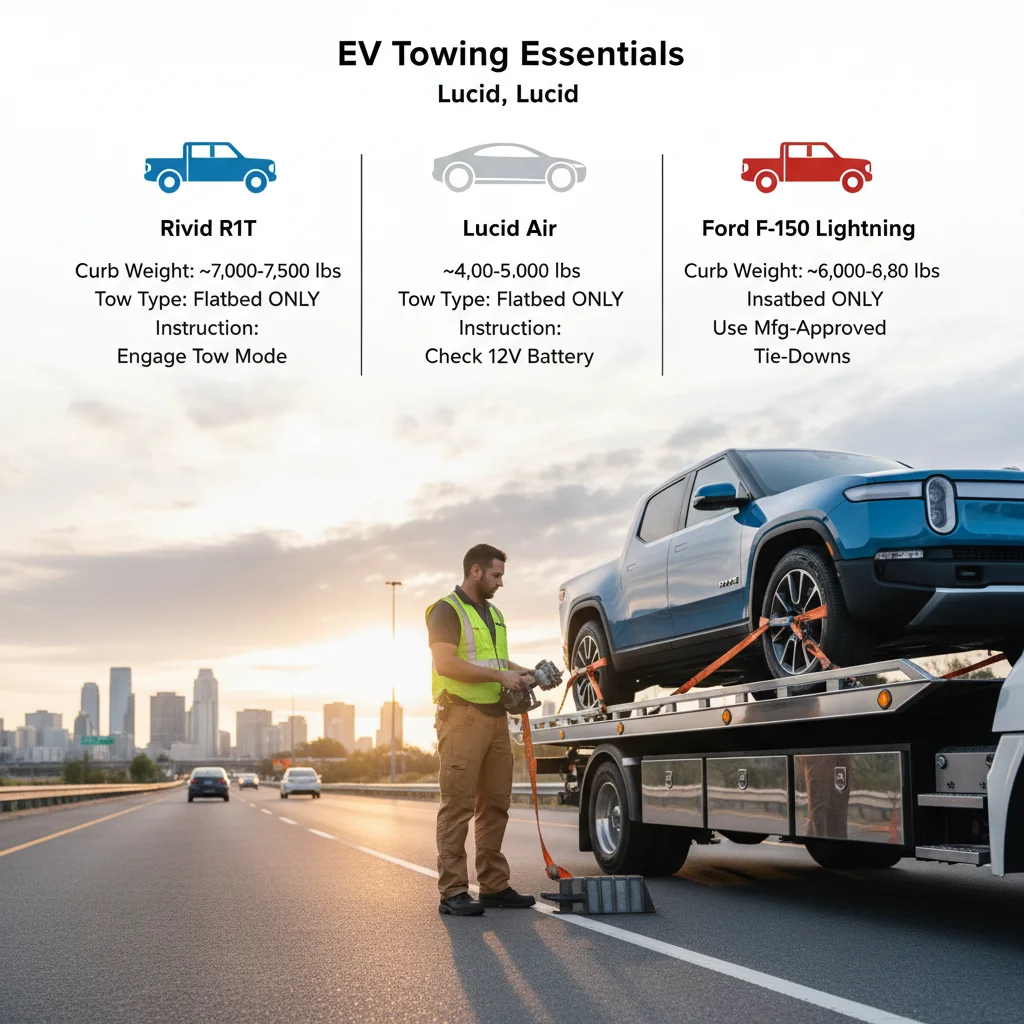
Beyond the motors, the sheer weight of these vehicles is a major factor. Rivians, Lucids, and Ford Lightnings are often considerably heavier than their ICE counterparts due to their large battery packs. A Rivian R1T, for instance, can weigh over 7,000 pounds, requiring a tow truck with a higher weight capacity and specific securement points. We’ve seen owners try to use standard tow services for these vehicles only to find the truck isn’t rated for the weight or lacks the proper equipment. This isn’t just about preventing damage; it’s about road safety for everyone involved. The chassis design, specific jacking points, and battery location also vary significantly between these brands, making a one-size-fits-all towing approach dangerous. Our team stays updated on manufacturer guidelines for proper EV transport, ensuring your “rivian towing service” or “lucid towing” request is handled correctly. If you’re a Tesla owner, we also have a dedicated guide on EV towing for Teslas that highlights their specific needs.
The critical need for a flatbed for all EVs
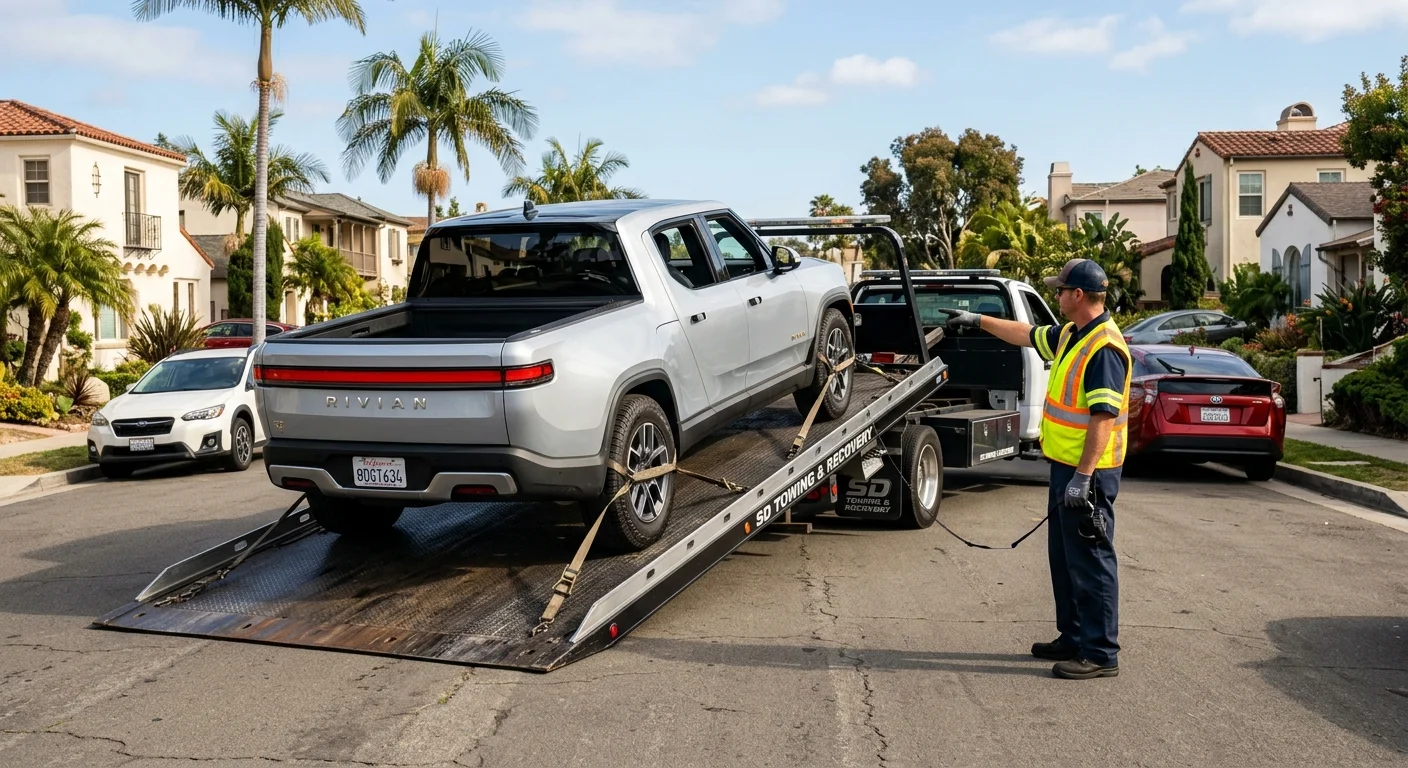
When it comes to towing any electric vehicle, especially models like the Rivian, Lucid, or Ford Lightning, a flatbed tow truck isn’t just a recommendation, it’s a critical requirement. This isn’t an upsell; it’s the only safe method endorsed by almost all EV manufacturers, including those for the vehicles we’re discussing. The primary reason is to completely lift all four wheels off the ground, preventing any rotation of the electric motors. As mentioned earlier, towing an EV with its wheels on the ground, even for a short distance, can cause the motors to act as generators, leading to significant drivetrain damage, battery drain, or even fire hazards due to excessive heat generation. This type of damage is often not covered under warranty because it results from improper towing.
A flatbed truck provides a secure, level platform where your EV can rest without any of its wheels touching the road. This completely isolates the drivetrain and protects the battery pack, which is typically located in the vehicle’s undercarriage. For heavier EVs like the Ford F-150 Lightning, the reinforced structure of a flatbed towing unit is essential to safely bear its weight without putting undue stress on the vehicle’s frame or suspension. The operators we dispatch are trained to carefully load and secure these high-value vehicles, using specific tie-down points approved by the manufacturer. This meticulous approach prevents any movement during transport, safeguarding against body damage or alignment issues. Choosing a flatbed ensures your EV reaches its destination in the same condition it was loaded, preventing costly repairs and preserving its complex electronic systems.
What to tell the tow operator about your specific EV model
Providing accurate information to your tow operator before they arrive is crucial for a smooth and safe towing experience. For your Rivian, Lucid, or Ford Lightning, there are specific details that can significantly impact how we approach the tow. First, clearly state the make and model of your EV. Saying “I have a Rivian R1T” immediately tells us important information about its weight, size, and potential towing complexities. Next, inform us about the reason for the breakdown. Is it a dead 12V battery, a completely depleted high-voltage battery, a flat tire, or a software issue? This helps us prepare the right tools and personnel.
Crucially, you’ll need to know about “tow mode” or “transport mode.” Each EV manufacturer has specific procedures to prepare the vehicle for towing, often involving placing it in a neutral or transport mode that de-energizes the drivetrain. For example, the Ford F-150 Lightning has a detailed tow mode procedure that ensures the parking brake is released and the vehicle is safe to move. Lucid Air and Rivian R1T also have similar protocols. If your vehicle has lost all power, accessing these modes can be challenging, but our trained operators often have workarounds or know how to safely access key points. Also, mention any recent service or unique modifications. Our experience with “ford lightning roadside assistance” calls confirms that these details make a real difference. The more information you can provide upfront, the better we can prepare and ensure your EV is handled with the expertise it deserves.
Common issues that lead to EV breakdowns in San Diego
Electric vehicles, while generally reliable, can still experience breakdowns, and some issues are unique to their powertrain. In San Diego County, we frequently encounter certain scenarios that lead to owners needing “ev towing san diego” services for their Rivians, Lucids, and Ford Lightnings. One common cause isn’t the main high-voltage battery, but rather the smaller 12-volt auxiliary battery, which powers essential systems like door locks, infotainment, and vehicle computers. If this 12V battery dies, your EV can be completely immobilized, even if the main battery has plenty of range. It’s a surprising but frequent cause of roadside assistance calls.
Another issue is unexpected software glitches. Modern EVs are essentially computers on wheels, and sometimes software bugs or updates can lead to system freezes or errors that prevent the vehicle from starting or driving. While often resolvable with a hard reset, these glitches can leave you stranded. Tire problems are also more prevalent with EVs due to their increased weight, which puts more stress on tires. A blown tire or unrepairable flat on a heavy EV like a Ford Lightning often requires a tow, as many lack a full-size spare. Lastly, while less common with range anxiety decreasing, sometimes drivers simply miscalculate their remaining range or encounter a non-functional charging station, leading to a fully depleted high-voltage battery. Navigating San Diego’s varied terrain, from coastal drives to inland highways, can also impact range more than expected. For that specific scenario - out of charge but otherwise fine - a tow isn’t always necessary: Charge Pro SD runs out-of-charge recovery with mobile charging across San Diego County, so you can drive away on your own power. Understanding these common culprits helps us diagnose the situation quickly and provide the right type of assistance.
How we handle EV battery and software considerations
Towing an EV isn’t just about moving a heavy vehicle; it’s about safely transporting a sophisticated piece of technology with a high-voltage battery system and complex software. At Quick Tow SD, our approach is designed to protect your Rivian, Lucid, or Ford Lightning from any further damage during a breakdown or accident recovery. The operators we dispatch receive specialized training specific to electric vehicles, understanding the unique components and potential hazards. We prioritize the safety of your vehicle’s high-voltage battery, ensuring it remains undisturbed and undamaged during the loading and transport process. The battery pack is the heart of your EV, and any impact or improper handling can lead to costly repairs or safety risks.
We use advanced flatbed tow trucks equipped with soft straps and securement points designed for the specific chassis of modern EVs, preventing any scratching or structural stress. The operators we dispatch know how to safely engage the appropriate tow modes without risking software errors or electrical issues. This includes careful consideration of wheel lockouts, parking brake systems, and ensuring the vehicle’s electrical systems are properly disengaged for transport. We treat every EV as the high-value, specialized vehicle it is, similar to how we handle exotic and classic vehicle towing. Before we even begin loading, our team conducts a thorough assessment, consulting any available manufacturer guidelines for your specific model. This meticulous attention to detail protects your investment, ensures the integrity of its battery and software, and gives you peace of mind that your EV is in expert hands throughout San Diego.
When to call us
If your Rivian, Lucid, or Ford Lightning experiences a breakdown, isn’t starting, or needs to be transported safely, don’t risk further damage by attempting an improper tow. An experienced towing professional with the right equipment is essential for these advanced electric vehicles. Call us at (858) 923-5787 for a same-day estimate.