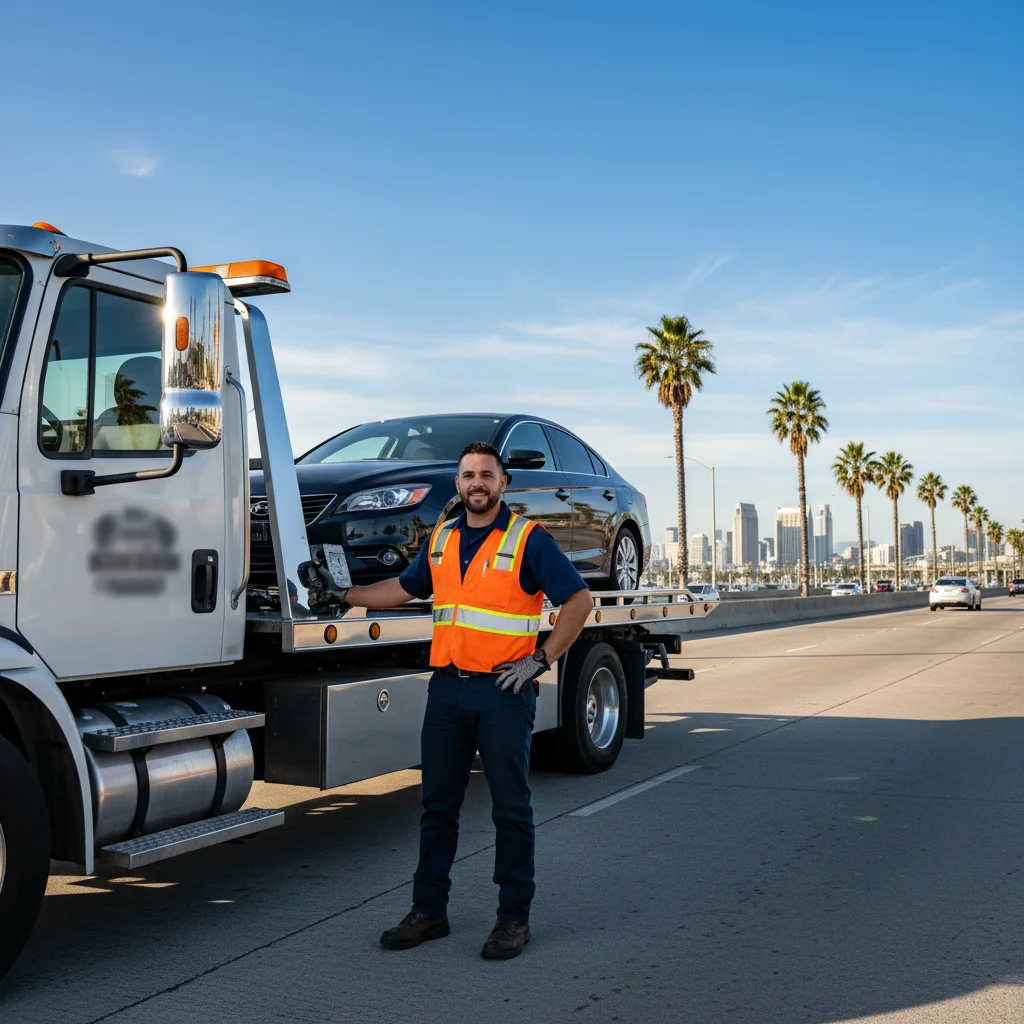
A cheap flatbed tow truck service in San Diego runs roughly $95 to $175 for the hook fee plus mileage. Ask dispatch for your written flat rate before the truck rolls. Cheap should mean honest, not stripped down. With us, all four wheels stay off the ground for zero risk to your drivetrain. Here’s how flatbed towing works, when you actually need it, and how to get an affordable rate without hidden fees.
You’re driving on I-5 near La Jolla, perhaps heading home from a long day, when suddenly your engine sputters, your dashboard lights up, and your car dies. Or maybe your EV just ran out of charge on a remote stretch of I-8 east of Alpine. In these moments, your first thought is likely, “I need a tow truck near me.” But not just any tow truck will do. For many San Diego drivers, especially those with all-wheel drive (AWD) vehicles, electric cars, or luxury models, a flatbed tow truck near me isn’t just a preference-it’s a necessity.
Understanding when and why to insist on a flatbed can save you thousands in potential damage to your vehicle’s drivetrain or electrical system. Here in San Diego County, with our diverse terrain from coastal highways to mountain passes, and a growing number of specialized vehicles on the road, knowing your towing options is more important than ever. Quick Tow SD is here to explain everything you need to know about flatbed towing in America’s Finest City.
What is a flatbed tow truck and how does it work?
A flatbed tow truck, often called a rollback tow truck, is exactly what it sounds like: a truck with a flat, hydraulic bed that can be tilted and slid backward. This allows a vehicle to be driven or winched onto the bed, where all four of its wheels rest securely on the platform. Once loaded, the bed is leveled, and the vehicle is strapped down, ensuring no part of it touches the road during transport.
This design offers significant advantages over other towing methods, particularly the wheel-lift tow truck. A wheel-lift truck uses a yoke or sling to lift either the front or rear wheels of a vehicle off the ground, leaving the other two wheels on the pavement. While efficient for many standard cars over short distances, this method can cause severe damage to certain vehicle types.
The key difference lies in how the towed vehicle is supported. With a flatbed, your vehicle is completely isolated from the road, eliminating any risk of wear, tear, or mechanical stress during transit. This makes it the preferred, and often required, method for a wide range of situations and vehicle types common here in San Diego.
Why a flatbed is often your only safe choice in San Diego
Not all breakdowns are created equal, and neither are all tow jobs. For many vehicles on San Diego’s roads today, from the busy I-15 commuter corridor to the coastal stretches of SR-78 in North County, a flatbed tow truck isn’t just an option-it’s the only way to avoid costly damage.
All-wheel drive (AWD) vehicles: Protect your drivetrain
San Diego drivers love AWD vehicles for their handling and safety, especially in occasional wet weather or for trips to the mountains. Brands like Subaru, Audi, and many SUVs use complex AWD systems. When an AWD vehicle is towed with a wheel-lift truck, only two wheels are lifted, while the other two remain on the ground and continue to rotate. This can put immense stress on the vehicle’s differential, transmission, and transfer case, as the system tries to compensate for the difference in wheel speeds.
The result can be drivetrain damage costing anywhere from $2,500 to $5,000 or more to repair. A flatbed tow ensures all four wheels are off the ground, preventing any rotation and protecting your vehicle’s intricate AWD system from harm.
Electric vehicles (EVs): Essential for battery and motor integrity
The number of EVs on San Diego roads is rapidly growing, from Teslas on SR-163 to Rivians exploring East County trails. Towing an EV requires special care. Many EVs, when towed with their drive wheels on the ground, will continue to generate electricity through regenerative braking, even if the car is “off” or disabled. This can fry the drive motors and inverter, leading to repairs that can cost $8,000 to $18,000.
Most EV manufacturers, including Tesla, Rivian, Ford, and Hyundai, explicitly state that their vehicles must be transported on a flatbed tow truck if they are disabled or cannot be put into “tow mode” properly. Even if an EV can be put into a neutral tow mode, a flatbed is still the safest option to prevent any unintended motor engagement or battery drain. For more details on this, see our article on EV towing and Tesla flatbeds.
Luxury, classic, and exotic cars: Preserving pristine condition
San Diego is home to a vibrant community of luxury, classic, and exotic car owners, from collectible muscle cars cruising PCH in Del Mar to high-end sports cars in La Jolla. These vehicles often have low ground clearance, making them susceptible to scraping or damage when loaded onto a wheel-lift or when navigating ramps. Furthermore, their delicate suspensions, custom body kits, and pristine finishes demand the utmost care during transport.
A flatbed tow truck provides a stable, level platform, eliminating the risk of damage from road debris, uneven surfaces, or improper lifting points. It ensures your prized possession arrives at its destination in the same condition it left. Quick Tow SD’s drivers are experienced in handling these specialized vehicles with precision and care, understanding their unique requirements. Learn more about our specialized service for exotic and classic vehicle towing.
Motorcycles: Secure and stable transport
Riding a motorcycle through the canyon roads of East County or along the coast is a quintessential San Diego experience. However, when a bike breaks down, it needs a specialized tow. While some wheel-lift trucks have motorcycle attachments, a flatbed tow truck offers the most secure and stable transport for motorcycles.
With a flatbed, the motorcycle can be carefully loaded, strapped upright, and completely secured, preventing it from tipping, falling, or sustaining damage during transit. This is especially important for long distances or for custom bikes. Quick Tow SD has the proper equipment and expertise to handle motorcycle towing done right.
Accident recovery: Safer for damaged vehicles
After an accident, especially on busy freeways like I-805 in the South Bay or I-8 heading up the grade, vehicles can be significantly damaged. Attempting to tow a compromised vehicle with a wheel-lift can exacerbate structural damage, bend axles, or cause further issues.
A flatbed allows the vehicle to be carefully loaded, often with specialized winching techniques, ensuring no additional stress is placed on already weakened components. This is why flatbeds are frequently used by tow companies on CHP rotation for accident scenes across San Diego County. For more on what to do after an incident, read our guide on what to do after a car accident in San Diego.
Long-distance towing: Less wear and tear
If you need your vehicle transported a significant distance, perhaps from San Diego up to Camp Pendleton or even out of the county, a flatbed tow is almost always the better choice. With all four wheels off the ground, your vehicle accumulates no mileage, experiences no wear and tear on its tires or suspension, and is protected from road hazards throughout the journey. This preserves its condition and value. For information on pricing, see our article on long-distance tow costs.
Finding a flatbed tow truck near me in San Diego: Quick Tow SD’s coverage
When you’re stranded, the term “near me” really matters. The Quick Tow SD line takes calls 24/7 and routes the job to an operator covering your area, which is what makes “near me” mean something on a county this large. Arrival time depends on where you are and what is on the road. Mountain and backcountry areas like Julian or Borrego Springs take considerably longer because of distance and terrain.
San Diego County coverage areas
We cover all 67 cities and communities within San Diego County, ensuring that no matter where you break down, a flatbed tow truck is within reach.
- Coastal Cities (La Jolla, Del Mar, Encinitas, Carlsbad, Oceanside, Ocean Beach, Pacific Beach, Coronado): We’re there for everything from beach-lot lockouts (which spike in summer) to breakdowns on dangerous PCH shoulders.
- North County Inland (San Marcos, Escondido, Vista, Poway, Rancho Bernardo): On the busy I-15 commuter corridor, especially during hot days, we see frequent overheating issues. The flatbeds we send are ready.
- East County (El Cajon, La Mesa, Santee, Lakeside, Alpine, Crest): The I-8 grade eats engines, and winding canyon roads like Crest and Sunrise Highway are notorious for motorcycle incidents. We know these routes well.
- South Bay (Chula Vista, National City, Imperial Beach, Otay Mesa): The I-5 and I-805 border corridors are high-traffic areas, and Otay Mesa’s commercial truck terminals mean we’re familiar with diverse vehicle needs.
- Mountain Regions (Julian, Pine Valley, Ramona, Mt Laguna, Borrego Springs): While response times can be longer here, the drivers we send are experienced with the unique challenges of these areas, including winter conditions requiring chains on Sunrise Highway.
- Camp Pendleton Corridor: The 20-mile gap on I-5 between Oceanside and San Clemente often leaves military families needing prompt POV (Privately Owned Vehicle) breakdown response. We serve this vital area.
What to tell the dispatcher
When you call Quick Tow SD at (858) 923-5787, providing clear information helps us dispatch the right flatbed tow truck quickly.
- Your exact location: Cross streets, freeway mile markers, or even GPS coordinates are helpful.
- Vehicle make, model, and year: This helps us understand its weight and size.
- Vehicle type: Is it AWD, an EV, a classic car, or a motorcycle? This is critical for determining if a flatbed is absolutely required.
- Nature of the breakdown: Engine trouble, flat tire, accident, out of gas, etc.
- Destination: Where do you need your vehicle towed? A mechanic, your home, a dealership?
Understanding flatbed towing costs in San Diego
Towing costs vary. Ask for a flat rate on the call for a standard tow, so you know the number before the truck rolls.
Factors influencing flatbed tow cost
- Distance: The further the tow, the higher the cost. Long-distance tows are typically quoted with a written flat rate.
- Vehicle Type: Heavier or more specialized vehicles might incur slightly higher rates due to the specific equipment needed.
- Complexity of the situation: If your vehicle is off-road, in a ditch, or requires extensive winching, additional charges may apply.
- Time of day/week: Some companies charge more at night or on weekends. Ask if the quote you’re given is the same at any hour.
Here’s a general idea of typical hook fees in San Diego, though these are estimates and can vary by company and specific service needs:
| Towing Service Type | Typical San Diego Hook Fee (Estimate) |
|---|---|
| Light-Duty Flatbed | $95 - $175 |
| Light-Duty Wheel-Lift | $85 - $165 |
| Medium-Duty Tow | $175 - $275 |
| Heavy-Duty Tow | $285+ (often requires a quote) |
| Motorcycle Tow (Flatbed) | $120 - $200 |
| Winch-out / Recovery | Additional $50 - $150+ (per hour/difficulty) |
Note: These are initial hook fees. Mileage charges apply in addition to these fees, typically calculated per mile after an initial base distance.
We always provide an upfront quote so you know exactly what to expect. You can also review our general pricing information in our tow cost San Diego article, or run your own numbers on our tow cost calculator before you call.
How to get a cheap flatbed tow truck service in San Diego without hidden fees
Cheap and safe aren’t opposites. A flatbed tow protects your car from thousands in drivetrain damage, so the goal isn’t the lowest sticker. It’s the lowest honest total with no surprises at the curb. Most “cheap” tow complaints in San Diego come from the same handful of add-ons that get tacked on after the truck shows up.
Here’s where the real money hides, and how Quick Tow SD handles each one.
- Night and weekend surcharges: Some operators quote a daytime rate, then add a multiplier after 6pm or on Sundays. Ask if the number holds at 1am on I-8 the same as it does at noon on I-15.
- Mileage that starts at their yard, not your car: A common trick is charging miles from the tow lot to you, then to the destination. Always ask where the meter starts. We quote the door-to-door distance you actually need.
- “Loaded” vs “unloaded” mile games: Reputable flat rates fold this in. Get the all-in number in writing, which we send by text before dispatch.
- Winch or recovery fees sprung at the scene: If your car is in a ditch off Sunrise Highway or buried in sand at an Oceanside beach lot, recovery may cost more. That’s fair, but you should hear it on the phone, not after. We tell you the moment you describe the situation.
- After-hours dispatch fees: Ask if the flat rate you’re quoted already includes the dispatcher who answers at 3am.
Three questions get you a genuinely cheap flatbed tow anywhere in the county. Ask for the flat rate in writing. Ask where the mileage meter starts. Ask whether the price changes for the time of day. If a company dodges any of the three, keep dialing. When you call Quick Tow SD at (858) 923-5787, you get clear answers to all three before you agree to anything. For a side-by-side look at how local operators stack up on price and honesty, see our guide to the best towing companies in San Diego.
What actually makes a flatbed tow cost more
A handful of real factors move the price, and knowing them helps you judge whether a quote is fair:
- Backcountry distance: A tow out of Julian, Borrego Springs, or Mt Laguna covers more miles on slower roads, so it costs more than a flat run through Chula Vista. That’s distance, not a markup.
- Recovery difficulty: A straight load on a shoulder is quick. A car off the road, on a steep canyon grade, or wedged in a tight parking structure takes time and gear.
- Vehicle weight and size: A lifted truck or a long-wheelbase van needs more strapping and sometimes a larger flatbed than a compact sedan.
- Accident scene work: Damaged vehicles often need careful winching and debris handling, which adds time.
None of these should ever be a surprise. A good dispatcher prices them on the call, the moment you describe your situation.
Quick Tow SD’s flatbed fleet and expertise
The flatbeds we send are modern and well-maintained, and they handle a wide range of vehicles, from compact sedans to heavy-duty trucks (larger trucks may need a specialized heavy-duty flatbed or wrecker). The drivers we send are experienced with safe, damage-free loading, including the latest EVs and complex AWD systems where the wrong hookup can cost thousands.
What you can count on is simple and upfront: a flat rate quoted in writing before the truck rolls, a line that takes calls 24/7, and coverage across all 67 San Diego County cities, coast to backcountry. You hear the price before you commit.
Beyond flatbed: Other towing options in San Diego
While flatbeds are ideal for many situations, Quick Tow SD also provides other towing services for different needs. Understanding these options helps you make an informed decision. For a deeper comparison, check out our post on flatbed vs. wheel-lift towing.
Wheel-lift towing
For standard front-wheel drive (FWD) or rear-wheel drive (RWD) vehicles, a wheel-lift tow truck is often a practical and efficient choice. These trucks are nimble, can maneuver into tight spaces like parking garages or crowded city streets in downtown San Diego, and are generally quicker to hook up. They are suitable for short-distance tows where drivetrain integrity is not a concern. We offer comprehensive wheel-lift towing services.
Heavy-duty towing
For larger vehicles such as commercial trucks, buses, RVs, or construction equipment, a standard flatbed or wheel-lift truck isn’t sufficient. Quick Tow SD operates a fleet of heavy-duty wreckers designed to handle the immense weight and size of these vehicles. If you have an RV breakdown while exploring East County or a semi-truck issue near Otay Mesa, our heavy-duty towing services are equipped for the job. We also specialize in RV towing.
Flatbed recovery: when the load isn’t simple
A flatbed isn’t only for cars that roll on easily. A lot of San Diego calls involve getting a vehicle to the bed in the first place, and the gear matters as much as the truck.
- Winch-out and off-road recovery: Cars slide off shoulders on the I-8 grade, sink into soft sand at coastal lots in Ocean Beach and Coronado, and get stuck in mud after a rare wet spell in East County. A flatbed paired with a winch line pulls the vehicle back to solid ground, then loads it level. Expect this to add to the base tow, and expect to hear that cost on the phone.
- Parallel-parked and tight-space loads: On packed downtown blocks or in low-clearance parking structures off SR-163, a car boxed in by bumpers can’t roll straight back onto a flatbed. The fix is gear like a tow stinger or dollies that move the car sideways first, then onto the bed without scraping the cars around it.
- Low-clearance loading: Exotics in La Jolla and lowered trucks need a long, shallow approach ramp so the front splitter or exhaust never touches the ramp lip. A flatbed with a gentle tilt angle handles this where a steep wheel-lift ramp would gouge the bumper.
- Multi-vehicle and equipment hauls: Small trailers, jet skis, and light equipment ride flat and strapped, the same way a car does. For anything heavier, that shifts to our heavy-duty towing gear.
The point is simple. The truck is half the job. The recovery method is the other half, and a dispatcher who asks the right questions up front, where exactly the car is, how it’s positioned, what’s around it, is the one who shows up with the right setup the first time.
Roadside safety tips while waiting for your flatbed
Breaking down on the side of a busy San Diego freeway like I-5 or I-805 can be dangerous. Your safety, and the safety of the drivers we send, is paramount.
- Pull Over Safely: If possible, steer your vehicle to the furthest right shoulder or exit the freeway entirely. On coastal roads like PCH, shoulders can be narrow and dangerous.
- Activate Hazard Lights: Turn on your hazard lights immediately to alert other drivers to your presence.
- Stay Inside Your Vehicle: Unless you are in immediate danger (e.g., smoke, fire), it’s generally safest to remain inside your vehicle with your seatbelt fastened. This provides protection from passing traffic. If you must exit, do so carefully and stand as far away from the road as possible. The National Highway Traffic Safety Administration (NHTSA) offers valuable road safety tips.
- Be Aware of Surroundings: Especially at night or in less populated areas like the mountain regions, stay vigilant.
- Call for Help: Contact Quick Tow SD at (858) 923-5787 and inform us of your precise location and situation.
Navigating San Diego’s freeways: Common breakdown spots
San Diego’s extensive freeway system connects our diverse communities, but it’s also where many breakdowns occur. The drivers we send are intimately familiar with these routes and their unique challenges.
- I-5 (Coastal Freeway): From the Mexican border up through Camp Pendleton, I-5 is a primary north-south artery. Breakdowns are common in high-traffic areas around downtown San Diego, La Jolla, and Oceanside.
- I-15 (Inland North-South): This freeway serves North County Inland communities like Escondido and Poway. It’s a major commuter route where heat-related engine issues can peak, especially on the grades.
- I-8 (East-West Grade to Desert): Heading east, I-8 climbs significantly, putting stress on engines, especially older vehicles. Breakdowns are frequent on the long grades towards El Cajon, Alpine, and Pine Valley.
- SR-163: Connecting downtown to Kearny Mesa and the I-15, SR-163 is a busy corridor with tight lanes where quick response is vital.
- SR-52 & SR-56: These east-west connectors in central and North County can see heavy commuter traffic, leading to common minor incidents or overheating.
- I-805 (Border Corridor): Running parallel to I-5 through the South Bay, I-805 is often congested, increasing the likelihood of collisions or mechanical failures.
- SR-94 & SR-78: These routes serve East County and North County respectively, often involving winding roads where careful towing is necessary.
Our dispatchers use real-time traffic data from sources like SANDAG to estimate arrival times and guide the drivers we send through San Diego’s dynamic traffic patterns.
Flatbed towing for specific San Diego scenarios
The varied landscape and lifestyle of San Diego create unique towing needs:
- Beach-lot lockouts: During summer, coastal cities like Ocean Beach, Pacific Beach, and Coronado see a spike in vehicle lockouts at beach parking lots. While often just a roadside assistance call, if a vehicle needs to be moved, a flatbed ensures no sand or debris damage.
- Hot-day overheating: North County Inland areas like San Marcos and Escondido, especially along I-15, frequently experience vehicles overheating during our hotter months. A flatbed is ideal for these disabled cars.
- Canyon road incidents: East County’s canyon roads, including Crest and Sunrise Highway, are popular with motorcyclists. Accidents or mechanical failures here require the secure transport only a flatbed can provide.
- Military family support: The roughly 20-mile stretch of I-5 between Oceanside and San Clemente, adjacent to Camp Pendleton, is a frequent breakdown spot for military families. We understand the urgency and often send flatbeds for their personal vehicles (POVs) to ensure safe transport.
- Private property towing: Quick Tow SD also handles private property towing in compliance with California Vehicle Code 22658. This code governs the grounds for removal, signage, written authorization, notice to law enforcement, and release rules. It sets no general waiting period; the one-hour wait people cite is CVC 22953, which does not apply to residential parking. While often done with wheel-lift, sometimes a flatbed is required for specific vehicle types on private property. You can review the full California Vehicle Code 22658 for details.
Frequently asked questions
When do I absolutely have to use a flatbed tow truck?
You must use a flatbed tow truck for all-wheel drive (AWD) vehicles, electric vehicles (EVs) that are disabled or cannot be put into a proper tow mode, luxury cars with low ground clearance, classic cars, and motorcycles. These vehicle types risk significant mechanical or cosmetic damage if towed with a wheel-lift truck.
Are flatbed tow trucks more expensive than wheel-lift trucks?
Generally, flatbed towing can be slightly more expensive for the initial hook fee compared to a basic wheel-lift tow, but the difference is often minor. However, considering the potential repair costs of thousands of dollars if an AWD or EV is improperly towed, a flatbed is a far more cost-effective and responsible choice.
How long does a flatbed tow take in San Diego?
The total time depends on your location, the destination, and current traffic conditions. Quick Tow SD gives you an arrival estimate for your exact location when you call. The loading process onto a flatbed typically takes about 10-15 minutes, after which the transport time depends on the distance to your desired location.
Can a flatbed tow truck handle an RV or a large commercial truck?
While some larger flatbeds exist, most standard flatbed tow trucks are designed for light to medium-duty vehicles. RVs, buses, and large commercial trucks typically require specialized heavy-duty wreckers or heavy-duty flatbeds, which have higher weight capacities and different recovery equipment. Quick Tow SD offers both flatbed and heavy-duty towing services.
How do I find a cheap flatbed tow truck service that isn’t a scam?
Ask three questions before you agree to anything: get the flat rate in writing, ask where the mileage meter starts, and confirm the price doesn’t change for nights, weekends, or holidays. A genuinely cheap flatbed tow in San Diego runs about $95 to $175 for the hook fee plus mileage. Ask dispatch for the full flat rate by text before the truck rolls, and confirm it holds at any hour.
What information should I have ready when calling for a flatbed tow?
Have your precise location (cross streets, freeway mile marker, or GPS coordinates), your vehicle’s make, model, and year, and whether it’s an AWD, EV, or luxury/classic car. Also, tell us the nature of the breakdown and your desired tow destination. This helps us dispatch the correct flatbed quickly and efficiently.
When you need a flatbed tow truck near me in San Diego, you need a company that understands the specific requirements of modern vehicles and the unique challenges of our local roads. Quick Tow SD provides reliable, damage-free flatbed towing 24/7 across all of San Diego County. Don’t risk costly damage to your vehicle. Call us at (858) 923-5787 for professional and prompt flatbed towing service. You can also visit our flatbed towing services page for more information.