Your car is dead, you’re on the shoulder of the 5, and someone on the phone is asking whether you need a flatbed or a wheel-lift. That’s not a fun decision to make under pressure. Here’s everything you need to know, including when flatbed is the only safe option and what it’ll cost in San Diego County.
When a flatbed is the only safe choice
Not every breakdown calls for a flatbed. But some situations make it non-negotiable.
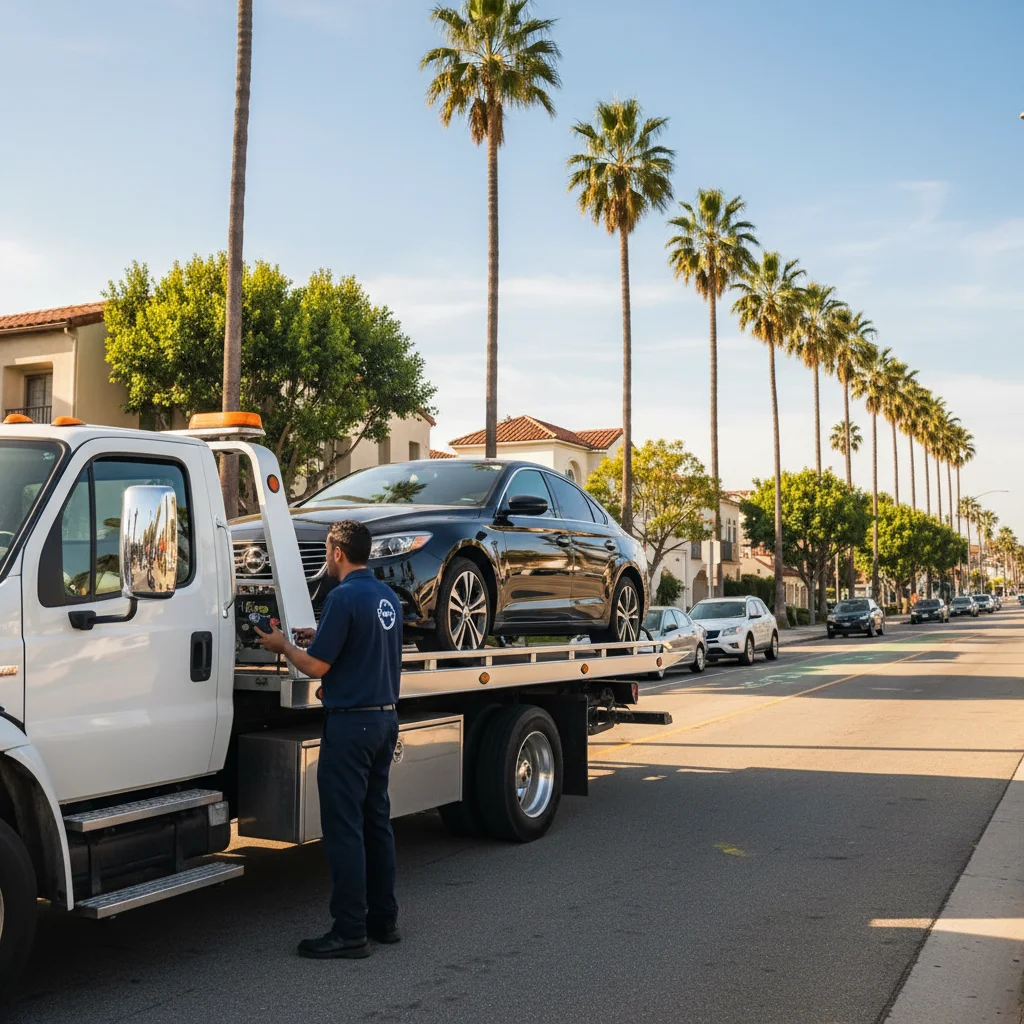
If your car has significant front-end damage, crushed frame, bent axle, or a wheel that won’t rotate, dragging it on a wheel-lift risks tearing up what’s left of the drivetrain. A flatbed lifts the entire vehicle off the ground. Nothing rolls. Nothing drags. The car rides flat until it’s back at the shop.
Accident scenes are the clearest case. If you’ve been in a collision on I-8 or the 163 and the car isn’t driveable, a flatbed keeps the damaged structure intact and preserves evidence for insurance purposes. California Highway Patrol tow protocols often specify flatbed transport for vehicles with disabled steering or braking systems, CHP has guidelines on tow service requirements that operators must follow.
Other situations where a flatbed is the smart call:
- Transmission failure. A dead automatic transmission can’t spin the output shaft freely. Towing on two wheels still puts miles on internal components that may already be shot.
- Brake lockup. If a caliper has seized and the wheel won’t turn, a wheel-lift will drag the tire sideways across the asphalt the entire route.
- Any car that’s been sitting long enough to have flat-spotted or deflated tires. Rolling on a flat destroys the rim fast.
If you’re not sure which method applies to your situation, tell the dispatcher what happened and they’ll figure it out. You don’t need to diagnose it yourself.
Vehicles that must go on a flatbed
Certain vehicles have zero business on a wheel-lift. It’s not a preference, it’s a mechanical reality.
All-wheel drive and four-wheel drive vehicles are at the top of the list. AWD systems are designed to distribute torque across all four wheels simultaneously. When two wheels are lifted and two are rolling on asphalt at towing speed, you’re feeding unintended rotation into the transfer case and differentials. On many modern AWD vehicles, that damage starts at just a few miles of towing the wrong way. Manufacturers including Subaru, Audi, BMW xDrive, and Honda SH-AWD explicitly prohibit anything other than flatbed transport in their owner’s manuals.
Electric vehicles are another firm flatbed requirement. EVs don’t have a neutral in the traditional sense. The electric motor is permanently connected to the drive wheels, and when those wheels spin, the motor spins, generating back-EMF and potentially overheating the inverter or battery management system. Tesla, Rivian, Lucid, and every major EV manufacturer mandate flatbed-only towing. If you’re driving a Tesla and it needs a tow, our EV and Tesla flatbed towing post covers the specifics of transport mode and what to tell the driver.
Low-clearance vehicles, sports cars, modified sedans, lowered trucks, physically can’t clear the wheel-lift yoke or the approach angle without scraping. A flatbed’s hydraulic tilt brings the deck to near-ground level, so a car that sits four inches off the pavement can load without contact.
Exotic and classic cars also belong here. A vintage Porsche or a Ferrari doesn’t go anywhere near a wheel-lift. The exotic and classic vehicle towing service exists for exactly that reason, these cars need full-deck transport with soft straps, not chains through the wheel wells.
Motorcycles are a separate category, they use dedicated bike transport, not a standard flatbed deck.
Flatbed towing rates in San Diego County
Pricing in San Diego follows a hook-up fee plus a per-mile charge. Those numbers shift based on time of day, vehicle type, and distance.
For a standard passenger vehicle, expect:
- Hook-up / base rate: $75–$125
- Per-mile charge: $3–$5 per mile
- After-hours / overnight surcharge: $25–$50 added to the base
A typical local tow, say, from a parking lot in Mission Valley to a dealership in Kearny Mesa, roughly 7 miles, runs $95–$145 during daytime hours. A longer haul from Chula Vista to Escondido (about 35 miles) lands in the $175–$275 range depending on the company and vehicle size.
Heavy-duty vehicles, exotics, and anything needing special equipment or extra labor to load will push rates higher. That’s not padding, it’s the cost of the specialized tie-down hardware and the extra time required to load safely.
If you want a full breakdown of how local towing rates are structured, our San Diego tow cost guide covers every line item you’ll see on a tow bill, including what questions to ask before you authorize the job.
One thing to confirm upfront: some companies quote a low hook-up rate and then charge destination fees, fuel surcharges, or “wait time” separately. Ask for the total out-the-door estimate before the truck rolls. A professional San Diego towing operator will give you that number without hesitation.
How a flatbed tow works step by step
Knowing what to expect makes the process less stressful.
1. Dispatch and arrival. You call, give the location and vehicle details, and a truck is assigned. Response times across San Diego County depend on traffic and driver availability, and the operator taking the job tells you what to expect. 24/7 emergency towing is available around the clock.
2. Positioning the truck. The driver backs up in front of or behind the vehicle, ideally with a straight approach. On a busy street or tight parking lot, this takes a minute of maneuvering.
3. Tilting the deck. The flatbed’s hydraulic system angles the deck toward the ground. The rear of the deck drops to a shallow ramp.
4. Loading. For a running vehicle, the driver pulls it forward or backs it up the ramp under its own power. For a non-running vehicle, a winch cable attaches to the frame and pulls the car up. This is the step where low-clearance cars are most vulnerable, an experienced driver watches the chassis clearance on every inch of the load.
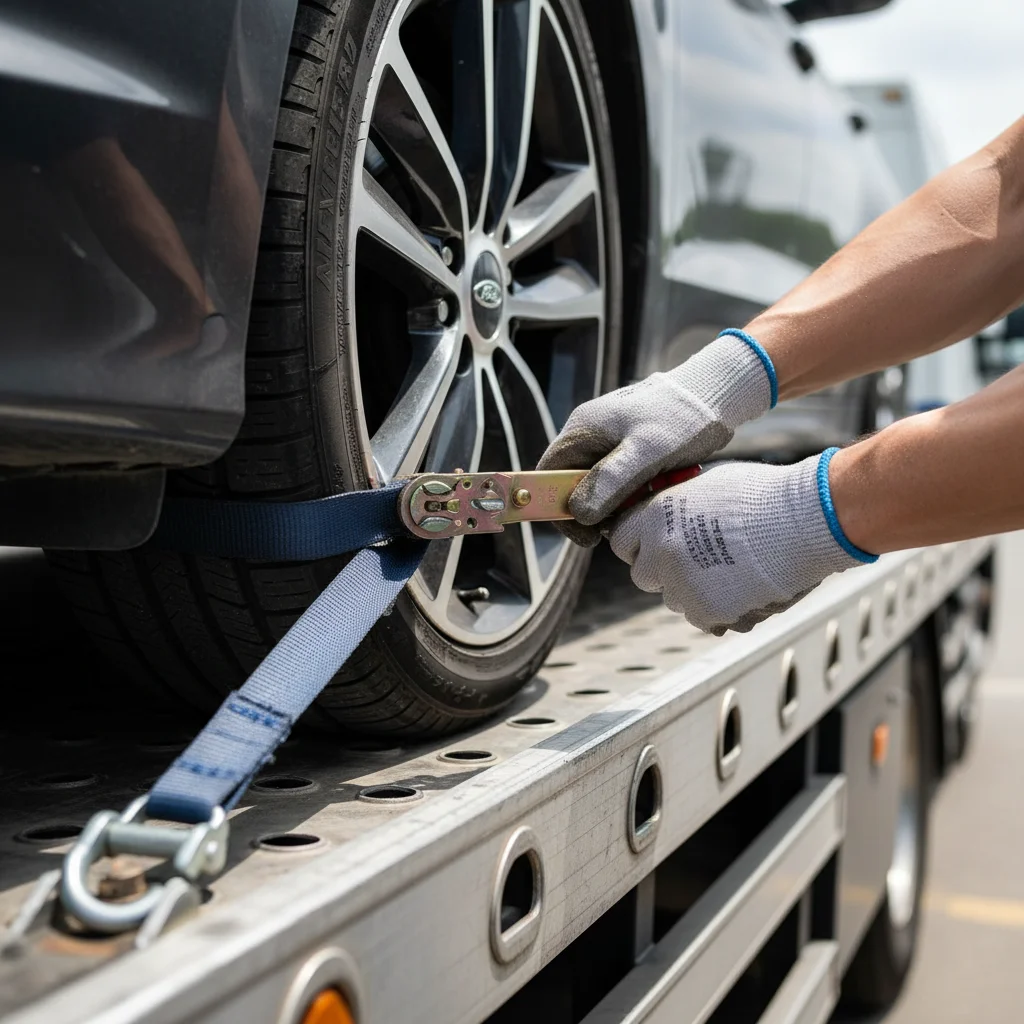
5. Securing. The car is chained or strapped at four points, typically the frame rails or tie-down loops. Ratchet straps are tensioned evenly. Wheels are chocked if needed. Nothing moves.
6. Transit and delivery. The deck is raised back to horizontal and locked. At the destination, the process reverses: deck tilts, car rolls or winches off, driver unhooks.
The whole load-and-secure process takes 10–20 minutes for a standard car in a normal situation.
Flatbed vs wheel-lift: quick comparison
Both methods are legitimate towing options, they just apply to different situations.
A wheel-lift is faster and cheaper. The truck slides a yoke under the front or rear wheels, lifts two wheels off the ground, and the other two roll. It works well for simple, short-distance tows on standard RWD or FWD vehicles with no drivetrain damage. The flatbed vs. wheel-lift comparison post goes deeper on the trade-offs, but here’s the short version:
| Factor | Flatbed | Wheel-lift |
|---|---|---|
| Vehicle fully off ground | Yes | No |
| Safe for AWD/EV | Yes | No |
| Safe for damaged vehicles | Yes | Often no |
| Low-clearance vehicles | Yes | Often no |
| Cost | Higher | Lower |
| Load time | 10–20 min | 5–10 min |
If your car is a standard front-wheel-drive sedan with a dead battery in a parking lot, a wheel-lift gets it to the shop fine. If there’s any doubt, AWD, EV, damage, low clearance, long haul, go with the flatbed. The price difference is small compared to secondary repair bills.
For a full look at wheel-lift towing service, that page covers when it’s the right call.
How to book a flatbed tow fast
When you’re standing next to a disabled car, you want this process to take under two minutes.
Call directly. Don’t fill out a web form. A phone call gets a dispatcher on the line immediately, and they’ll confirm availability, get your exact location, and give you an ETA. If you’re on a freeway shoulder, San Diego County roads emergency contacts can also coordinate if there’s a hazard involved.
Know what to tell them:
- Exact location, cross streets, freeway exit, parking lot name
- Year, make, and model of the vehicle
- Whether it runs (can it be driven onto the flatbed or does it need winching)
- AWD, EV, or any drivetrain specifics
- Whether there’s visible damage
Check your insurance. Many comprehensive auto policies include roadside assistance with towing coverage. AAA members also get towing included at various coverage levels. Knowing your coverage before the truck arrives saves the hassle of sorting it out on the shoulder.
Stay with the car or send someone. The driver needs a point of contact at the vehicle. If you have to leave the scene for safety reasons, active traffic, medical situation, let the dispatcher know so the driver has the context.
Our flatbed towing service covers all of San Diego County, including the 78, 52, and 15 corridors, coastal routes, and inland areas like El Cajon, Santee, and Poway. If you’re unsure whether your location is covered, call and we’ll confirm in under a minute.
When to call us
Flatbed towing isn’t a DIY situation, and choosing the wrong equipment for your vehicle can turn a manageable repair into a much bigger one. If your car is an EV, AWD, has drivetrain damage, or sits too low to clear a wheel-lift yoke, you need an experienced flatbed operator, not the first truck that shows up. Call us at (858) 923-5787 for a same-day estimate.