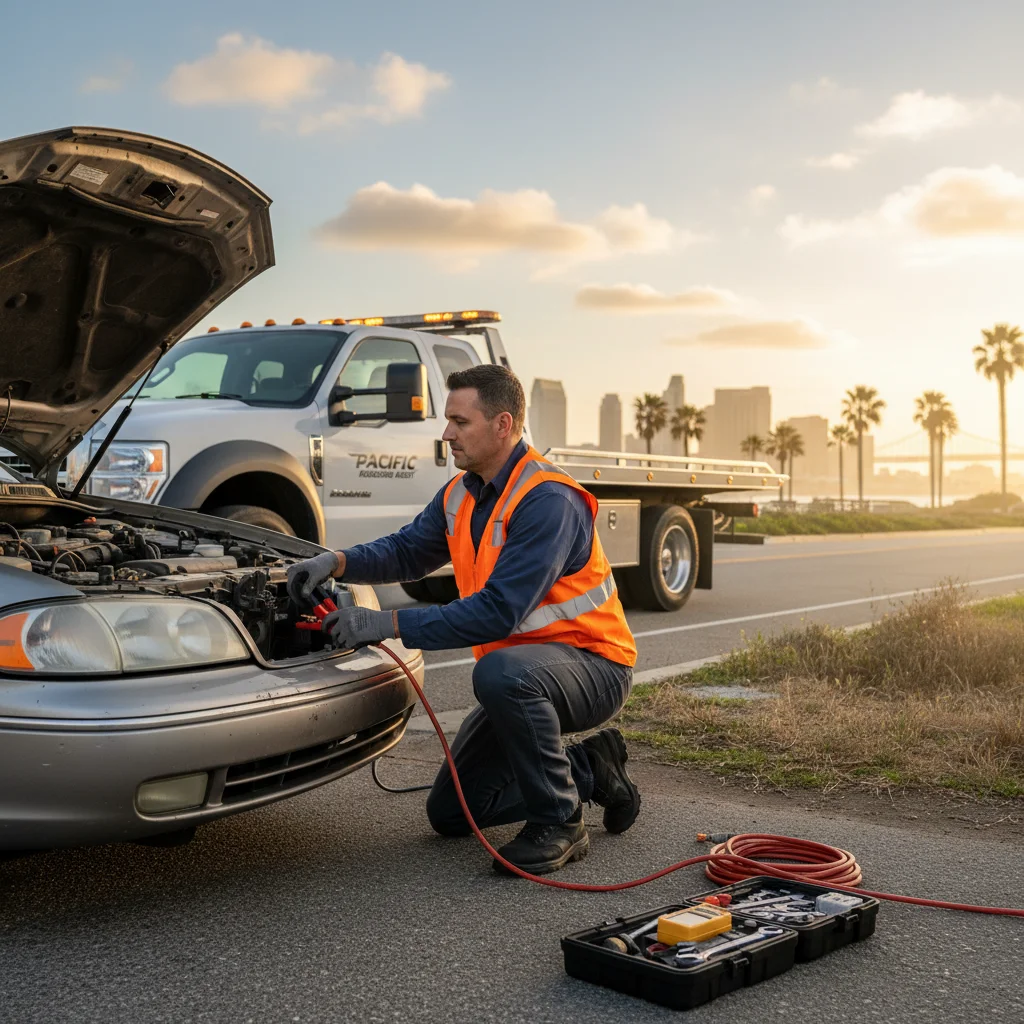
You turn the key, hear a click, and nothing happens. Or maybe your dashboard lights flicker, then die. For San Diego drivers, a dead car battery is a common, frustrating reality. Whether you’re parked at a beach lot in Pacific Beach, stuck in a shopping center in Chula Vista, or facing a silent engine on the I-15 commuter corridor, a professional jump start service near me can be the quickest way to get moving again.
This isn’t just about getting a quick boost. It’s about understanding why your battery died, knowing when to call for help, and ensuring you get a safe, reliable service that knows San Diego’s unique driving conditions. Quick Tow SD has been helping drivers across San Diego County for years, providing fast and efficient roadside assistance whenever you need it.
What causes a car battery to die in San Diego?
Car batteries don’t just suddenly give up for no reason. Often, there’s a clear cause, and understanding it can help prevent future issues. Here are some of the most common reasons we see dead batteries across San Diego County:
- Age: Batteries typically last 3-5 years. Beyond that, their ability to hold a charge weakens. San Diego’s warm climate, while pleasant for us, can actually shorten battery life by accelerating internal corrosion.
- Lights left on: This is a classic. Parking lights, interior dome lights, or even headlights left on after turning off the engine can drain a battery quickly. We see this often in busy coastal parking lots in La Jolla and Coronado.
- Parasitic drain: Sometimes, an electrical component in your vehicle continues to draw power even when the car is off. This could be a faulty relay, a short circuit, or an aftermarket accessory wired incorrectly. Diagnosing this often requires a mechanic.
- Extreme temperatures: While San Diego isn’t known for harsh winters, the intense summer heat, especially in inland areas like El Cajon or Escondido, can stress batteries. Conversely, colder temperatures in mountain communities like Julian or Pine Valley can reduce a battery’s cranking power.
- Short trips: If you only drive short distances, your alternator might not have enough time to fully recharge the battery after starting the engine. This is common for city drivers in downtown San Diego or those with short commutes.
- Infrequent driving: Cars parked for extended periods, like those stored for military deployment from the Camp Pendleton area or vacationers at San Diego International Airport, often return to a dead battery. Batteries naturally discharge over time.
- Faulty charging system: It might not be the battery itself, but your alternator failing to charge it. A jump start might get you going, but the battery will likely die again quickly if the alternator isn’t working right.
When you need a professional jump start service
While a friend with jumper cables can sometimes help, there are many situations where calling a professional jump start service near me is the smarter, safer choice.
- Safety on San Diego freeways: Breaking down on I-5, I-8, I-15, or even SR-163 can be incredibly dangerous. These freeways are busy, and shoulders are often narrow. Trying to flag down help or perform a DIY jump start puts you at risk. A professional service knows how to handle roadside incidents safely, using proper warning signals and procedures. For more on staying safe, check out our guide on freeway breakdown safety in San Diego.
- No jumper cables or another vehicle: It’s simple. If you don’t have the equipment or another car, you’re stuck. A professional service arrives with all the necessary tools.
- The battery looks damaged: If your battery casing is cracked, bulging, or leaking fluid, do not attempt to jump start it. This indicates a serious internal problem and could be dangerous. You’ll need a tow and a new battery.
- Repeated dead batteries: If your car dies shortly after a jump start, or if it’s a recurring problem, a simple jump isn’t the solution. You likely have a deeper issue with your battery, alternator, or starter. A professional can assess the situation and recommend the next steps, which might include towing to a repair shop.
- Unfamiliar with the process: Jump starting a car improperly can damage your vehicle’s electrical system, the donor vehicle, or even cause personal injury. If you’re unsure about the correct procedure, it’s always better to call an expert.
DIY jump starting: risks and rewards
For those who are prepared and know what they’re doing, a DIY jump start can be a quick fix. However, there are significant risks if done incorrectly.
Safety first
Always prioritize safety. Wear gloves and eye protection. Make sure both vehicles are off, in park or neutral, with parking brakes engaged. Never jump start a frozen or visibly damaged battery.
The basic steps (brief overview)
- Position the donor car.
- Connect the positive cable (red) to the positive terminal of the dead battery.
- Connect the other end of the positive cable to the positive terminal of the good battery.
- Connect the negative cable (black) to the negative terminal of the good battery.
- Connect the other end of the negative cable to an unpainted metal surface on the engine block of the dead car, away from the battery.
- Start the donor car, let it run for a few minutes.
- Try starting the dead car.
- Once started, disconnect cables in reverse order.
For a more detailed guide on how to perform a jump start safely, you can read our dedicated post: How to jump start a car. For what a professional jump start costs in San Diego, see our jump start pricing guide. Remember, if anything feels off, or if you’re on a busy street in San Diego, calling for professional help is the safest bet.
How Quick Tow SD handles your jump start call
When you call Quick Tow SD for a jump start service near me in San Diego, you can expect a professional, efficient process designed to get you back on the road with minimal fuss.
- Calls taken 24/7: The line at (858) 923-5787 takes calls around the clock, every day of the year. A dead battery doesn’t care if it’s 2 AM or a holiday.
- A straight arrival estimate: Arrival time depends on where you are and what is on the road. Remote areas like the mountains (Julian, Pine Valley, Mt Laguna) or backcountry roads in Borrego Springs take considerably longer, and you get an estimate for your exact location up front. The network covers North County Inland, East County, South Bay and the coast, and the nearest available operator takes the job.
- Professional equipment and safety: The technicians we send arrive in well-equipped service vehicles. They use commercial-grade jump boxes and cables, which are more powerful and safer than standard consumer models. They follow strict safety protocols, especially when working on busy roads like SR-78 or I-805, to protect both themselves and your vehicle.
- Battery assessment: After successfully jump starting your car, the technician sent out will often perform a quick check of your battery’s voltage and the charging system (alternator) if possible. This can give you an immediate idea if the jump was a one-off fix or if you have a deeper issue that requires attention. We’re not mechanics, but we can help identify if a trip to the shop is likely needed soon.
Beyond the jump: what if your car still won’t start?
Sometimes, a jump start isn’t enough. If your car cranks slowly, clicks, or remains silent even after a boost, the problem might not just be a dead battery.
Common culprits
- Faulty alternator: If the alternator isn’t charging the battery while the engine runs, your battery will quickly die again.
- Bad starter motor: The starter motor is responsible for turning the engine over. If it’s failing, your car won’t start even with a fully charged battery.
- Other electrical issues: A blown fuse, a loose connection, or a more complex electrical fault could be preventing your car from starting.
When a tow is necessary
If the jump start fails, or if the technician sent out identifies a more serious problem, we can provide immediate towing services. Quick Tow SD offers various towing options to suit your vehicle’s needs:
- Flatbed towing: This is the safest way to transport any vehicle, especially for specific types common in San Diego.
- AWD vehicles: Subaru, Audi, Tesla, Rivian, and many SUVs with all-wheel drive MUST be towed on a flatbed. Using a wheel-lift can damage the drivetrain, leading to expensive repairs ($2,500-$5,000).
- Electric Vehicles (EVs): Every EV brand, including Tesla, Rivian, Ford Lightning, and others, MUST be towed on a flatbed. Their drive motors stay engaged even when “off,” and dragging them on a wheel-lift can fry the motor and inverter, resulting in repairs costing $8,000-$18,000. San Diego has a growing number of EVs, particularly in areas like La Jolla and Del Mar, so this is a critical point. For more on this, see our guide on EV towing and Tesla flatbed service.
- Luxury, classic, or low-clearance vehicles: These benefit from flatbed towing to prevent any damage during transport.
- Wheel-lift towing: Suitable for most front-wheel drive (FWD) or rear-wheel drive (RWD) vehicles. The front or rear wheels are lifted off the ground.
- Heavy-duty towing: For larger vehicles like RVs, buses, or commercial trucks, which are common along the I-5/I-805 border corridor in South Bay.
If a tow is needed, we can take your vehicle to your preferred mechanic, a dealership, or a reputable repair shop in San Diego County. For immediate towing needs, visit our emergency towing services page. You can also learn more about our flatbed towing options.
Understanding jump start service costs in San Diego
When you’re looking for a jump start service near me, cost is always a factor. Ask for a clear flat rate on the call.
- Ask for a flat rate: Get the number for the jump start or roadside call before anyone is dispatched. The operator sets the price and bills you directly, so confirm the total before you agree.
- Quoted before dispatch: Ask for the number when you call. A real flat-rate quote covers the trip, the technician’s time, and the jump start itself, no guessing after the truck shows up.
- What drives the price: Your exact rate depends on distance, vehicle type, and time of day. Ask dispatch for your number before you agree to the job.
- Towing costs: If a jump start fails and a tow is required, separate towing fees will apply, based on vehicle type and distance. For long-distance towing, ask for a written flat quote upfront. For a deeper look into towing costs, check our post on tow cost in San Diego.
We always provide an upfront quote before dispatching a truck so you know what to expect.
Choosing a reliable jump start service near you in San Diego
When you need a jump start, you want a company you can trust. Here’s what to look for when selecting a jump start service near me in San Diego:
- 24/7 availability: Car trouble doesn’t keep business hours. A reliable service should be available whenever you need them, day or night.
- Transparent pricing: Avoid companies that are vague about costs or demand cash upfront. Reputable companies provide clear, flat-rate quotes.
- Fast response times: Especially on busy San Diego freeways or in remote areas, a quick arrival can make a big difference for your safety and schedule.
- Proper equipment: Ensure they use professional-grade jump boxes and cables, not just standard car-to-car jumper cables.
- Local knowledge: A company that knows San Diego County well can navigate traffic, understand local road conditions (like PCH shoulders or I-8 grades), and accurately estimate arrival times.
- Reputation: Look for positive reviews and a strong local presence.
Quick Tow SD meets all these criteria, serving all 67 cities and communities across San Diego County with professional, reliable roadside assistance. We’re on CHP rotation for freeway incidents and follow all California Vehicle Code regulations, including CVC 22658 for private property towing, though less relevant for jump starts, it speaks to our adherence to state law. For more on what to look for, read our blog post on choosing a tow company and red flags to watch for.
Quick Tow SD’s San Diego coverage areas
Quick Tow SD provides comprehensive jump start and roadside assistance across all of San Diego County. We understand the unique challenges of each region:
- Coastal cities: From La Jolla to Del Mar, Encinitas, Carlsbad, Ocean Beach, Pacific Beach, and Coronado, beach-lot lockouts and dead batteries are common, especially in summer. PCH shoulders can be dangerous for roadside stops.
- North County Inland: San Marcos, Escondido, Vista, and Poway see heavy commuter traffic on I-15. Hot summer days here can put extra strain on car batteries and cooling systems.
- East County: El Cajon, La Mesa, Santee, Lakeside, and Alpine drivers often tackle the challenging grades of I-8, which can eat engines and batteries. Canyon roads like Crestwood and Sunrise Highway are popular with motorcyclists, who also need reliable assistance.
- South Bay: Chula Vista, National City, and Imperial Beach are part of the busy I-5 and I-805 border corridor, with significant commercial truck traffic around Otay Mesa terminals.
- Mountain communities: Julian, Pine Valley, Ramona, Mt Laguna, and Borrego Springs are beautiful but remote. Response takes considerably longer out there, and winter conditions on Sunrise Highway sometimes require chains, adding complexity to roadside calls.
- Camp Pendleton corridor: The 20-mile stretch on I-5 between Oceanside and San Clemente is a frequent breakdown spot. Military families relying on their personal vehicles (POVs) need swift, dependable breakdown response in this area.
No matter where you are in San Diego County, our team is ready to assist.
Safety tips when waiting for roadside assistance
If you find yourself with a dead battery, especially on a busy San Diego road, your safety is paramount while you wait for Quick Tow SD to arrive.
- Pull over safely: If possible, move your vehicle to the furthest possible point off the road or shoulder. On freeways like I-5 or I-805, this might mean a wider shoulder or an exit ramp.
- Stay in your vehicle: Unless it’s unsafe to do so (e.g., smoke, fire), remain inside your car with your seatbelt fastened. Your vehicle offers the best protection from passing traffic.
- Turn on hazard lights: This makes your vehicle more visible to other drivers, especially at night or in low visibility conditions.
- Be aware of your surroundings: Keep an eye on traffic. If you’re on a freeway, be mindful of the California Highway Patrol (CHP) rotation, as they coordinate accident scenes and breakdowns. You can find more general roadside safety tips from the National Highway Traffic Safety Administration (NHTSA) at https://www.nhtsa.gov/road-safety.
- Communicate with dispatch: Keep your phone charged and stay in contact with Quick Tow SD if your situation changes.
Jump Start vs. Towing Scenario Guide
Sometimes, it’s not immediately clear whether a jump start will solve your problem or if you’ll need a tow. This table can help you understand the common scenarios.
| Scenario | Likely Solution | Reason | Quick Tow SD Action | | Your car just clicks, no start. | Jump start (first step) | The battery might be drained. | We’ll attempt a jump start. If successful, we’ll suggest a battery check.