The car’s been parked five years, the front tires are flat down to the rims, and it’s nosed into a carport with a beam six inches over the roofline. That’s not the pickup most people picture when they call for junk car removal. It’s the one that gets refused on arrival if nobody looks at the access first.
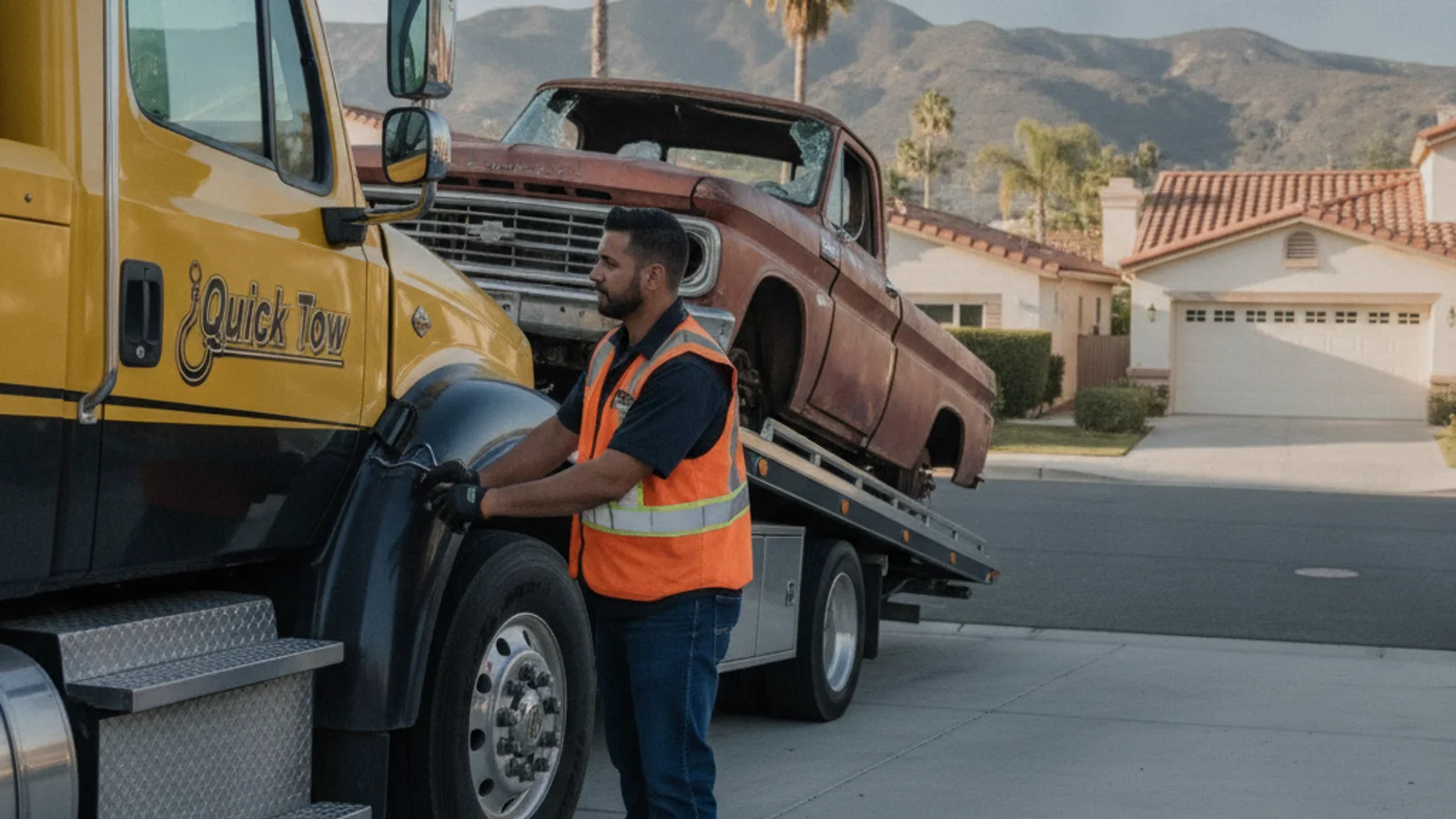
This post is about the physical pickup itself, not what the car is worth or what paperwork transfers title. For the money side, read cash for junk cars in San Diego. For the DMV and title steps, read the paperwork to junk a car in California. Here, the question is simpler: can a truck actually get this car out.
What makes a pickup get refused on arrival
A driver who shows up and can’t safely move the vehicle isn’t being difficult. A few things trigger a refusal or a return trip:
- Seized wheels. A car that’s sat five or more years often has wheels rusted or bound to the hub. If a wheel won’t turn at all, the standard wheel-lift hookup doesn’t work, because the vehicle needs to roll onto the equipment.
- Flat or rotted tires. Tires that have sat flat for years can be brittle enough to blow out or shred under load, which changes what equipment the job needs.
- No clearance. A carport beam, a low garage header, or a tight gate opening that the vehicle’s height or width won’t clear stops a flatbed cold.
- Blocked path. A parked neighbor’s car, patio furniture, stacked yard waste, or a locked gate between the vehicle and the street means nobody’s getting a truck close enough.
- No access authorization. If the property has an HOA, a property manager, or a landlord, and nobody with authority is present or has signed off, a driver may not be able to remove the vehicle at all, even with a key in hand.
Spring Valley, East County hillsides, and apartment carports
San Diego’s terrain makes this more common than flat-lot cities. Spring Valley and much of East County sit on hillside lots where a driveway pitches down at a steep angle from the street, sometimes with a sharp turn partway down. A vehicle with no working brakes sitting at the bottom of a grade like that needs a controlled recovery, not a straight pull, because gravity does the opposite of what the operator needs it to do.
Apartment and condo carports around the county add their own limits: a fixed clearance bar at the entrance, tight turning radius between support posts, and assigned spaces wedged between other residents’ cars. A single-family driveway in a coastal or central neighborhood usually has more room to maneuver than a shared carport row, where one badly parked neighbor can block the whole operation.
Skates and a winch versus a straight hook-up
A normal pickup uses a wheel-lift or flatbed with the vehicle rolling on its own wheels onto the equipment. When wheels are seized or tires are flat and unusable, an operator may switch to recovery skates, low dollies placed under each locked wheel that let the car slide instead of roll. That takes more time on scene and isn’t guaranteed to work on every surface or with every vehicle weight.
A winch comes into play when the car can’t move under its own power and can’t be pushed by hand, common on a slope or when the parking surface is soft dirt or gravel rather than pavement. Winching a dead vehicle up a steep hillside driveway or out of a tight carport space takes a clear, straight pull path. If a wall, a support post, or a parked car blocks that path, the operator has to reposition before starting, which is part of why a truck can arrive and still not be able to start work immediately.
What “flatbed only” access looks like
Some pickups aren’t a wheel-lift job at all, and knowing that before the truck arrives saves a wasted trip. A car with a seized front wheel and a working rear axle, or one with a bent control arm from sitting on a flat tire for years, may only be safe to move fully off the ground on a flatbed rather than partially rolling on a wheel-lift. Mentioning that the vehicle hasn’t moved in years, and describing which wheels turn and which don’t, lets dispatch send the right truck the first time instead of a wheel-lift operator discovering the problem on scene. The flatbed towing operators we dispatch handle exactly this kind of non-rolling pickup.
What to clear before the truck comes
A few minutes of prep on your end can be the difference between a completed pickup and a rescheduled one:
- Move any vehicle, trash cans, or furniture blocking the path from the car to the street
- Unlock any gate and have the code or key ready, or plan to be present to open it
- Confirm there’s nothing loaded in the trunk or cabin the operator would need to remove first
- Measure or note any low clearance point, a carport beam or garage header, if you can
Personal property and what’s left inside the car
A car that’s sat five years often has years of accumulated stuff inside it: old paperwork, tools, a spare tire that’s separated from its well, sometimes items that have nothing to do with the vehicle at all. Clear out what you can before the truck arrives, since an operator focused on a difficult recovery isn’t equipped to sort through someone’s belongings on scene. If the vehicle sat in a rental unit’s carport and the previous tenant left it behind, check with the landlord about what documentation proves you have the right to have it removed before you schedule anything.
HOA and landlord sign-off
If the vehicle sits on shared property, an HOA-managed lot, or a rental where you’re not the property owner, get written authorization from whoever manages the property before scheduling. A driver arriving to find a car on someone else’s assigned space, with no proof the removal is authorized, may decline the job on the spot. That’s a case covered by California Vehicle Code 22658 when a property owner initiates the tow, but a junk car removal you’re requesting yourself as the owner is a different situation and still needs proof you have the right to have it moved.
When to call us
If the vehicle has seized wheels, sits behind a locked gate, or is parked on a hillside driveway with no working brakes, describe the access honestly when you call so dispatch can send an operator equipped for it, rather than one set up for a standard roll-on pickup. Junk car and abandoned vehicle removal covers exactly this kind of job. Call (858) 923-5787 to reach dispatch and walk through what the pickup actually looks like.